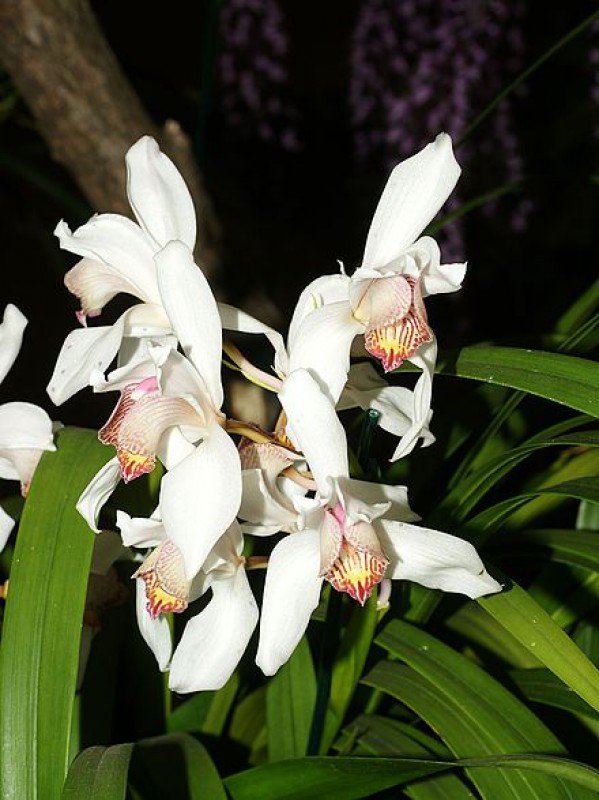
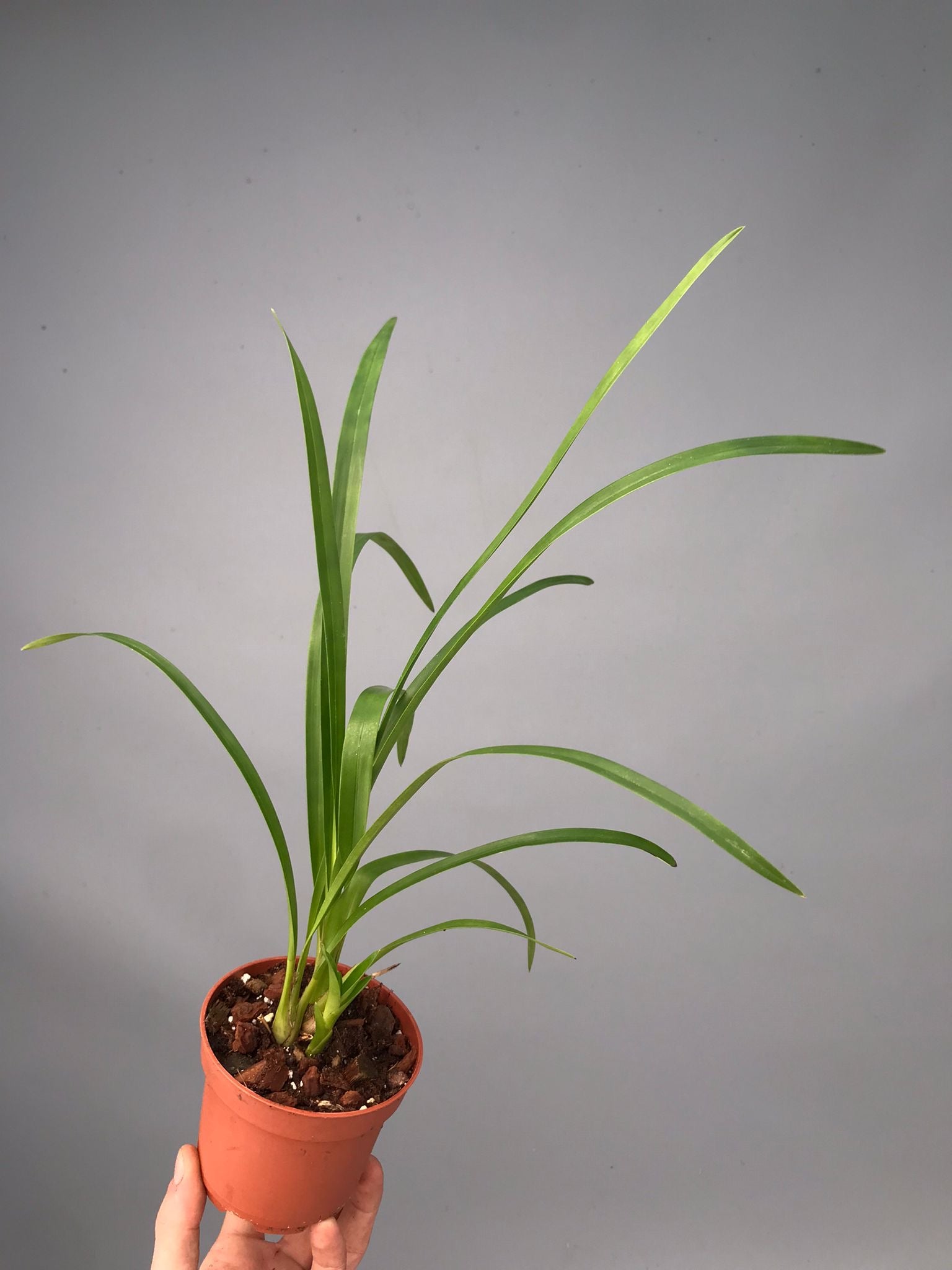
Cymbidium Erythrostylum bears little resemblance to the robust, densely flowered Cymbidiums that are known as winter-blooming houseplants. This botanical species from Vietnam has a more refined and airy growth habit. Above the narrow, overhanging leaves, a curved flower stalk emerges, bearing crystal-white flowers that almost look as if they were made of thin porcelain.
Only up close does it become clear where the name Erythrostylum comes from. In the light-colored center of the flower lies a yellowish lip with reddish-pink to purplish-red stripes and spots, while the column may also display a reddish tint. The two petals curve slightly forward over the center. This creates a sheltered, triangular flower shape that is instantly recognizable and starkly different from the round shape of modern Cymbidium hybrids.
Another view of Cymbidium
The flowers grow to about six centimeters wide and usually appear in clusters of five to eight on an upright to gracefully curved stem. A vigorous mature plant may produce even more. The white sepals and petals have a delicate, almost translucent texture, which makes the colored center stand out even more sharply.
Cymbidium Erythrostylum remains relatively compact for a large-flowered species. The narrow leaves form an elegant, overhanging fan and take up less space than the broad leaves of many commercial Cymbidiums. Nevertheless, over time the plant grows into a clump with multiple pseudobulbs and requires sufficient space for its flower stalks to develop freely.
The delicate flower structure requires some protection. Water droplets, condensation, and stagnant cool air can cause brown spots on the white parts. Therefore, provide a plant in bud or bloom with adequate ventilation and keep the flowers themselves as dry as possible. Under suitable conditions, a flower spike typically remains attractive for about four to six weeks.
Origin
Cymbidium Erythrostylum is a botanical species found exclusively in the wild in Vietnam. It grows primarily as an epiphyte in moist mountain forests, at an elevation of approximately 1,500 meters. There, the plant receives bright, filtered light, high humidity, and significantly cooler nights than species found in tropical lowlands.
Sometimes plants establish themselves among moss and plant debris on rocks or other well-drained sites. The roots receive regular moisture during the growing season, while excess water can drain away quickly. During the cooler winter months, precipitation decreases and the plant remains noticeably drier.
Care
Provide Cymbidium erythrostylum with a bright spot that receives bright, filtered sunlight. Gentle morning or evening sun is well tolerated, but intense midday summer sun can quickly damage the relatively delicate foliage. An east- or west-facing window is suitable; for a south-facing window, some distance from the window or light shading is advisable during sunny months.
This species grows best in cool to moderate temperatures. During the active growing season, daytime temperatures of approximately 18 to 25 °C and nighttime temperatures between 10 and 16 °C are ideal. Temporarily warmer days are not a direct problem as long as the plant is shaded, kept moist, and well-ventilated. However, prolonged warm nights can disrupt growth and flower formation.
Starting in late spring, the plant can be placed outdoors in a sheltered spot as soon as nighttime temperatures remain consistently above about 10 °C. The natural difference between day and night temperatures helps the plant mature. Place it under a shelter, tree canopy, or shade cloth, and protect it from strong winds, driving rain, and intense midday sun. Bring the plant back indoors well before the first frost.
Use a well-aerated Cymbidium potting mix based on peat, coconut coir, and perlite. The mixture should retain some moisture but must drain excess water easily and should not become compacted around the roots. Regular compact potting soil stays wet for too long and contains too little air for a healthy root system.
While new shoots and roots are forming, keep the plant evenly slightly moist. Water thoroughly and then wait until the mixture has mostly dried out. Allowing the soil to dry out completely and for an extended period inhibits the development of the new pseudobulb, while a permanently wet pot causes root loss.
During active growth, apply a weakly diluted orchid fertilizer regularly. Once the new growth has matured and temperatures drop, reduce watering and fertilization. In winter, the growing medium may be kept noticeably drier, especially at low temperatures. However, do not allow the pseudobulbs to shrivel severely for long periods.
Repot preferably when a new shoot begins to form fresh roots. A mature clump only needs to be repotted when the growing medium loses its airy structure or new growth threatens to extend beyond the pot. Leave enough old pseudobulbs together, as a strong clump has more reserves for a full flower spike.
After receiving the plant, allow it to acclimate for a few days first and do not automatically water it right away. First check the moisture level deeper in the pot. Then gradually adjust the care routine to the new location.
Cool Nights and Flower Bud Formation
For this species, a cool location is more than just a way to keep the flowers looking beautiful longer. The temperature difference between day and night helps the plant complete its growth and supports the formation of a flower stalk. A constantly warm living room is therefore less suitable than a bright, unheated room, a cool sunroom, or a temperate greenhouse.
The exact flowering time may shift when grown in cultivation. Cymbidium Erythrostylum often blooms from late summer into fall among European growers, while in its natural range, later spring or early summer blooming has also been reported. Growth, temperature, and previous growing conditions ultimately determine when the flower stalk appears.
Each pseudobulb blooms only once. Therefore, leave pseudobulbs that have finished blooming but are still green on the plant. They continue to store water and nutrients and support the development of new shoots.
Why this species?
Cymbidium Erythrostylum is of interest to collectors who wish to explore the botanical origins of modern Cymbidiums without immediately having to care for a very large plant. The combination of relatively compact growth, a gracefully curved stem, and pure white flowers with a red-marked center is immediately recognizable within the genus.
This species particularly requires a location where the nights can cool down sufficiently. Those who have a light, cool room, conservatory, or greenhouse available will be rewarded with a Cymbidium that looks much more subtle and refined than the well-known cut-flower hybrids. It is precisely this combination of simplicity from a distance and fine details up close that makes this Vietnamese species attractive for a specialized collection.
Short product description
Cymbidium erythrostylum is a botanical Cymbidium from the cool mountain forests of Vietnam. The gracefully curved flower stalk bears multiple crystal-white flowers with forward-facing petals and a striking yellow to reddish-purple-marked lip. This relatively compact species grows best in a light, cool, and airy location, with consistent moisture during active growth and a drier winter period.