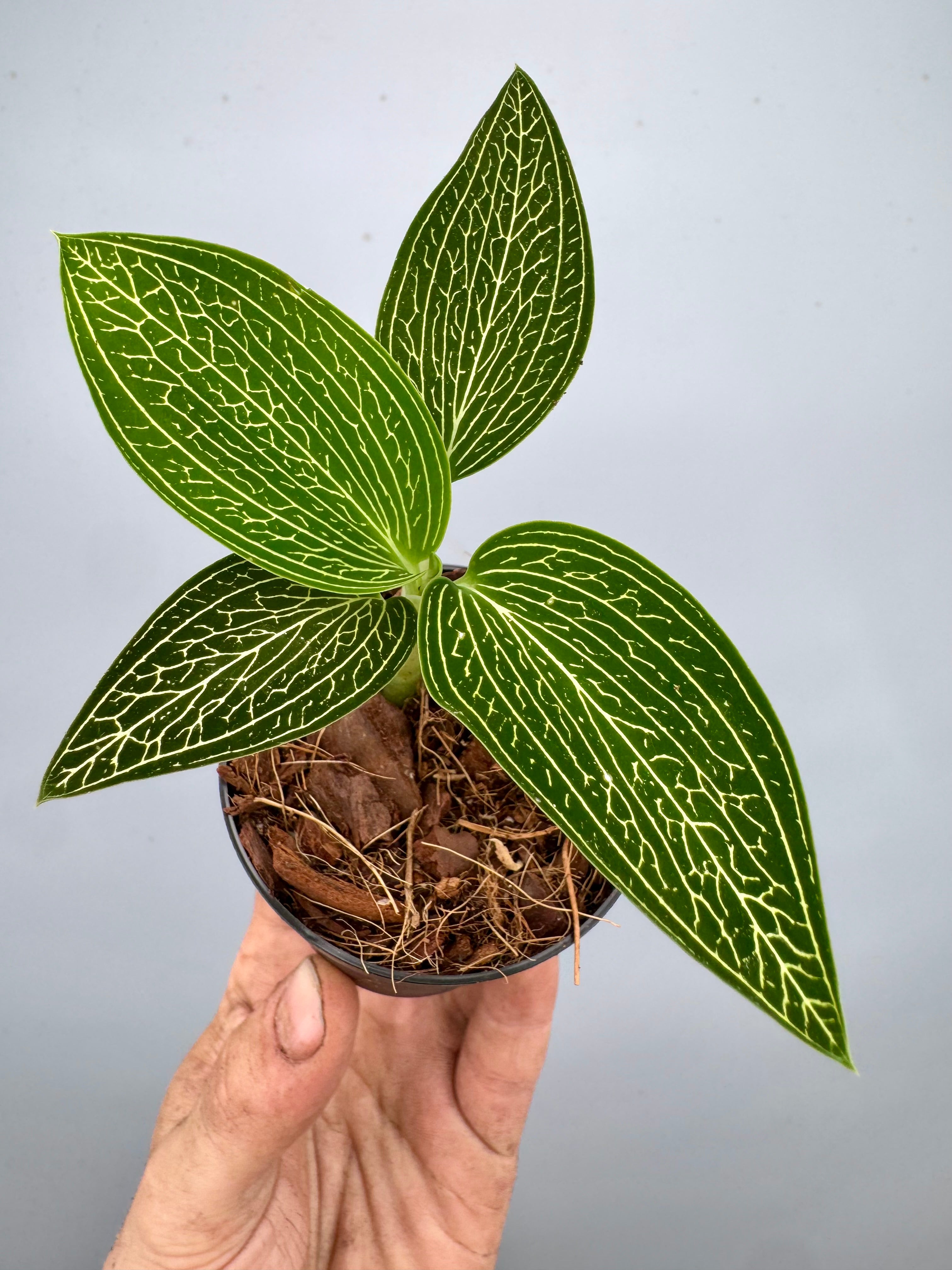
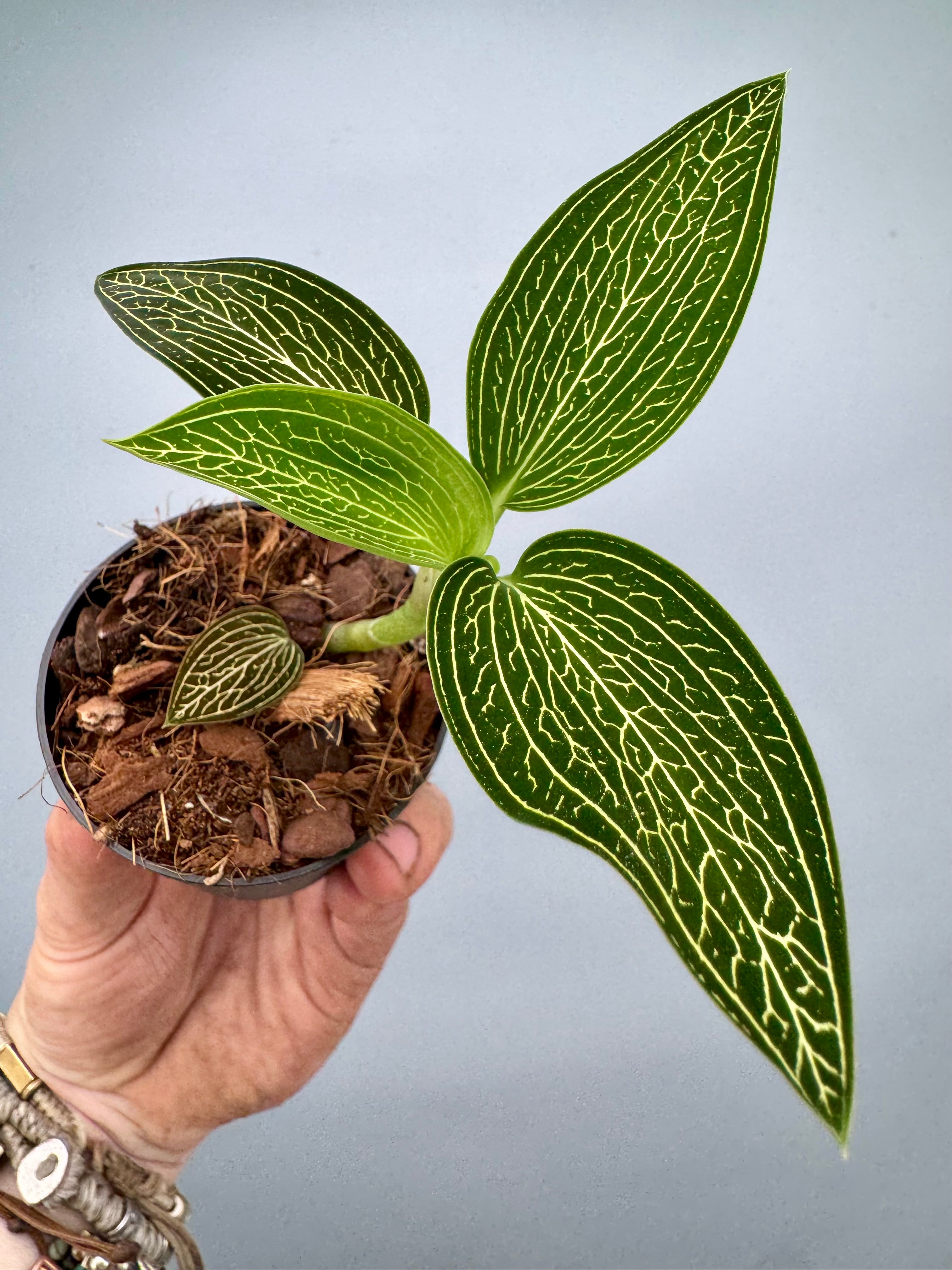
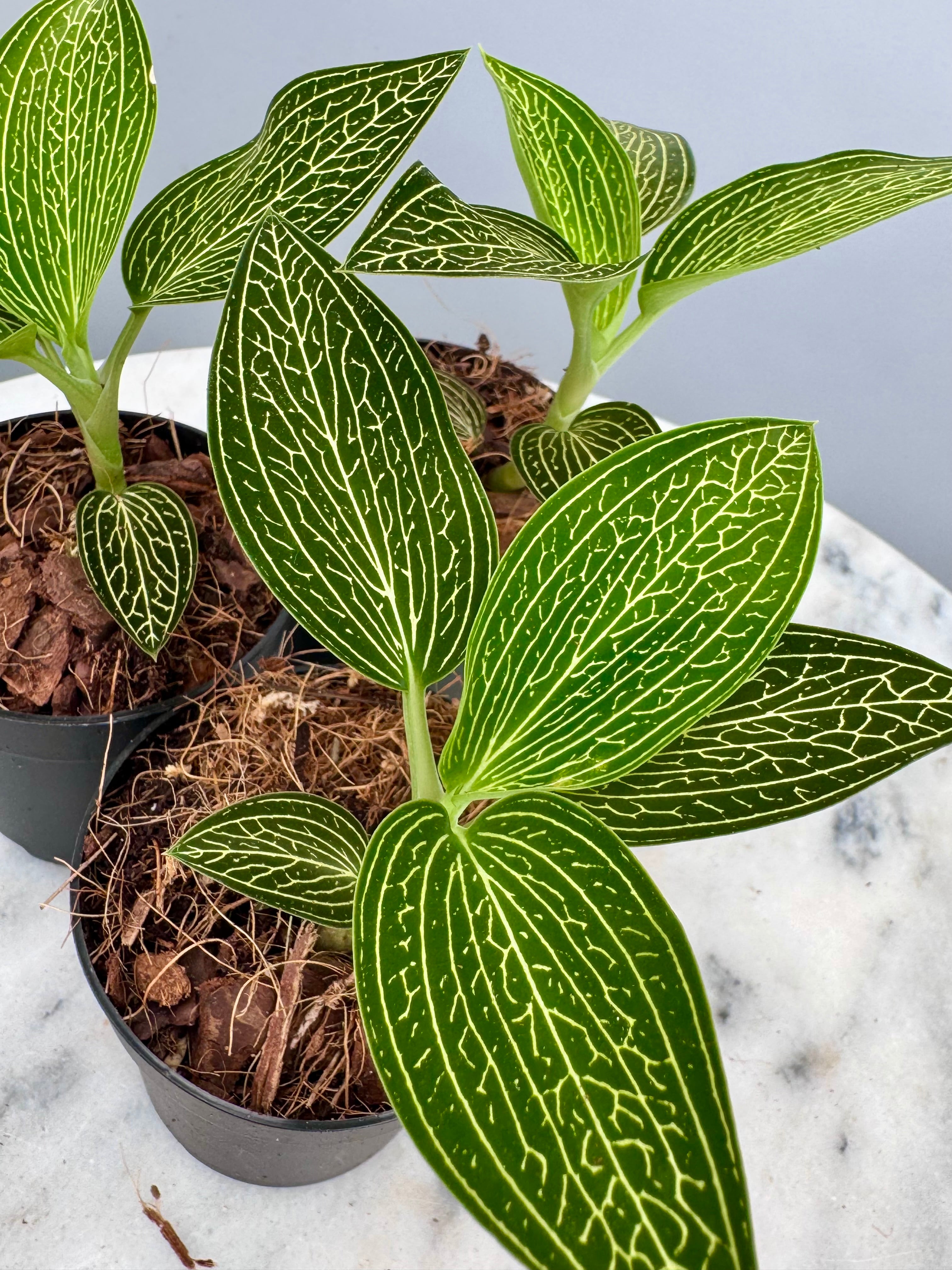
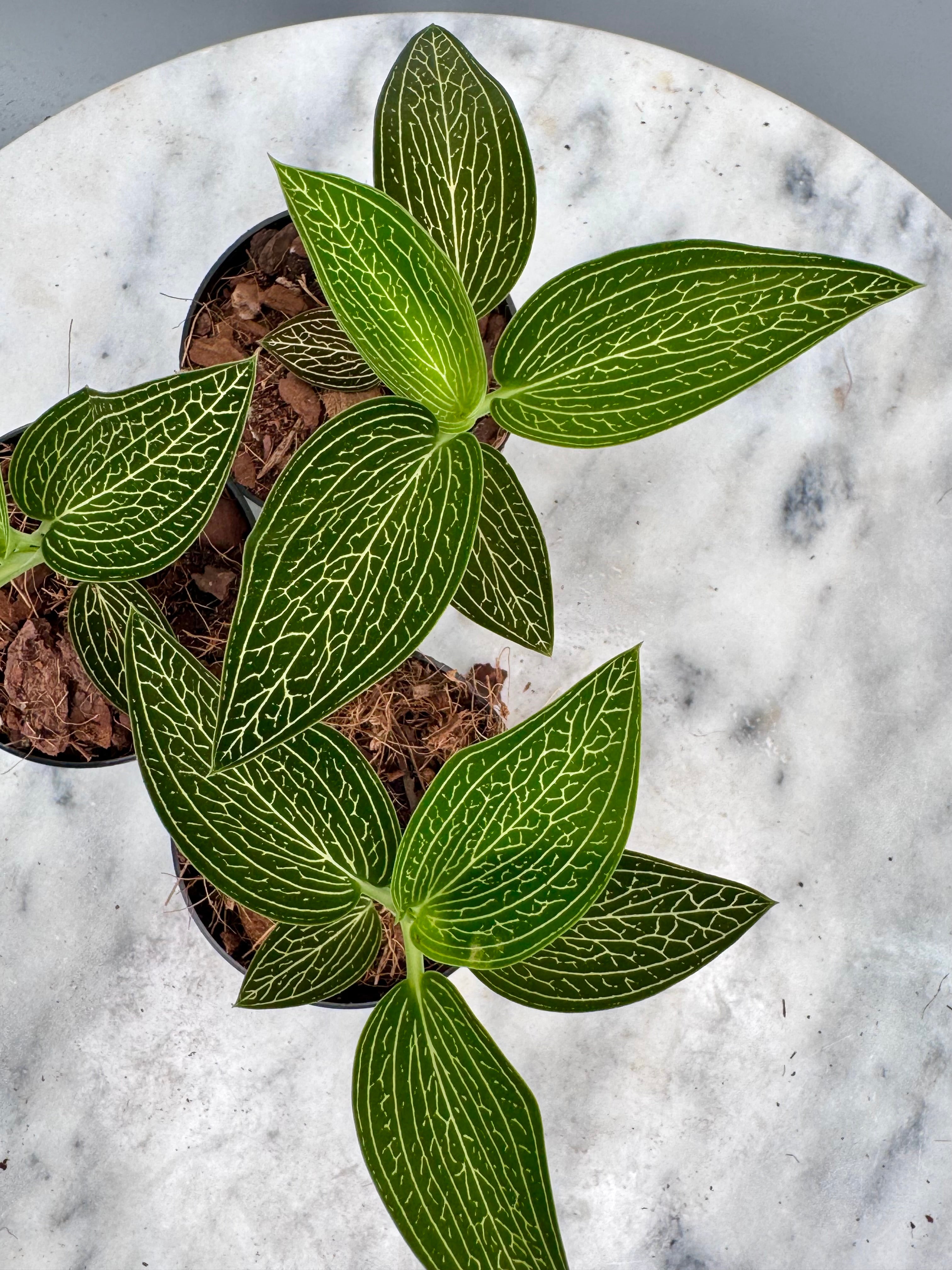
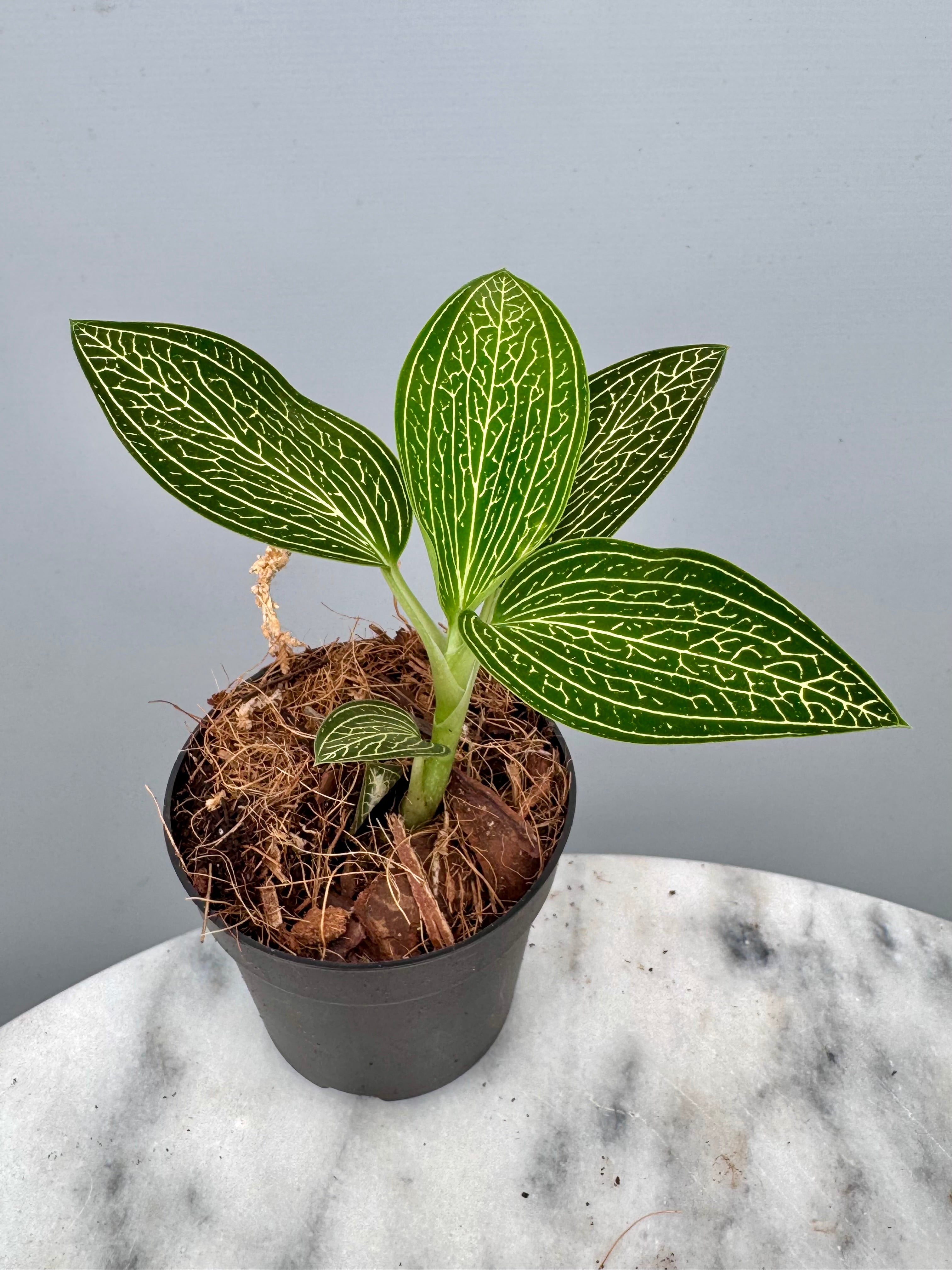
Ludisia discolor var. alba ‘Gold Vein’ is a compact jewel orchid that is prized primarily for its velvety green leaves. A network of golden-yellow to light metallic veins stands out sharply against the leaf surface and subtly changes its sheen when viewed from different angles.
This selection has a lighter, fresher appearance than the classic dark-leaved Ludisia discolor. This makes ‘Gold Vein’ an excellent choice for a terrarium, a plant cabinet, or a shady spot in your home where its decorative leaves remain visible year-round.
Origin
Ludisia discolor is native to an area stretching from southern China to Southeast Asia, Sumatra, Borneo, and the Philippines. The species grows terrestrially on moist, humus-rich forest soils and among loose leaf litter. Unlike many other orchids, Ludisia does not grow with thick aerial roots on tree branches.
Botanically, Ludisia discolor is the accepted species name. The designations var. alba and ‘Gold Vein’ are used in the orchid trade for this green-leaved, golden-yellow-veined selection. It is not a separate wild species.
Older names such as Haemaria discolor and Goodyera discolor still appear in historical literature and old collections.
Characteristics
‘Gold Vein’ forms creeping, somewhat fleshy stems that spread across the substrate and can produce new roots and shoots at the nodes. Over time, a single plant can thus develop into a broad, compact clump.
The leaves are oval to lanceolate and feel soft to velvety to the touch. Depending on the light, the light, golden-yellow veins can take on an almost metallic sheen. The leaf pattern is already recognizable in young plants, but the contrast and number of veins become more pronounced as the leaves grow larger and sturdier.
The plant’s ornamental value lies primarily in its foliage. During flowering, the plant produces upright flower stalks bearing several small white flowers with a yellow center.
Care
Ludisia discolor is one of the most accessible jewel orchids. The plant does not require exceptionally high humidity, but it does need a stable, warm location and a growing medium that remains slightly moist without becoming waterlogged.
The main pitfall is not drought, but a root zone that is constantly wet and oxygen-deprived. This can easily lead to rot, especially around the base of the stems.
Light
Place ‘Gold Vein’ in low to moderate, filtered light. Approximately 5,000 to 12,000 lux is usually sufficient for this variety. A north- or east-facing window, a spot slightly further from a bright window, or a shaded position under grow lights is suitable.
Direct midday sun can cause the tender leaves to fade or burn. Too little light, on the other hand, results in long internodes, limp stems, and less compact growth.
The golden-yellow veins are most visible in sufficiently bright, indirect light. However, more light does not automatically mean a more pronounced pattern; light that is too bright can actually result in a dull leaf color.
Temperature
A normal, warm room temperature suits this jewel orchid well:
During the day, approximately 20 to 26
°C At night, approximately 17 to 21 °C
Avoid prolonged periods of temperatures below 15 °C. A combination of cold and wet growing medium, in particular, can cause root and stem rot.
On hot summer days, temperatures up to about 28 °C are tolerated, provided the plant is not in direct sunlight and there is sufficient air circulation.
Substrate and Cultivation Method
Ludisia discolor is a terrestrial orchid and therefore does not belong in a standard orchid growing medium consisting solely of coarse bark. Its fine roots naturally grow in a loose layer of humus, moss, and decomposed plant material.
Use an airy, moisture-retaining mixture of, for example, fine orchid bark, coconut fiber, or a light, humus-rich potting soil, perlite, and a small amount of loose sphagnum moss. The mixture should absorb water but also retain sufficient oxygen after watering.
A wide, relatively shallow pot suits its horizontal growth habit well. Do not plant it unnecessarily deep: the base of the stem and the growing tips should rest on or just above the substrate.
In a terrarium, the plant can be planted directly into a well-aerated soil layer, but only if excess water can drain away and the root zone does not remain permanently saturated. In a paludarium, Ludisia should be placed well above the waterline. If in doubt, growing it in a separate inner pot is safer and easier to monitor.
Humidity
A humidity level of approximately 50 to 75% is sufficient. This makes this Ludisia better suited for a normal living room than many Macodes and Anoectochilus species.
In a terrarium or plant cabinet, the humidity may be higher, as long as there is ventilation. Permanently stagnant, humid air can cause mold on the leaves and rot around the stems.
Daily misting is not necessary. Water droplets that remain on the velvety leaves for too long can cause spots. Therefore, it is best to water directly onto the substrate.
Watering
Keep the substrate evenly slightly moist, but not constantly soaking wet. Water again when the top layer begins to dry out slightly. The entire root ball does not need to become bone dry.
Ludisia tolerates a brief dry period better than standing water around the roots. Wilted leaves and slightly wrinkled stems usually indicate dehydration. Yellow leaves, a soft stem base, or a musty odor from the substrate are more likely signs of overwatering.
Preferably use rainwater, reverse-osmosis water, or other relatively soft water. Always allow excess water to drain away and do not leave the pot standing permanently in a layer of water.
Fertilization
During active growth, apply a low dose of orchid fertilizer or a balanced houseplant fertilizer once every three to four weeks. A quarter of the recommended concentration is usually sufficient.
Reduce fertilization during the dark winter months when the plant produces very few new leaves. Rinse the potting mix regularly with clean water to remove accumulated fertilizer salts.
Flowering
Ludisia discolor often blooms between late fall and early spring. Upright flower stalks with small white flowers and a yellow center emerge from the tips of mature shoots.
The flowers are more subtle than the foliage, but provide a lovely light contrast to the green, gold-veined leaves. A flowering plant may temporarily produce fewer new leaf shoots, as some of the available energy is directed toward the flower stalk.
After flowering, cut back the flower stalk as soon as it has fully bloomed. Leave the creeping stems and nodes intact; new roots and shoots may develop from them later.
Care Level
Beginner to intermediate.
Ludisia discolor var. alba ‘Gold Vein’ is a great choice as a first jewelry orchid. The plant can tolerate normal indoor air conditions and requires fewer specialized conditions than many other variegated terrestrial orchids.
The plants offered are adolescents and are potted in small containers. Therefore, you will not yet receive a broad, mature clump like the ones shown in older example photos. With proper care, the plant will continue to branch out and gradually develop more decorative foliage.
These plants have been imported and may first need to develop new roots after arrival. Keep conditions stable during this acclimatization phase and do not repot immediately, unless the growing medium is clearly unsuitable or damaged.
Who is this plant suitable for?
This Ludisia is a good fit for enthusiasts who:
- Are looking for a compact, jewel-like orchid with year-round foliage appeal
- Prefer golden-yellow veins against dark red or pink-veined foliage
- Are looking for a plant for a windowsill, display case, or terrarium
- Want to try a relatively easy-to-care-for jewel orchid
- Enjoy watching the plant grow
from an adolescent stage into a full clump Can provide moist, but not permanently wet, conditions
This plant is less suitable for a bright south-facing windowsill or a completely enclosed, damp terrarium.
Experience growing indoors, in a plant cabinet, or in a terrarium
Indoors, ‘Gold Vein’ thrives near a north- or east-facing window or slightly further away from a bright window. Due to its modest light requirements, the plant thrives in spots where many flowering orchids would receive insufficient light.
In a plant cabinet, growth usually remains more compact, and the leaf pattern can stand out more prominently. Keep it at a distance from powerful grow lights and use a fan to prevent stagnant, humid air.
In a terrarium, this Ludisia works well as a terrestrial foreground or midground plant. The creeping stems can gradually form a wider clump. Ensure proper ventilation and do not place the plant in a low-lying area where water collects. In a paludarium, the root zone must remain clearly above the permanent water level.
Additional Care Tip
Gently lay a growing stem across the substrate instead of tying it completely upright. Nodes that touch the substrate can form new roots and shoots. This allows the plant to develop more quickly into a full clump without having to plant the sensitive stem base too deeply.
Short product description
Ludisia discolor var. alba ‘Gold Vein’ is a compact jewel orchid with velvety green leaves and striking golden-yellow veins. This easy-to-care-for variety grows at normal room temperature and is suitable for a bright windowsill, a well-ventilated plant cabinet, or a terrarium that isn’t too damp. The plant offered here is adolescent and, over time, can grow into a broad, densely foliated clump.