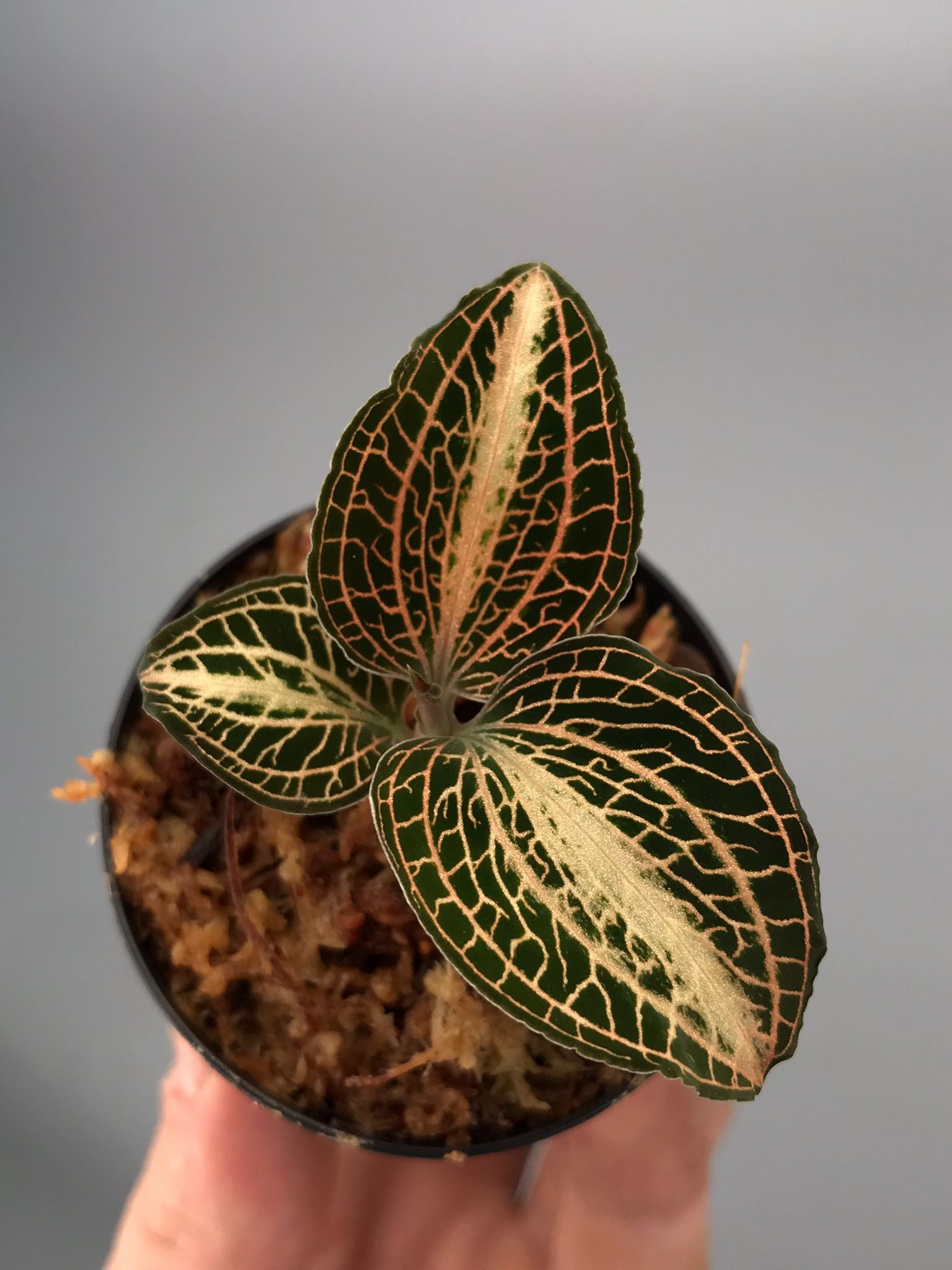
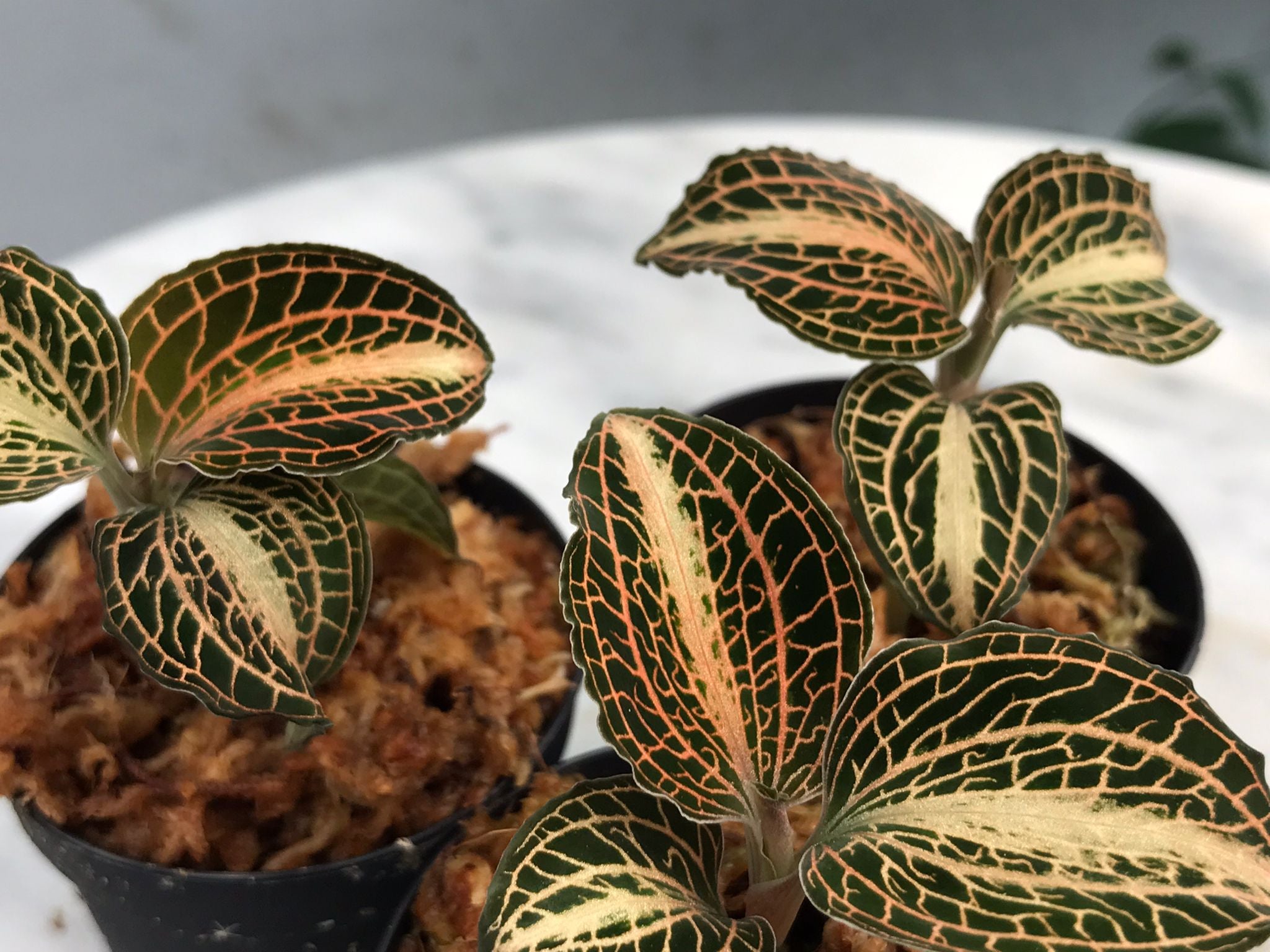
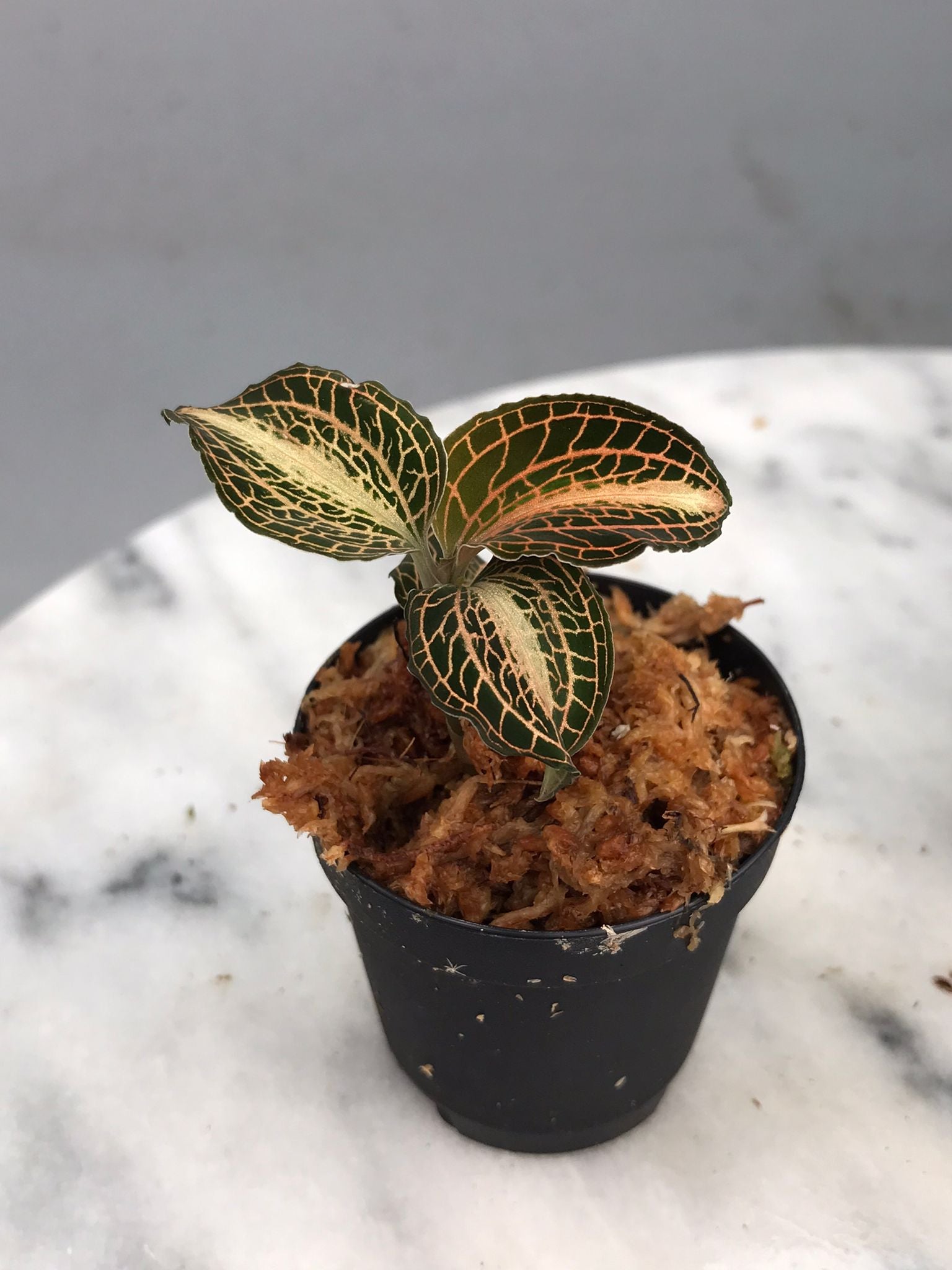
Anoectochilus koshunensis is a compact botanical gem of an orchid native to Taiwan and the southern Japanese islands. The plant is particularly prized for its dark green, velvety leaves, in which light silvery-white to soft golden veins form a delicate network. When light falls at an angle on the leaf, this pattern takes on a subtle sheen that is often difficult to fully capture in photographs.
In addition to its foliage, this species also has botanically interesting flowers. The lip of the flower differs from that of many other Anoectochilus species. This makes A. koshunensis particularly attractive to collectors who are not only looking for a striking foliage plant but also value a true species with a recognizable origin and flower form.
Name and Taxonomy
Anoectochilus koshunensis Hayata is the accepted botanical name. The species was described in 1914 and was later also published under the name Odontochilus koshunensis. That latter name is now considered a synonym.
The species name koshunensis refers to Kōshun, the historical Japanese name for present-day Hengchun in southern Taiwan. The plant is therefore also known as the Koshun jewel orchid. It is a botanical species and thus not a hybrid or commercial cross.
Origin
This jewel orchid occurs naturally in Taiwan and on Iriomote, one of Japan’s southern Ryukyu Islands. There, it grows terrestrially in shaded, moist subtropical forests and bamboo groves. The plant is found in loose humus and leaf litter on the forest floor, often in places where the air remains humid but excess rainwater can easily drain away.
The species occurs from lower hillside forests up to higher mountain areas. As a result, it tolerates moderate temperatures and cooler nights better than many true tropical lowland species. At the same time, it is not a winter-hardy orchid: frost, cold drafts, and prolonged wet substrate at low temperatures remain dangerous.
Characteristics
The plant forms a creeping to slightly ascending, fleshy stem with a few broad oval leaves. These leaves are dark green and may develop a brownish to olive-green undertone as they age. The underside is often reddish-purple in color.
The upper surface features a contrasting pattern of light veins. Depending on the individual plant, leaf age, and lighting, these may appear silvery-white, yellowish-white, or soft golden in color. The veins are generally slightly more subdued and less branched than in some modern jewelry orchid hybrids. It is precisely this natural, understated leaf pattern that gives the species its botanical charm.
The plant remains small and develops slowly through new shoots emerging from the base or at the nodes of the stem. This makes it suitable for limited space. The plant offered is in a 5.5-centimeter pot and is classified as a mature specimen. With this miniature species, “mature” does not mean the plant is large, but rather that it is sufficiently developed to produce new shoots and, under suitable conditions, a flower spike.
Care
Anoectochilus koshunensis grows best under stable conditions. The combination of soft light, a well-aerated but slightly moist growing medium, and sufficient air circulation is particularly important. The species does not require intense lighting or heavy fertilization, but is sensitive to prolonged waterlogging of the roots.
Since the plants offered here are imported, the roots may still be recovering upon arrival. Therefore, first place the plant in a quiet spot with a consistent temperature. As long as the stem remains firm and no rot is visible, it does not need to be repotted immediately.
Light
Provide the plant with low to moderate indirect light. A north- or east-facing window is usually suitable. If placed near a sunnier window, the plant should be positioned farther from the glass or protected by a light curtain.
Direct afternoon sun can quickly damage the thin, velvety leaves. Excessive light intensity can be recognized by fading, reddish-brown discoloration, or dry spots. More light does not automatically make the vein pattern more pronounced. Conversely, with too little light, the stems become longer, the leaves spread farther apart, and the plant clearly leans toward the light source.
Under a grow light, this species thrives at low to moderate intensity. As a result, it fits easily at the bottom of a display case or among other low-growing terrarium plants.
Temperature
A daytime temperature of approximately 18 to 24 °C aligns well with its natural habitat. At night, the temperature may drop to about 15 to 19 °C. This cooling promotes compact growth and distinguishes this species from jewel orchids, which require consistently warm lowland conditions.
A normal living room temperature is usually suitable. However, avoid prolonged temperatures above 27 °C, especially when humidity is high and there is little air movement. In hot weather, the risk of soft, leggy growth and stem rot increases.
Temperatures below approximately 13 to 15 °C are also not recommended. As temperatures drop, the plant uses less water. Allow the growing medium to dry out slightly more and prevent cold roots from remaining permanently wet.
Substrate and Cultivation Method
Because Anoectochilus koshunensis is a terrestrial orchid, it should not be grown exclusively in coarse orchid bark. At the same time, regular compact potting soil is too heavy and often remains wet around the fine roots for too long.
Therefore, use a fine, humus-rich, and airy growing medium. A mixture of fine bark, loose coconut fiber, or an airy humus component, perlite or fine pumice, and a small amount of finely chopped sphagnum moss is suitable. The mixture must be able to retain moisture, while still allowing sufficient air to remain between the components after watering. A slightly acidic soil suits this species well.
Place the creeping stem on or just above the surface. When a healthy node makes contact with the growing medium, a new root can form there. However, do not bury the stem completely, as rot will develop more quickly around the nodes and leaf bases.
As the plant branches out, a shallow, slightly wider pot is more practical than a deep one. In a terrarium, this species can also be placed directly in the substrate, provided there is a proper drainage layer. Do not place it in the lowest part of the terrarium or directly next to a sprayer, waterfall, or other permanently wet area.
Humidity
A humidity level of approximately 65 to 80 percent supports steady growth. In a normal living space, the plant can adapt to slightly lower humidity, but prolonged dry air may cause new leaves to remain smaller or develop dry edges.
High humidity is effective only when combined with ventilation. In a closed terrarium without air circulation, leaves, stems, and substrate remain wet for too long. This actually increases the risk of mold and rot. A small fan or regular air circulation therefore makes a big difference.
Constant misting is not necessary. When you mist the plant, do so early in the day and avoid leaving water on young growth points overnight.
Watering
Keep the substrate evenly slightly moist, but never saturated. Water again when the top layer just begins to dry out. The fine roots must not dry out completely, while a permanently wet root zone will also quickly cause problems.
Preferably use rainwater, reverse-osmosis water, or other low-mineral water at room temperature. Water around the base of the plant and allow excess water to drain away completely. In a terrarium with plants planted directly in the substrate, check the moisture level at the root zone and not just on the visible surface.
Wilted or inwardly curling leaves may indicate dehydration. Yellow, translucent leaves and a soft, darkening stem base are more commonly associated with overly wet conditions. During cooler and darker months, the substrate may be allowed to dry out slightly more, but a completely dry dormant period is not necessary.
Fertilization
During active growth, apply a highly diluted orchid fertilizer once every three to four weeks. About a quarter of the recommended dosage is usually sufficient. This compact species grows slowly and does not have high nutrient requirements.
Reduce fertilization when no new leaves or root tips are visible. Also, rinse the growing medium regularly with clean water to remove accumulated fertilizer salts. Especially in a small pot, these salts can quickly damage the delicate roots.
For a newly imported plant, wait to fertilize until a new leaf, a side shoot, or a fresh root tip indicates that growth has resumed.
Flowering
An upright, slightly hairy flower stalk may emerge from a mature shoot. Several small flowers develop on this stalk, with predominantly white to cream-colored parts. The upper sepals and petals may be tinged with pink, reddish-brown, or greenish-brown and together form a small cap above the flower.
The structure of the lip is distinctive. While many Anoectochilus species bear striking comb- or fringe-like projections, A. koshunensis has broader, more wing-shaped lobes. This makes the flower more interesting to botanical collectors than its modest size might initially suggest.
In its natural habitat, flowering occurs mainly in late summer and fall. Under constant conditions indoors or in a display case, the timing may shift. A well-developed plant can flower regularly, but an “adult” classification does not automatically mean that every specimen will already have a flower stalk upon delivery.
After flowering, the old shoot may gradually become less active, while new growth emerges from the base. Therefore, remove only a completely dried-out flower stalk. Leave healthy parts of the stalk and nodes in place, as roots or side shoots may still develop from them.
Care Level
Anoectochilus koshunensis has a moderate care level. This species is suitable for someone who already has some experience with jewelry orchids, terrarium plants, or other small terrestrial orchids. In a ventilated display case, conditions are generally easier to maintain than on a dry windowsill.
The plant is not particularly demanding in terms of light or nutrition, but does require attention to the root zone. In particular, the combination of high humidity, stagnant air, and a permanently wet substrate poses a risk. Those who regularly check the moisture level and avoid extreme temperatures can successfully keep this species indoors.
The plants offered are mature but compact and may still need to develop new roots after import. Therefore, do not expect a large, full plant in a 5.5-centimeter pot. The value lies precisely in the miniature size, the true-to-type origin, and the delicate leaf pattern.
Who is this plant suitable for?
This species is particularly suitable for collectors of botanical gem orchids and enthusiasts who prefer natural leaf patterns over strikingly variegated cultivars. The unusual structure of the floral lip also makes the plant interesting for anyone who looks beyond just the leaves.
Thanks to its small size, Anoectochilus koshunensis fits easily into a smaller plant display case or a subtropical terrarium. It can also be kept indoors if a sheltered spot with soft light and reasonably humid air is available.
The plant is less suitable for those expecting a fast-growing groundcover or an immediately dense clump. Nor is it suited for a sunny, dry windowsill above a radiator. Those primarily seeking large orchid flowers will likely appreciate its modest blooms less than a collector of botanical miniatures.
Experience with this plant indoors, in a greenhouse, or in a terrarium
Indoors, this species prefers a north- or east-facing window, or a spot slightly further away from a sunnier window. A bright bathroom or a spot under a low-intensity grow light may also be suitable. Avoid dry air currents from heating and air conditioning.
A display cabinet is often the most practical environment. Here, humidity, lighting, and temperature can be kept reasonably stable, while a small fan provides the necessary air circulation. Due to its low-growing habit, the plant can be placed among other jewel orchids without taking up much space.
In a true terrarium, it can grow either in its pot or directly in a suitable substrate. When planted directly, a drainage layer and a loose, non-compacted substrate are necessary. In a completely sealed terrarium without ventilation, there is a risk of mold and rot.
This species also grows well in a moderately warm orchid greenhouse. Place it low and in the shade, away from bright sunlight and hot heating pipes. A temperate section with cooler nights is more suitable than a constantly hot lowland greenhouse.
Additional Care Tip
When caring for a recovering plant, pay special attention to the creeping stem. Carefully place a sturdy, healthy node against the slightly moist substrate, without burying it too deeply. A new root and, later, a side shoot can develop from such a node. This is the safest way to help the plant become fuller.
A fresh root tip or a new leaf is the most reliable sign that the plant has established itself after import. Only then can you gradually bring watering and fertilization back to normal levels.
Brief Product Description
Anoectochilus koshunensis is a compact botanical gem of an orchid native to Taiwan and the Ryukyu Islands. Its dark green, velvety leaves feature a delicate network of silver-white to soft golden veins. The mature plant is supplied in a 5.5-centimeter pot and is suitable for a ventilated terrarium, a plant display case, or a sheltered spot in your home.