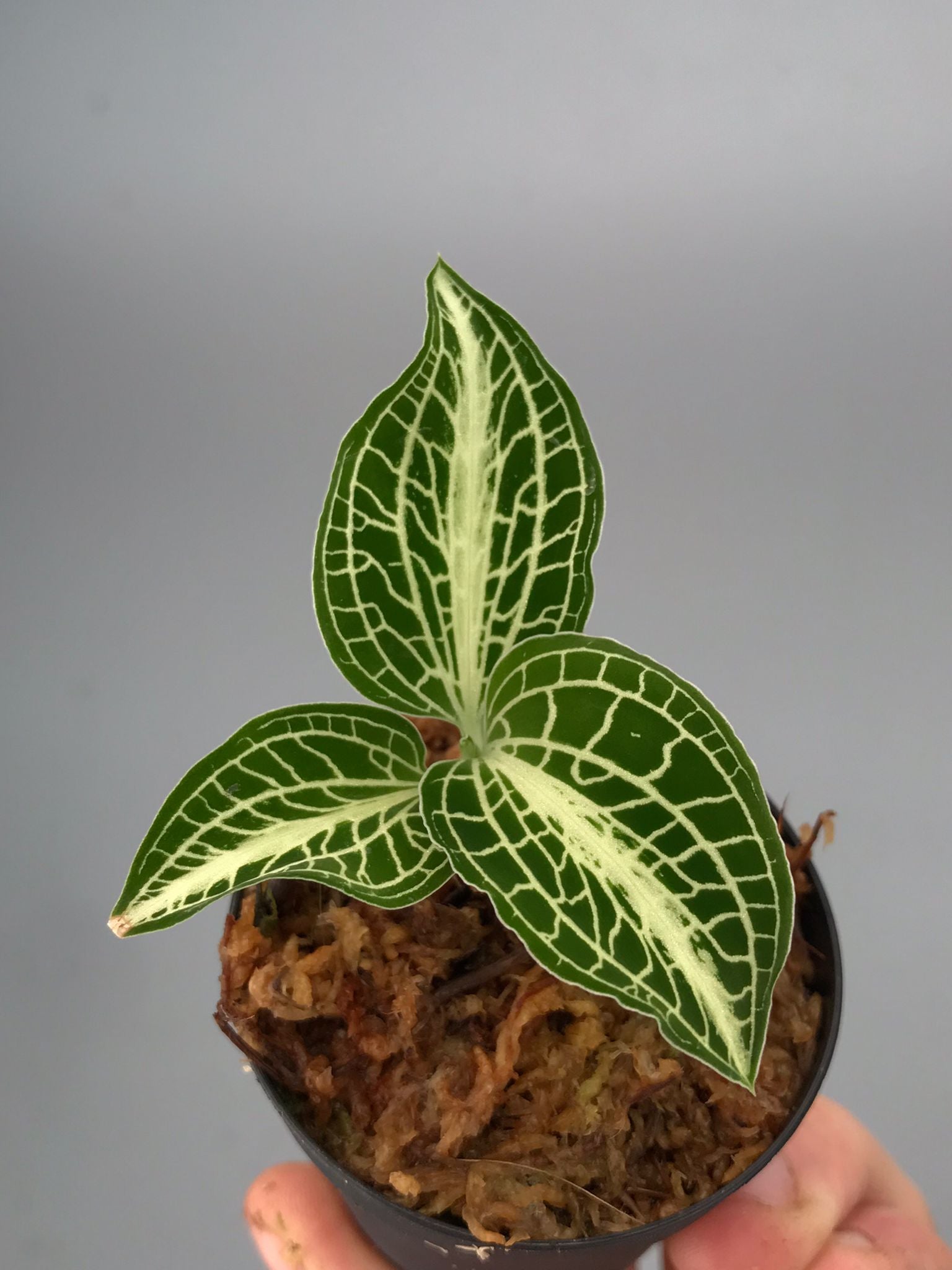
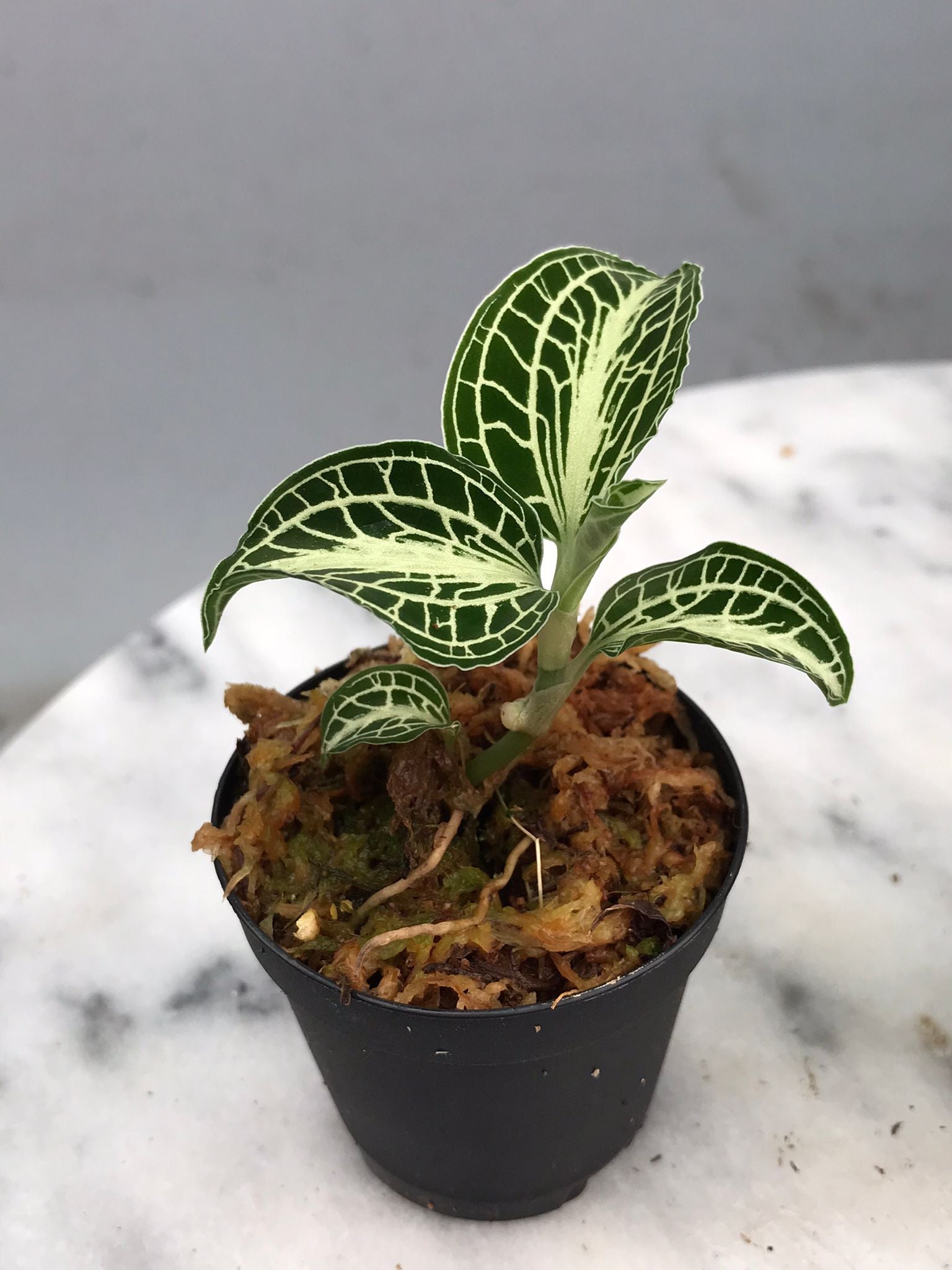
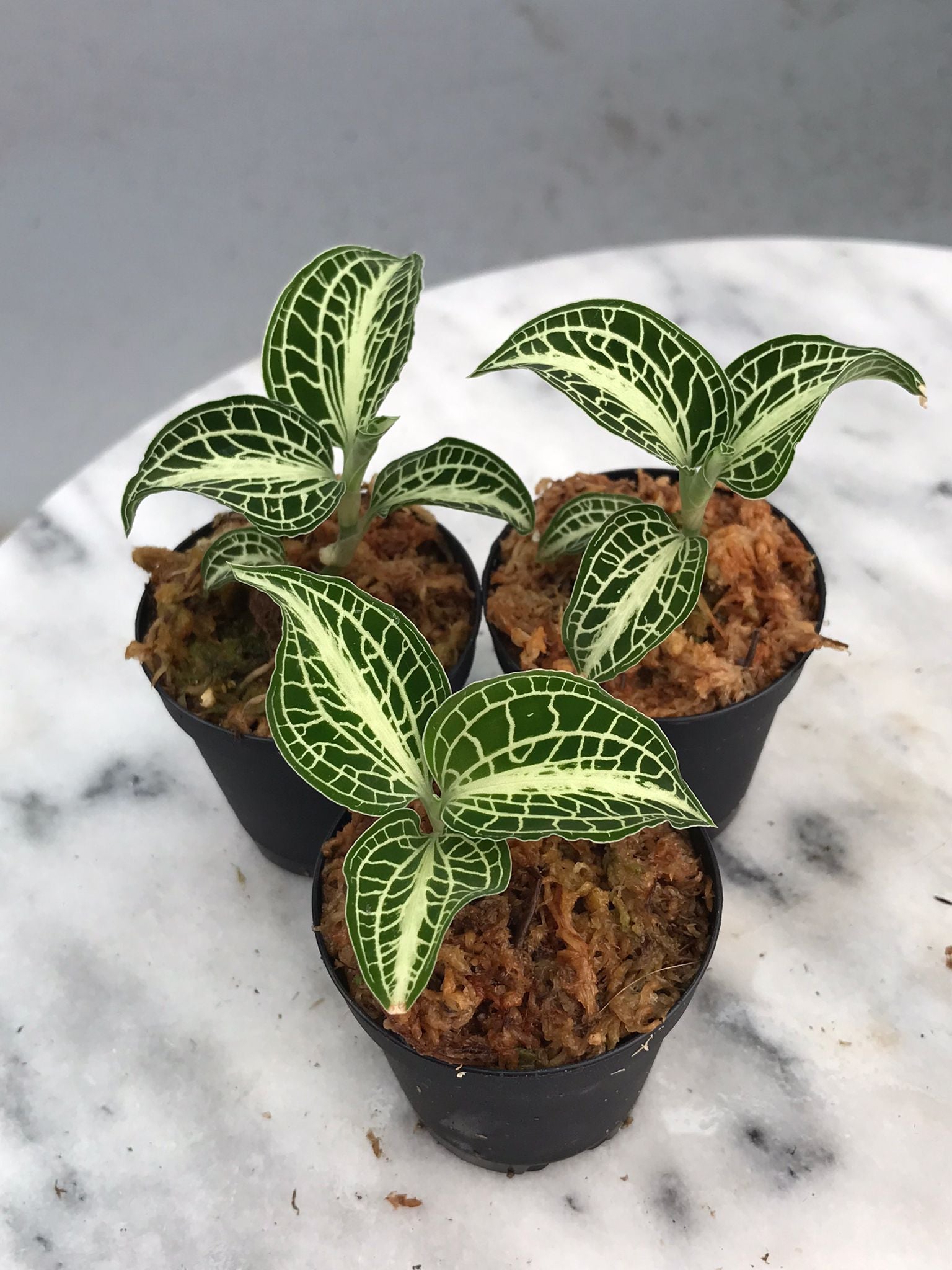
Anoectochilus siamensis is a compact jewel orchid that is primarily collected for its dark, velvety leaves. A fine network of silvery-white, pink to coppery veins runs across the leaf. As soon as light hits the leaf, these lines take on an almost metallic sheen. As a result, the plant doesn’t need to bloom to be constantly ornamental.
Unlike many well-known orchids, this species is terrestrial. This means it takes root in the forest floor in loose humus, leaf litter, and moss. This growth habit makes it particularly well-suited for a display case or terrarium, but with the right substrate and a sheltered location, it can also be kept in the living room.
The plant is sold in a 5.5-centimeter pot and is classified as a mature specimen. With this miniature species, however, “mature” does not mean that the plant will grow large. It primarily indicates that it is sufficiently developed to form new shoots and, eventually, a flower stalk under favorable conditions.
Name and Taxonomy
The plant is primarily known in the orchid trade as Anoectochilus siamensis. According to the current taxonomic classification, however, this name is considered a synonym of Anoectochilus albolineatus. The modern name refers to the light lines on the leaf: albolineatus loosely translates to “white-lined.”
For a product page, it is advisable to list both names. This is because collectors and growers still frequently search for Anoectochilus siamensis, even though Anoectochilus albolineatus is the botanically accepted name. This refers to a botanical species and not to the hybrid Anoectochilus formosanus × burmanicus.
There is natural variation within the species. Some plants develop predominantly silvery-white veins, while others display more pink, coppery, or warm tones. The base color of the leaves can also vary from dark green to brownish-purple. The example photo therefore provides a good impression of the type of plant, but each living plant may differ slightly.
Origin
Anoectochilus albolineatus, better known by its synonym Anoectochilus siamensis, is native to Myanmar, Thailand, and Vietnam. There, the species grows in moist hill and mountain forests, usually in shaded areas with humus-rich soil. The plant is found, among other places, among leaf litter and moss, often on a substrate of granite or sandstone.
The species occurs on mid- to high-altitude mountain slopes. As a result, it does prefer warmth but is less tolerant of consistently hot conditions than some lowland orchids. In particular, the combination of moderate daytime temperatures, slightly cooler nights, diffused light, and an airy root environment closely matches its natural habitat.
Characteristics
The plant forms a low, creeping to slightly ascending stem with a limited number of relatively broad leaves. The leaves are oval to elliptical and taper gently at the tip. Their surface feels velvety to the touch and ranges in color from very dark green to brownish-purple. The underside may have a pink to reddish-purple hue.
The light vein pattern is its most distinctive ornamental feature. Fine lines branch out from the midrib across the leaf, creating a net-like pattern. Depending on the individual plant and the light, the veins may appear silvery-white, soft pink, or coppery. The sheen is most beautiful in oblique, indirect light.
Although the plant remains compact, it can produce new roots and side shoots from the nodes. Over time, this results in a fuller clump. Growth is generally slower than in Ludisia discolor. A small Potsize is therefore normal for this species and says little about its maturity or ultimate collector’s value.
Care
Anoectochilus siamensis requires stable conditions. The plant does not tolerate sudden changes in temperature, humidity, or watering. At the same time, care does not have to be complicated once it is in a suitable location.
The plants offered here are imported and may still be developing new roots upon arrival. Therefore, give the plant time to adjust to its new environment first. A gradual recovery with consistent temperatures and a slightly moist, well-aerated substrate is more important than rapid fertilization or immediate repotting.
Light
Provide this jewel orchid with low to moderate bright, indirect light. A sheltered spot near a north- or east-facing window is usually suitable. Near a south- or west-facing window, the plant should be placed farther from the glass or protected by a light curtain.
Direct sunlight can quickly damage the thin, dark leaves. The color will then fade, and dry, light-brown scorch marks may appear. Furthermore, more light does not automatically make the veins more attractive. Conversely, if there is too little light, the stems may become longer, and the plant will clearly begin to grow toward the light source.
In a display case or terrarium, the plant thrives under a moderately set grow light. Maintain sufficient distance from the light and check—especially on young leaves—to ensure they do not turn lighter, yellowish, or reddish-brown. Such discoloration may indicate excessive light intensity.
Temperature
A daytime temperature of approximately 18 to 24 °C is ideal. At night, the temperature may drop to about 15 to 19 °C. This slight nighttime cooling is well suited to the plant’s mountainous origin and can also contribute to sturdy, compact growth.
A normal room temperature is therefore usually suitable. However, avoid prolonged heat above 27 °C, especially when the air is stagnant. Cold drafts and temperatures below approximately 13 to 15 °C are also unfavorable. At lower temperatures, water consumption decreases, and root or stem rot develops more quickly if the growing medium remains too wet.
Substrate and Cultivation Method
Because this is a terrestrial orchid, the plant should not be grown exclusively in coarse orchid bark. At the same time, regular compact potting soil is too heavy and often remains wet around the fine roots for too long.
Therefore, use an airy, fine, and humus-rich mixture. A combination of fine bark, loose coconut fiber, or high-quality humus, perlite, or fine pumice, along with a small amount of finely chopped sphagnum moss, works well. The growing medium must be able to absorb water without turning into a dense, wet mass. A slightly acidic soil is best suited for this species.
The creeping stem should rest on or just above the growing medium. Do not bury it too deeply, as rot can easily develop, especially around the nodes and leaf bases. As the plant grows larger, a shallow, slightly wider pot is often more suitable than a deep one. This gives new shoots room to develop sideways.
In a terrarium, the plant can grow directly in the substrate, provided there is a well-functioning drainage layer. There, too, ensure an airy root zone and do not place the plant in a low-lying area where water constantly pools. Mimicking a moist forest floor is not the same as keeping the roots permanently waterlogged.
Humidity
A humidity level of about 65 to 80 percent supports the best growth. In a typical living space, the plant can sometimes adapt to slightly lower humidity, but prolonged dry air can cause new leaves to remain smaller or develop dry edges.
A plant display case or terrarium therefore offers clear advantages. However, even in a humid environment, there must be sufficient air circulation. Stagnant, saturated air increases the risk of mold, soft spots on the stems, and rot around young growth points. Constant condensation on the leaves is therefore not a sign that conditions are automatically optimal.
Regular ventilation is more important than daily misting. If you do mist the plant, do so early in the day and make sure the plant has time to dry off for the most part before nightfall.
Watering
Keep the growing medium evenly slightly moist, but never let it remain saturated for long periods. Water again when the surface just begins to dry out. The root zone must not dry out completely, as the fine roots and tender stems are sensitive to this.
Preferably use rainwater, reverse-osmosis water, or other low-mineral water at room temperature. Water around the base of the plant and avoid allowing water to pool for extended periods in the center or between closely spaced leaves.
Wilted, inward-curling leaves may indicate dehydration. Yellow or translucent leaves, a musty odor, and a soft, darkening stem base, on the other hand, are more commonly associated with overly wet conditions. Because water requirements depend heavily on temperature, light, and ventilation, checking the plant’s condition is more reliable than watering according to a fixed weekly schedule.
During cooler and darker periods, the growing medium may be allowed to dry out slightly more. However, the plant does not require a completely dry dormant period.
Fertilization
During active growth, apply a highly diluted orchid fertilizer once every three to four weeks. About a quarter of the usual dosage is generally sufficient. Anoectochilus naturally grows in humus-rich material, but its fine roots remain sensitive to high concentrations of fertilizer salts.
Reduce fertilization when the plant is not producing new leaves or roots. Also, rinse the substrate regularly with clean, low-mineral water. This prevents fertilizers from accumulating in the small pot and damaging the root tips.
Do not fertilize a newly imported plant heavily right away. Instead, wait until a new leaf, a fresh shoot, or active root growth indicates that the plant has become established.
Flowering
An upright, slightly hairy flower stalk may emerge from a mature shoot. Several small, delicate flowers develop on this stalk. The flowers typically have light cream, whitish, and soft green hues, sometimes combined with pink or brown accents.
The strikingly shaped lip, in particular, makes the flowers interesting. It features fine, thread-like projections, giving it an almost lace-like appearance. Although the flowers are less showy than those of large-flowered orchids, they are particularly appealing to enthusiasts of botanical varieties.
In the wild, this species typically blooms around summer, fall, or the beginning of the cooler season. Under controlled growing conditions, the exact timing may vary. A healthy mature plant can bloom regularly, but the term “mature” does not mean that every specimen will already have a flower spike upon delivery.
After flowering, the old shoot may become less active. Therefore, do not immediately remove all leafless or less attractive parts of the stem. First, check whether a new shoot is appearing at the base or at a node. Cut away only a completely dried-out flower stem.
Care Level
Anoectochilus siamensis has a moderate care level. The plant is well-suited for someone who already has some experience with jewel orchids, terrarium plants, or small tropical species. In a well-ventilated display cabinet, care is generally easier than on a dry, warm windowsill.
For an absolute beginner, Ludisia discolor is usually more forgiving. This Anoectochilus, on the other hand, reacts more quickly to a combination of overly wet substrate, stagnant air, and high temperatures. However, if you check the moisture level regularly and provide the plant with a stable location, you’ll be rewarded with a compact variety featuring exceptionally finely patterned leaves.
Since this is an imported plant, the roots may be underdeveloped at first. That’s no reason to repot it right away. As long as the stem remains firm and there’s no rot, it’s best to let the plant acclimate gradually.
Who is this plant suitable for?
This species is suitable for collectors who are looking for more than just a general houseplant and who particularly value leaf pattern, natural variation, and botanical background. For enthusiasts who already own a Ludisia or Macodes, this Anoectochilus also represents an interesting next step.
Due to its compact size, the plant is suitable for a small display cabinet, a tropical terrarium, or a small collection on a windowsill. Furthermore, the foliage remains attractive year-round, so the plant has decorative value even without flowers.
This species is less suitable for someone expecting a fast-growing, large plant or who values only large orchid flowers. A sunny, dry windowsill above a radiator is also not a suitable location.
Experience Growing Indoors, in a Greenhouse, or in a Terrarium
Indoors, the plant prefers a sheltered spot with soft daylight and a stable temperature. An east-facing window, a bright bathroom, or a spot under a low-intensity grow light can work well. In a dry living room, it helps to place the plant alongside other plants, as long as there is sufficient airflow between the foliage.
A display cabinet or terrarium usually offers the most predictable conditions. The higher humidity supports the development of new leaves and prevents young growth points from drying out too quickly. Ensure proper ventilation and avoid spraying the plant until it is completely wet multiple times a day.
This species can also thrive in a moderately warm greenhouse. Place it low down, out of direct sunlight, and at a distance from heating pipes. Since this species originates from high-altitude forests, a constantly hot greenhouse is less suitable than a moderate, shaded section.
Additional care tip
When caring for a recovering plant, pay special attention to the nodes on the creeping stem. When a healthy node gently touches the airy, slightly moist substrate, a new root or side shoot may develop there. Therefore, place the stem loosely on the surface rather than burying it deeply.
A new leaf or a fresh root tip is the clearest sign that the plant has acclimated well. From that point on, watering can be gradually increased slightly, and you can carefully begin applying fertilizer.
Brief product description
Anoectochilus siamensis, now accepted as Anoectochilus albolineatus, is a compact terrestrial jewel orchid with velvety dark green to brownish-purple leaves. The delicate network of silvery-white, pink, or coppery veins gives each plant its own unique appearance. This mature plant in a 5.5-centimeter pot is particularly well-suited for a ventilated terrarium, a display case, or a sheltered spot in the home.