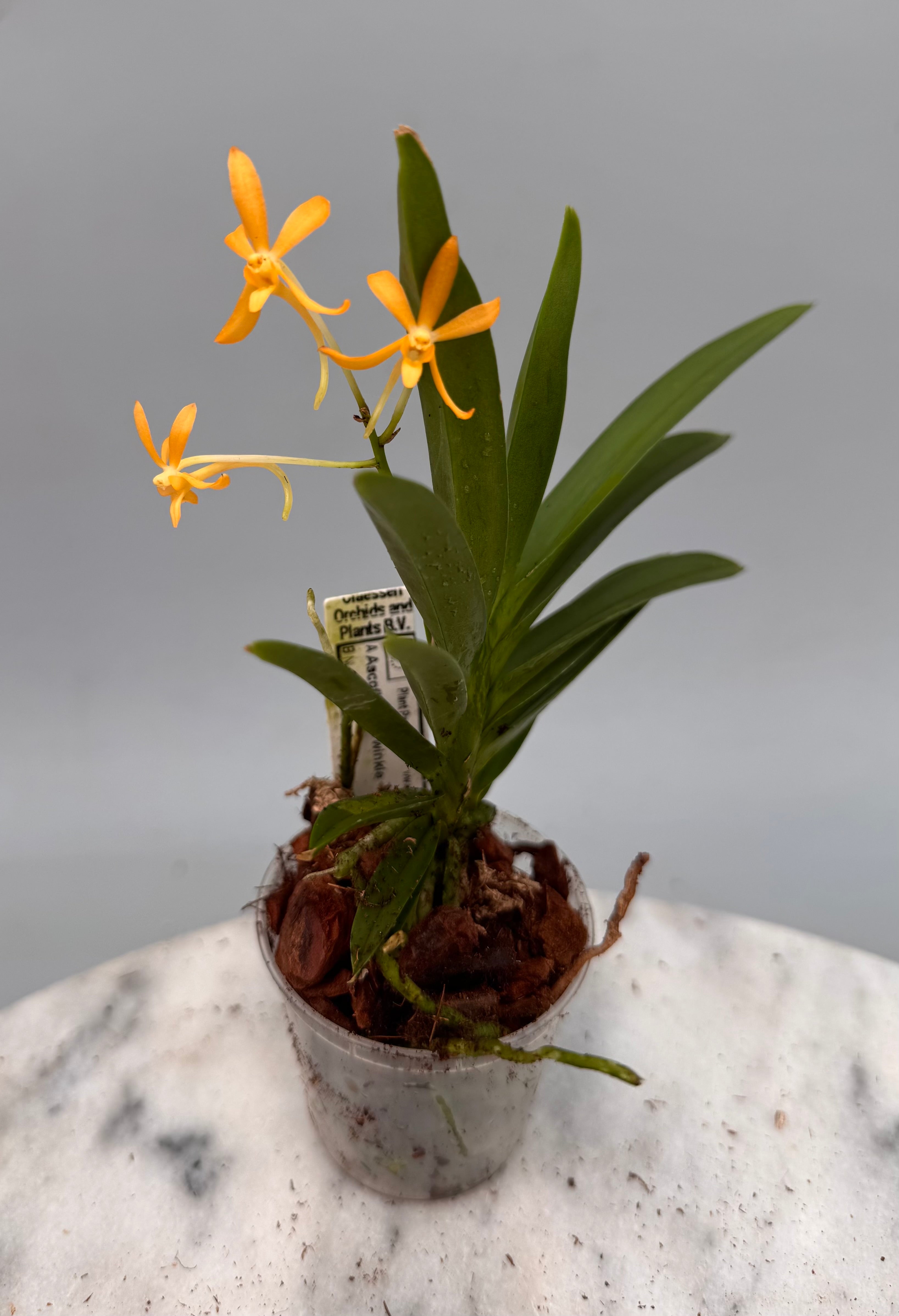
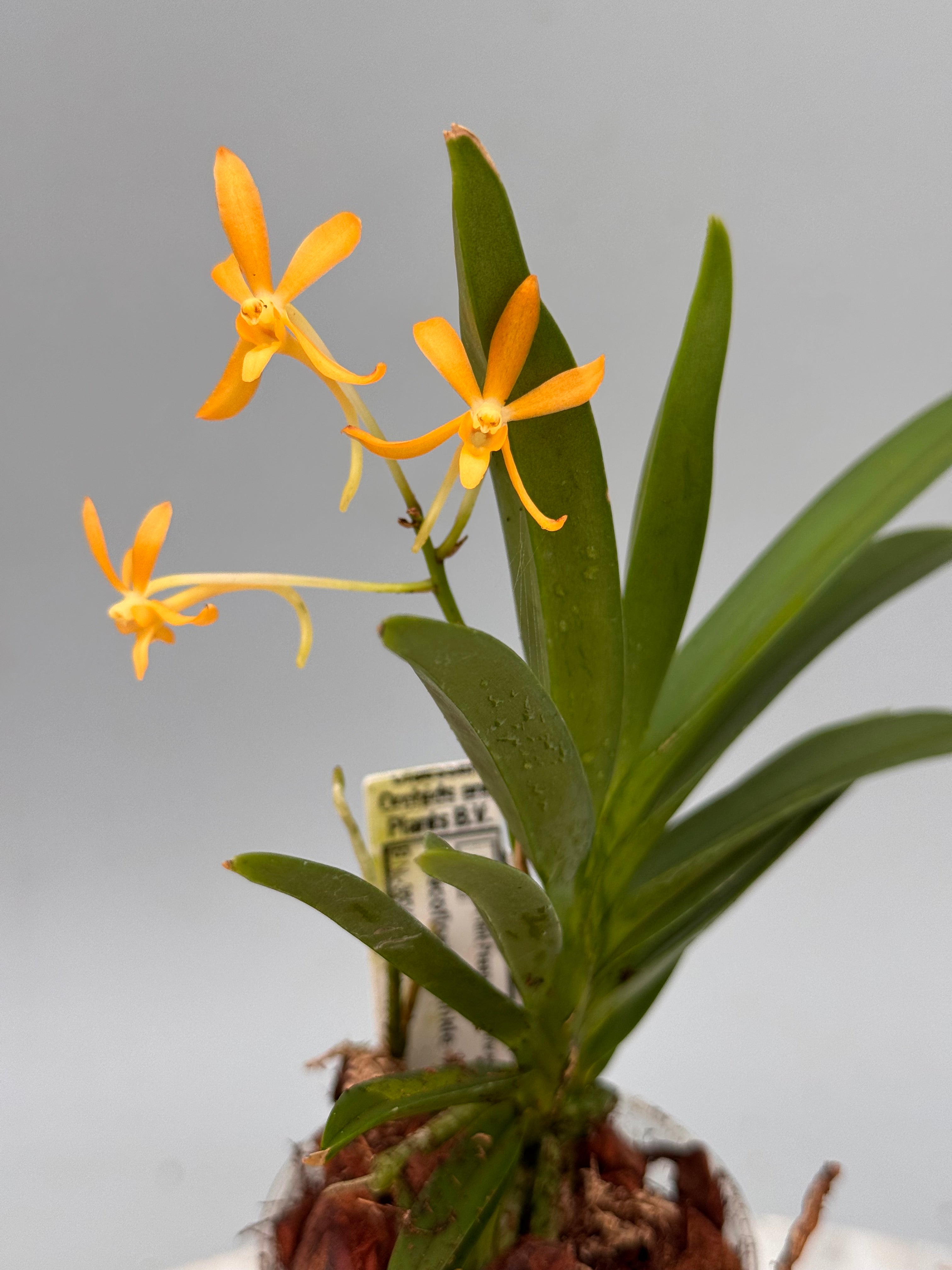
Ascofinetia Twinkle is a compact, profusely flowering orchid from the Vanda Alliance. The plant is prized for its delicate, grass-like leaves, small but numerous flowers, and often pleasant fragrance. Due to its modest size, this is an attractive orchid for enthusiasts who are looking for the appearance of a Vanda but do not have room for a large plant with long aerial roots.
The classic name Ascofinetia Twinkle is still widely used among enthusiasts and in the trade. The modern, RHS-accepted name is Vanda Twinkle. This hybrid originated from Vanda falcata × Vanda miniata, formerly better known as Neofinetia falcata × Ascocentrum miniatum. It is precisely this combination that explains the plant’s characteristics: compact, floriferous, fragrant, and much easier to care for than many larger Vanda species.
Origin
Ascofinetia Twinkle is a primary hybrid from 1960, registered by Masao Yamada. A primary hybrid means that the plant was derived directly from two botanical species, in this case Vanda falcata and Vanda miniata.
Vanda falcata is native to an area stretching from China to temperate East Asia, where it grows as an epiphyte in subtropical conditions. This parent is known for its compact growth, narrow leaves, and strong fragrance. Vanda miniata, formerly Ascocentrum miniatum, is a small epiphytic Vanda native to West Malaysia and related Southeast Asian regions. This species primarily contributes the warm orange flower color, compact inflorescences, and vigorous flowering.
Ascofinetia Twinkle does not occur in the wild, but it is composed of two species with a distinct natural background. In cultivation, it is one of the better-known compact Vanda hybrids, precisely because it combines many traits of both parents in a practical way.
Characteristics
Ascofinetia Twinkle grows monopodially, just like other Vanda relatives. The plant forms a compact fan of narrow, slightly curved leaves. The foliage is more delicate and elegant than that of many large Vanda species, making the plant less space-consuming and well-suited for a windowsill, display case, small greenhouse, or plant room.
The flowers appear in upright to slightly curved clusters containing multiple small flowers. The color typically ranges from cream-orange, light orange, apricot, or bright orange, depending on the clone, light intensity, and flowering stage. Some flowers open lighter in color and later develop a warmer orange hue. The flowers are small, but the number of flowers per cluster makes them quite striking.
Many plants are fragrant, often especially in the morning, evening, or under warmer conditions. The fragrance is primarily due to the influence of Vanda falcata. Ascofinetia Twinkle can also form clumps over time, allowing older plants to bloom more profusely.
Care
Light
Provide Ascofinetia Twinkle with plenty of bright, indirect light. The plant can tolerate more light than many shade-loving orchids, but harsh midday sun through a window can damage the leaves. Morning sun or late afternoon sun is usually suitable.
If there is too little light, the plant will often continue to grow, but flowering will be poor or fail entirely. A bright windowsill, sunroom, display case with grow lights, or warm greenhouse is therefore ideal. The leaves should remain firm and bright green; yellowish leaves may indicate too much direct sun, while very dark leaves often indicate too little light.
Temperature
Ascofinetia Twinkle grows best in moderate to warm conditions. A daytime temperature of approximately 20 to 28°C is suitable. At night, the temperature may drop to about 15 to 20°C.
Due to the influence of Vanda falcata, this hybrid can tolerate slightly cooler nights than some heat-loving Vandas. However, prolonged cold should be avoided, especially when the roots are wet. Warm days, cool nights, and good air circulation usually result in the best growth.
Substrate and Cultivation Method
This hybrid needs air around its roots. Ascofinetia Twinkle can be grown well in a small open basket, a net pot, a very airy bark mix, or mounted on cork with some sphagnum moss around the roots.
For indoor cultivation, a small open basket or mesh pot is often more practical than growing the plant completely bare-root or mounted. This keeps the roots well-aerated without allowing them to dry out too quickly. When grown mounted, the plant has a decorative and natural appearance, but it requires more frequent misting or soaking.
Do not use a compact substrate that remains wet for long periods. The roots must be able to breathe again after watering.
Humidity
A humidity level of about 60 to 80% is ideal. In a display case or greenhouse, Ascofinetia Twinkle often grows more easily than on a dry windowsill, because the fine roots remain more active. In drier air, root tips may stop growing or dry out.
High humidity must always be combined with air circulation. Stagnant, humid air can cause mold or rot, especially in the leaf axils and around young roots.
Watering
Allow the roots to get completely wet and then dry out slightly again. In an open basket or on cork, Ascofinetia Twinkle may need to be watered more often than in a pot filled with bark. Water preferably in the morning so the plant can dry out during the day.
Preferably use demineralized water, rainwater, or other soft water at room temperature. Healthy roots turn green when wet and silvery when they dry out. This makes it easy to see when the plant needs water again.
During warm, sunny periods, the plant requires more water. During cooler or darker periods, you can reduce watering, but do not let the plant dry out completely for long periods.
Fertilizer
During the active growing season, apply a light dose of orchid fertilizer regularly. A quarter to half the recommended dose is usually sufficient. In plants grown in open baskets or on cork, fertilizers wash away more quickly, but salt buildup on the roots can still occur.
Therefore, rinse the roots regularly with clean water. In winter or during periods of slower growth, you can reduce the amount of fertilizer.
Flowering
Ascofinetia Twinkle blooms with compact clusters of small, often fragrant flowers. Flowering often occurs during the warmer and sunnier months, but well-established plants can also bloom at other times under stable conditions.
The flower color is usually warm orange to apricot-orange, sometimes lighter as the flowers open. After flowering, the flower stalk may be removed once it begins to dry out. The plant will then continue to grow from the top and may later produce new flower stalks from the leaf axils.
Care Level
Ascofinetia Twinkle is of moderate difficulty. It is clearly more practical than many large Vandas, but does require more light, air, and regular watering than a standard Phalaenopsis. Watering is especially important for mounted plants, as the roots can dry out quickly.
This plant is a good choice for enthusiasts who already have some experience with orchids and understand that Vanda-like plants prefer airy roots to a wet pot. It may be suitable for beginners if the location is bright enough and watering is done consistently.
Who is this plant suitable for?
Ascofinetia Twinkle is suitable for enthusiasts looking for a compact, fragrant Vanda hybrid with abundant blooms and a small footprint. The plant is well-suited for a bright windowsill, sunroom, small greenhouse, display case, or plant room.
It is particularly appealing to collectors of miniature orchids, Neofinetia/Vanda falcata hybrids, and compact Vanda alliance plants. For someone looking for a low-maintenance orchid for a dark living room, this plant is less suitable. For someone who regularly monitors light, water, and root growth, Ascofinetia Twinkle is actually a rewarding and floriferous choice.
Experience growing at home or in a greenhouse
Indoors, Ascofinetia Twinkle is often easier to care for than large Vandas, because the plant remains compact and takes up less space. An open basket or net pot usually works well: the roots get air, but don’t dry out as quickly as with fully bare-root cultivation.
In a display case or greenhouse, the plant often grows even more easily, because humidity and temperature are more stable. There, it can develop roots more quickly and form clumps more easily. On a windowsill, light is especially important. If the plant is kept in too dark a spot, it will remain compact but won’t bloom as well.
Extra care tip
With Ascofinetia Twinkle, pay special attention to the root tips. Active root tips are a good sign that the plant is getting enough moisture, warmth, and air. If the tips keep drying out, the air is probably too dry or the plant isn’t being watered regularly enough. If the roots turn brown and soft, the plant is staying wet for too long without enough air.