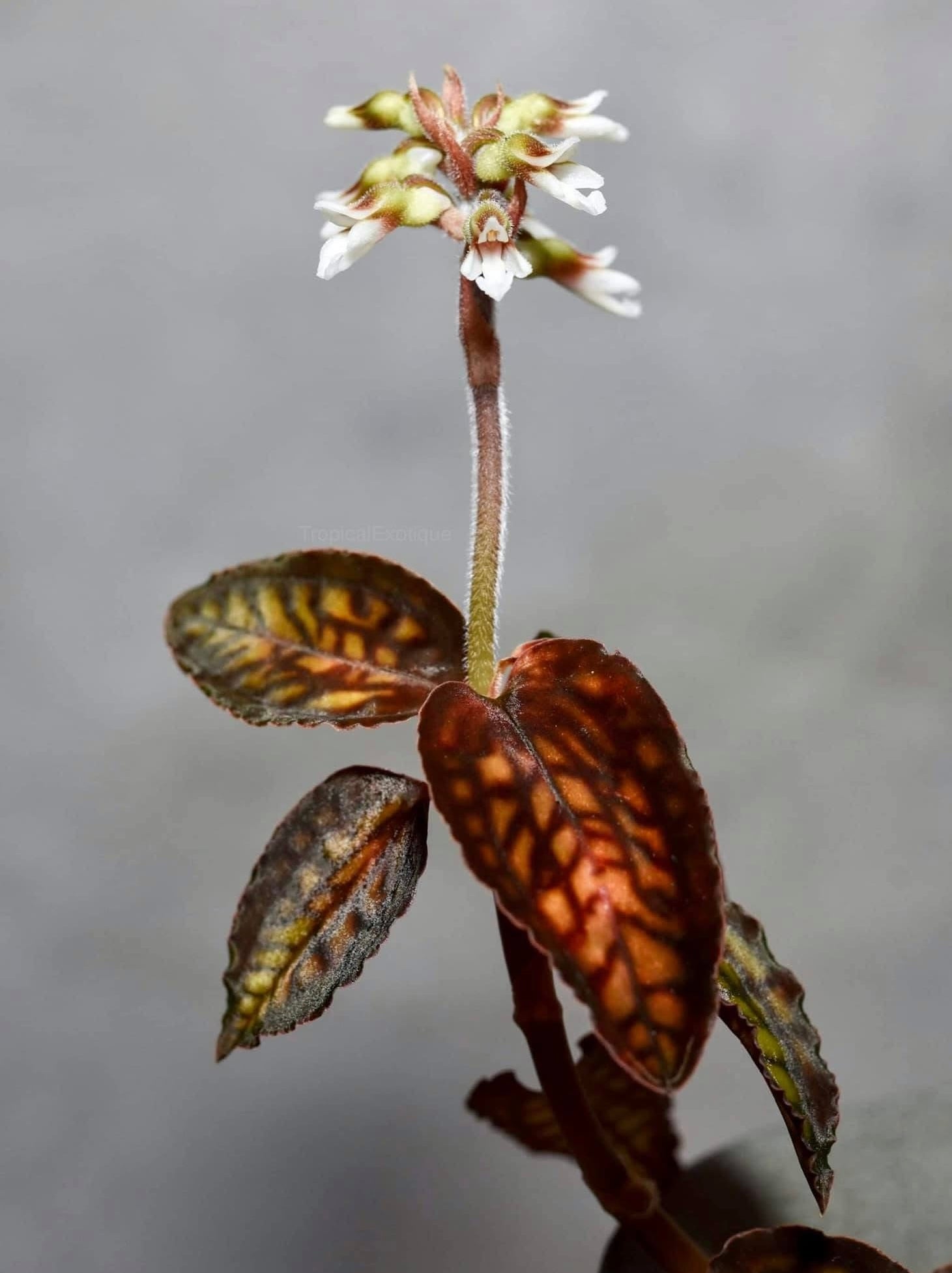
Cystorchis stenoglossa is a rare terrestrial orchid that belongs to the group of so-called jewel orchids. These species are mainly appreciated for their decorative foliage rather than their flowers. Cystorchis stenoglossa is notable for its dark, velvety leaves with a subtle pattern of contrasting veins. Within specialized orchid collections, this species is prized for its botanical rarity and refined leaf structure.
Origin
Cystorchis stenoglossa is native to tropical rainforests of Southeast Asia and parts of the Indonesian archipelago. There it grows terrestrially on the forest floor in areas where constant humidity and a thick layer of organic matter are present.
In this natural environment, the species grows among moss, humus and fallen leaves under the canopy of larger trees. Light is highly filtered, so the plant has adapted to shady conditions with a stable microclimate.
Within the orchid system, Cystorchis belongs to the group of terrestrial orchids closely related to other well-known jewel orchids such as Anoectochilus and Macodes.
Characteristics
Cystorchis stenoglossa forms compact shoots with oval to slightly oblong leaves. The leaves have a velvety texture and a deep dark green to brownish color.
Across the leaf surface runs a fine network of lighter veins that can light up subtly in the right light. This gives the plant the distinctive appearance characteristic of many jewel orchids.
The growth habit is low and slightly creeping. New shoots develop from the base of the plant, which over time can create a compact group.
Flowering is modest. The plant produces slender flowering stems with small flowers that rise above the foliage. Although the flowers are botanically interesting, the ornamental value of the species lies mainly in the decorative foliage.
Care
Light
Cystorchis stenoglossa grows best in soft, indirect light. Direct sunlight can damage the foliage. A shady spot or a terrarium environment with filtered light is often ideal.
Temperature
The species grows well at temperatures between about 18 and 26 °C. Prolonged cold temperatures below about 15 °C are less well tolerated.
Substrate
Use an aerated but moist substrate rich in organic matter. Mixtures based on fine bark, peat moss and humus-rich components usually work well for this terrestrial orchid.
Humidity
Humidity between about 60 and 80 percent promotes healthy leaf development. In terrariums or display cases, jewel orchids often develop particularly well.
Watering
The substrate should remain slightly moist but not wet for long periods of time. Water small amounts regularly and preferably use demineralized water or rainwater.
Feeding
During the growing period, highly diluted orchid nutrition can be given occasionally. Over-fertilization should be avoided as the roots can be sensitive to it.
Flowering
When mature, the plant may develop a slender flowering stem with small flowers. Many collectors remove the flowering stem so that the plant continues to devote its energy to leaf growth.