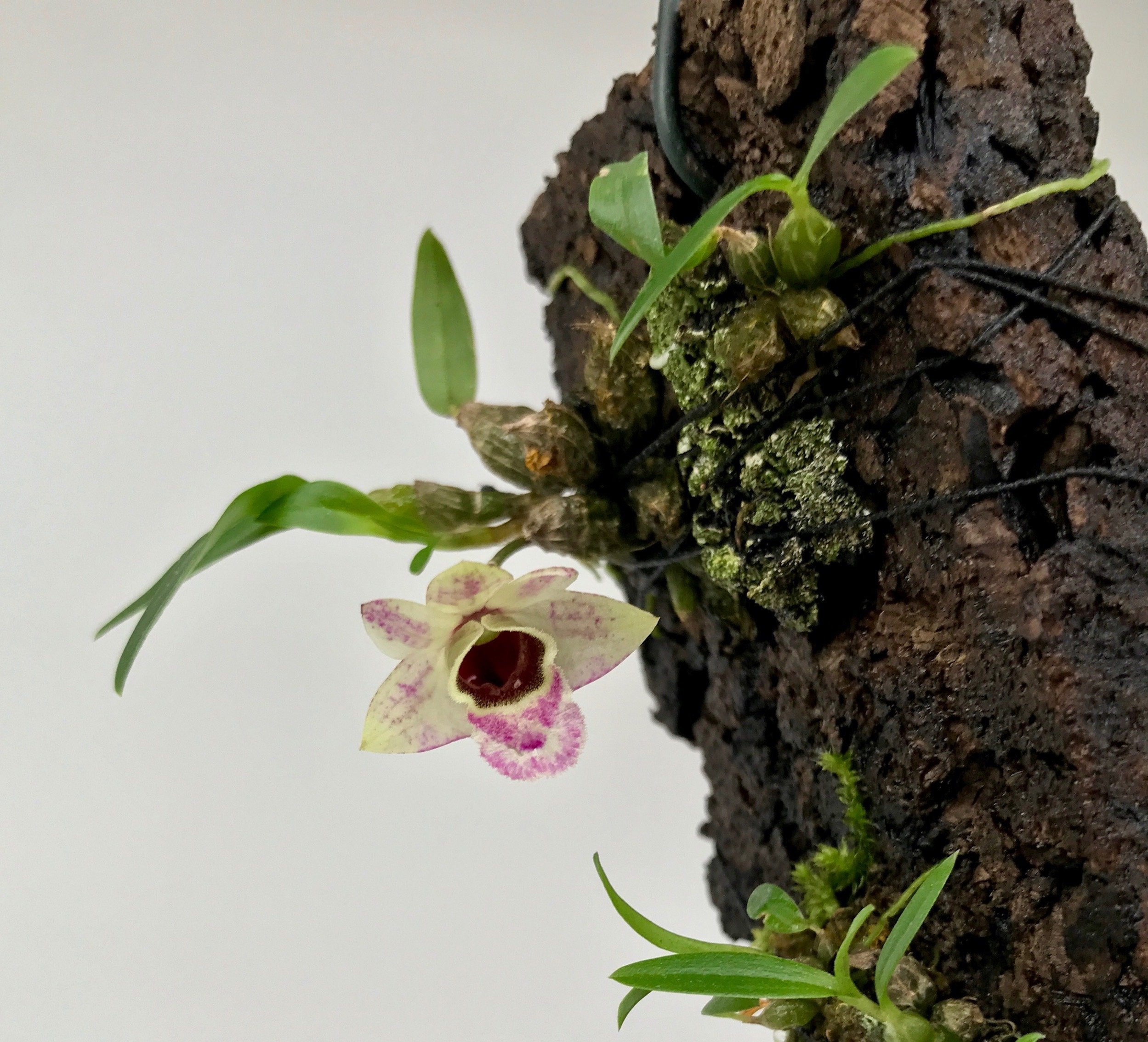
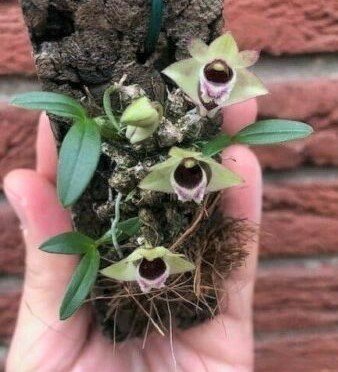
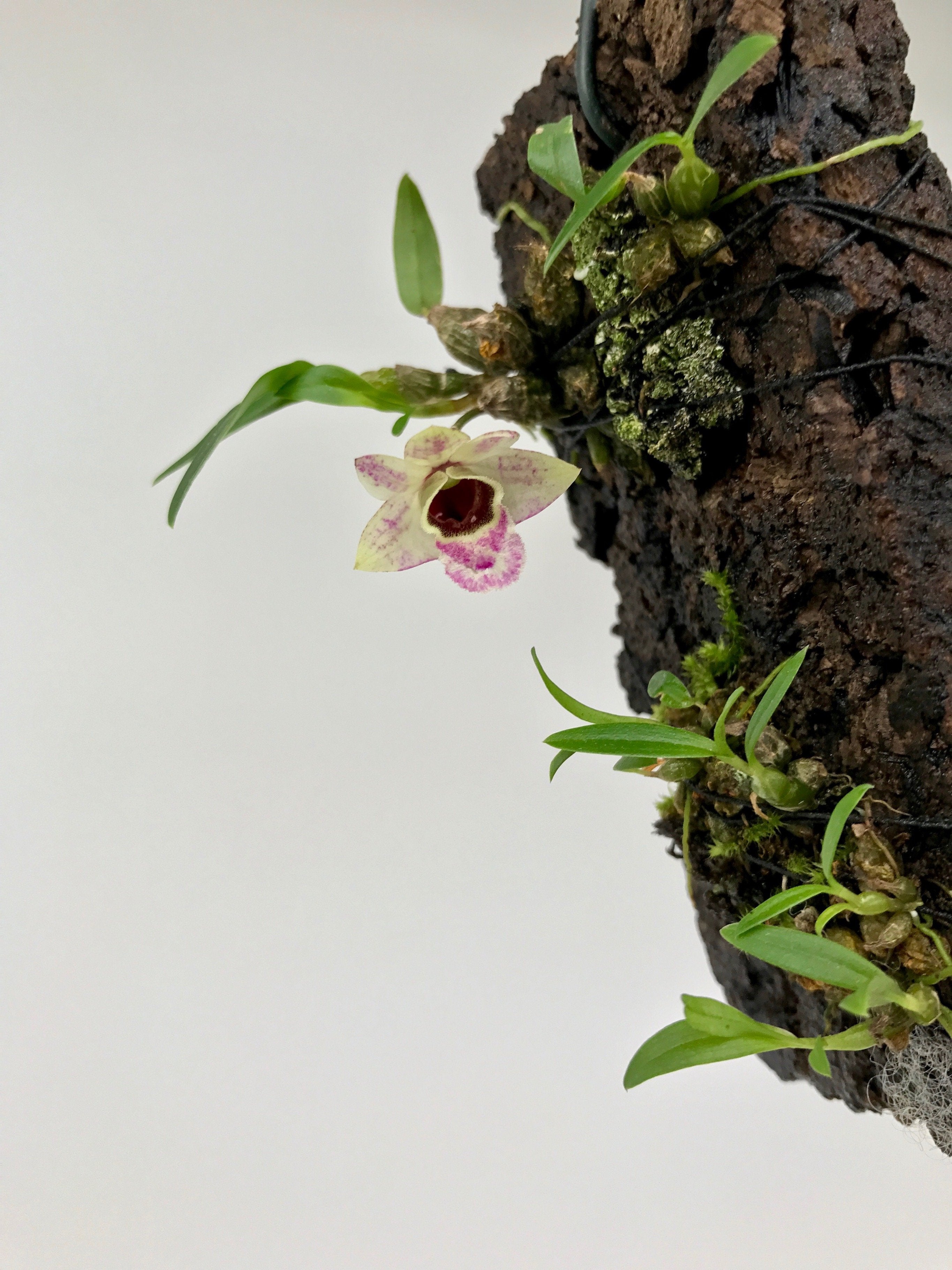
Dendrobium Hekouense is a miniature botanical orchid in which the proportion between the plant and the flower is immediately striking. The rounded pseudobulbs are sometimes barely larger than a fingertip, while the flower can grow to be almost as large as an entire separate growth.
The white to pale greenish-yellow flower is marked with purplish-red veins and speckles. The dark burgundy-red center, the hairy lip, and the strikingly long, tubular back give the flower an almost animal-like character. This is a species for the collector who values botanical details rather than the physical size of a plant.
Origin
Dendrobium hekouense was not scientifically described until 2011. The species is named after Hekou in the southeastern part of the Chinese province of Yunnan, where the first plants were studied. The species has since also been recorded in northern Vietnam.
In the wild, this epiphyte grows on tree trunks in subtropical, evergreen broadleaf forests on limestone slopes, usually at elevations between approximately 1,000 and 2,000 meters. Summers are humid and foggy, while the period from November through March is noticeably drier.
It is notable that the plants often grow on the side of trunks and branches facing the ground. The flowers are positioned almost horizontally, so that rainwater cannot easily enter the deep, tubular flower opening.
Characteristics
Dendrobium hekouense forms compact clusters of short, spherical to oval-round pseudobulbs. Each new shoot usually bears a few narrow, sturdy leaves. The pseudobulbs are only about one centimeter long, which means that even a mature, flowering plant remains exceptionally small.
After maturing, the leaves may turn yellow and fall off. The flowers emerge from these leafless pseudobulbs. A leafless shoot is therefore not necessarily dead.
Each pseudobulb usually produces one flower. An older plant with multiple pseudobulbs can open several flowers at the same time and, despite its miniature size, create a striking display.
Care
Dendrobium He Kouense prefers a cool to moderate climate, high humidity, gentle air movement, and a clear distinction between the humid growing season and the cooler, drier winter period.
Due to its small size, the plant can dry out quickly but is also prone to rotting. The key, therefore, is not to let the soil become waterlogged, but to water frequently and ensure the roots get enough air in between waterings.
Light
Provide this species with medium to bright, filtered light. A bright spot without scorching midday sun is ideal. Gentle morning sun or late evening light can be tolerated once the plant has gradually acclimated to it.
Although Dendrobium hekouense occurs in dense forests, it often grows there on relatively light-exposed parts of trunks and branches. A dark corner of the terrarium is therefore not ideal. Insufficient light results in weak growth and reduces the likelihood of flowering.
On a windowsill, an east-facing window or a lightly shaded south- or west-facing window is suitable. Under artificial light, the plant can be placed slightly off to the side of the strongest light beam.
Temperature
Dendrobium hekouense grows best at cool to moderate temperatures. Daytime temperatures of about 18 to 24 °C are suitable, with nighttime temperatures between 12 and 17 °C.
On hot summer days, the plant can temporarily tolerate higher temperatures, provided that humidity and ventilation are increased. Prolonged heat above 27 to 28 °C, especially in combination with warm nights, can stunt growth.
In winter, the temperature may drop further, but protect the plant from frost and cold, damp drafts. A slight nighttime cool-down is better suited to this mountain species than a living room that is constantly heated year-round.
Substrate and Cultivation Method
Dendrobium Hekouense thrives best on a small piece of cork, wood, or tree fern fiber, with a thin layer of sphagnum moss around the roots. This cultivation method mimics its natural growth on tree trunks and allows plenty of air around the delicate roots.
Do not use too much moss. A thick, compact layer stays wet for a long time and can suffocate the small pseudobulbs and roots. The moss serves only to prevent a mounted plant from drying out completely immediately after watering.
Cultivation in a small mesh pot is also possible. In that case, use fine orchid bark, perlite, and a limited amount of loose sphagnum moss. Choose a pot that is barely larger than the root system.
It is best to repot or secure the plant when new root tips appear. The fine roots recover less easily if disturbed during a dormant period.
Humidity
A humidity level of approximately 65 to 85% is ideal. During active growth, the air may be more humid than in winter. Constant air circulation remains important in this regard.
High humidity without ventilation can quickly lead to mold, soft pseudobulbs, and root rot. A small fan is therefore particularly useful in a terrarium, display case, or plant cabinet.
A brief drop in humidity is less harmful than a constantly damp, stagnant environment.
Watering
Water regularly during spring and summer as soon as new shoots and roots begin to grow. A mounted plant may need daily watering during hot periods. Thoroughly wet the moss and roots, then allow the surface to dry out again.
Starting in the fall, gradually reduce watering. During the cooler winter months, allow the moss to dry out almost completely between waterings. However, do not let the plant dry out completely for weeks on end: the very small pseudobulbs have only a limited water supply.
Check the pseudobulbs. Slight wrinkling during the dormant period is normal, but severe shriveling indicates insufficient water. In winter, water preferably in the morning so the plant can dry out before nightfall.
Use rainwater, reverse-osmosis water, or other soft water at room temperature.
Fertilizer
Apply a low dose of orchid fertilizer only during active root and shoot growth. Once every two to three weeks at about one-quarter of the normal concentration is sufficient.
Due to its small root system, this species is sensitive to high salt concentrations. Rinse the moss or substrate regularly with clean water and stop fertilizing as soon as the new pseudobulbs have matured.
Do not resume fertilizing until new root tips become visible.
Flowering
In its natural range, Dendrobium hekouense usually blooms in August and September, in the middle of the wet season. Under European growing conditions, the exact timing may shift.
The flower emerges from a leafless pseudobulb and stands almost horizontally. The sepals and petals are white to pale greenish-yellow and bear purplish-red veins or speckles. The three-lobed lip is hairy and features a dark burgundy to purplish-red center.
A single flower of this species can appear almost as large as the rest of the plant. In a mature clump with many old pseudobulbs, a striking contrast emerges between the small, bead-like growth and the relatively large flowers.
Care Level
Advanced.
Dendrobium hekouense isn’t necessarily finicky, but its miniature size leaves little room for error. A thin layer of moss can dry out quickly, while a layer that’s too thick will remain wet for too long. High summer temperatures and stagnant air are also poorly tolerated.
Newly imported plants often have very few active roots. Initially, keep such a plant in a stable environment that is moderately warm and slightly moist. Do not subject a recovering plant to an extremely dry dormant period until new roots have become well established.
Who is this plant suitable for?
Dendrobium hekouense is suitable for collectors of miniature botanical orchids who can provide a cool to moderately warm terrarium, orchid display case, or greenhouse. The plant is particularly interesting due to its recent discovery, limited range, and the extraordinary ratio between plant and flower size.
This is not a good choice for anyone looking exclusively for large, lush foliage. Outside of the flowering period, the plant consists of a compact cluster of small pseudobulbs, some of which may be temporarily leafless. It is precisely this subtle appearance that makes the species attractive to specialized collectors.
Caring for this plant at home, in a terrarium, or in a greenhouse
In a ventilated orchid display case or a cool to moderate terrarium, it is easier to maintain stable humidity. Do not place the plant in a warm, completely sealed tropical container, where the temperature and stagnant air can rise too quickly.
In a plant cabinet, Dendrobium hekouense can be kept well as long as there is sufficient air circulation and the lights do not produce too much heat. A vertically mounted setup allows water to drain better and beautifully showcases the plant’s natural growth habit.
On a windowsill, the plant can be kept in a bright, cool room. However, a mounted plant requires regular monitoring there, as the small amount of moss dries out quickly in dry indoor air.
In a temperate greenhouse, the species prefers a sheltered, bright spot with plenty of ventilation and cooler nights.
Additional care tip
Mount the plant vertically or at a slight angle so that water can easily drain from the flower and around the pseudobulbs. This position mimics its natural growth on the underside of tree trunks and reduces the risk of water pooling in the deep flower opening.
Do not remove old, leafless pseudobulbs as long as they are firm. Flowers may actually emerge from these seemingly dormant growth parts.
Short product description
Dendrobium hekouense is a rare botanical miniature orchid from Yunnan and Northern Vietnam. The small, bead-like pseudobulbs produce relatively large white-green flowers with purplish-red markings and a dark, hairy center. Suitable for experienced collectors with a cool, humid, and well-ventilated growing environment.