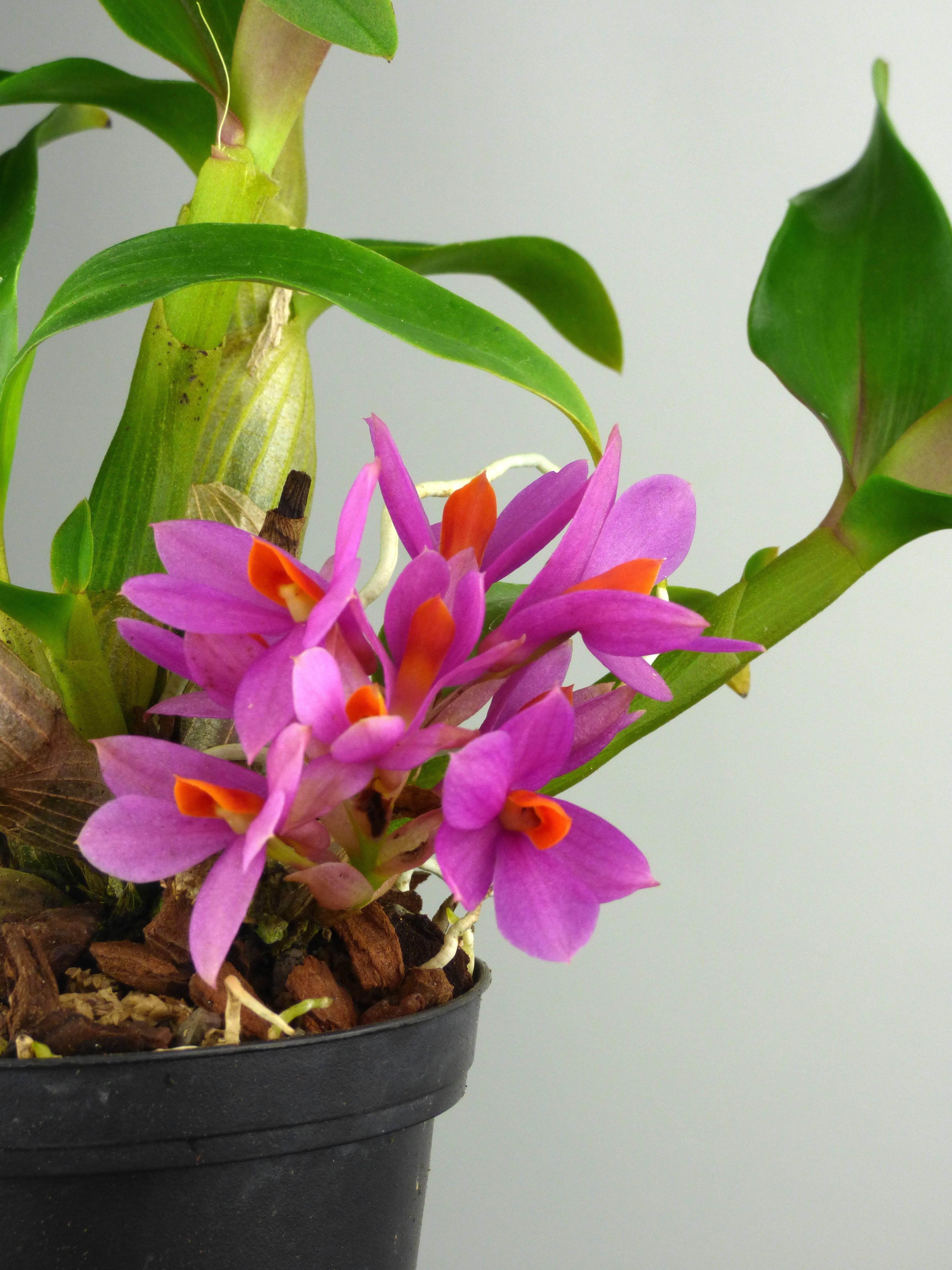
Dendrobium laevifolium ‘Pink-Sensation’ is a compact species orchid with strikingly large flowers relative to the plant. The intense magenta- to fuchsia-pink flowers have a contrasting orange-red lip and appear close to the short stems. This creates a concentrated burst of color during flowering.
This selected pink variety is particularly appealing to enthusiasts of miniature Dendrobiums and orchids from New Guinea and the islands of the southwestern Pacific. The plant remains modest in size but does require a well-ventilated, moist location that is not exposed to prolonged heat.
Origin
Dendrobium laevifolium is native to New Guinea, the Solomon Islands, the Santa Cruz Islands, and Vanuatu. There, the species grows as an epiphyte among thick layers of moss and lichen on trunks and branches.
Its natural habitats are generally located at elevations between 650 and 2,400 meters. This broad range explains why different clones react somewhat differently to temperature. The plants are regularly surrounded by fog and light rain, while brief sunny periods provide additional light and warmth.
Dendrobium laevifolium is the accepted botanical name. Dendrobium occultum and Maccraithea laevifolia are synonyms that may still appear in older literature and collections. ‘Pink-Sensation’ is a cultivar name for this strikingly pink-colored form and not a separate botanical variety.
Characteristics
The plant forms short, club-shaped pseudobulbs or stems, usually topped by two sturdy, glossy green leaves. A mature plant typically remains compact, with the leaves often longer than the pseudobulbs themselves.
The flowers emerge on very short flower stalks from the nodes near the top of mature, sometimes already leafless stems. Each inflorescence bears one to a few flowers, but a well-developed plant can produce multiple flowering points at the same time.
The flowers grow to about 2.5 to 5 centimeters in size. In ‘Pink-Sensation’, the striking fuchsia-pink color and the warm orange-red lip are particularly eye-catching. This species is not known for its fragrance; its appeal lies primarily in the intensity of its color, the long-lasting blooms, and the balance between flower and plant size.
Care
Dendrobium laevifolium ‘Pink-Sensation’ requires a stable combination of moisture, fresh air, and moderate temperatures. The roots should not be allowed to dry out for long periods, but they must also receive a constant supply of oxygen.
The plant does not have a hard, dry dormant period. In winter or after the new stems have matured, watering may be reduced slightly, especially when the plant is kept in a cooler location and is growing less actively. However, never allow the growing medium to become bone-dry for extended periods.
Light
Provide this Dendrobium with bright, filtered light. Approximately 15,000 to 25,000 lux is a good starting point for most plants. A spot near a bright east- or west-facing window, in a shaded greenhouse, or under good grow lights is suitable.
A little gentle morning or evening sun is usually well tolerated. Protect the plant from hot midday sun through the glass. Too little light results in limp, dark green growth and reduces the chance of flowering. Yellow or reddish-brown scorched spots, on the other hand, indicate too much direct sun or overheating.
Temperature
A moderate to moderately cool climate is best suited for most clones:
During the day, approximately 18 to 24 °C
; at night, approximately 13 to 18 °C
Short-term higher temperatures are possible when humidity is high and air is constantly moving. Prolonged heat above 28 °C, especially in combination with warm nights and stagnant air, can weaken growth.
A clear difference between day and night temperatures supports development and flowering. Avoid temperatures below approximately 10 to 12 °C when the roots are wet.
Substrate and Cultivation Method
In the wild, this species grows among moist moss on branches and trunks. The growing medium must therefore be able to retain moisture without becoming compacted or oxygen-deprived.
In a small pot, an airy mixture of fine to medium-coarse orchid bark and loosely added long-fiber sphagnum works well. A small amount of perlite or fine pumice can be added to keep the mixture airy. Coarse bark alone often dries out too quickly for this fine-rooted species. Conversely, tightly packed pure sphagnum moss tends to stay wet for too long in a normal living room environment.
Do not use a large pot. A small root space dries out more evenly and reduces the risk of a cold, wet core. Repot only when the growing medium deteriorates or as soon as new root tips appear.
Mounting on cork or tree fern is also possible, but especially in a humid greenhouse or well-regulated plant cabinet. When mounted on a block, watering is often required daily during active growth.
Humidity
A relative humidity of approximately 65 to 85% is ideal. At higher humidity levels, continuous, gentle air circulation is necessary. Stagnant, humid air increases the risk of leaf spots, mold, and rot around the young growth points.
In a living room, humidity isn’t the only important factor. A bright, airy spot away from the heat of a radiator is just as crucial. A humidifier or a ventilated plant cabinet works better than simply placing a small dish of water under the pot.
Watering
Keep the growing medium evenly slightly moist while new stems and roots are developing. Water again as soon as the growing medium has almost dried out, but before the plant becomes completely dry.
Preferably use rainwater, reverse-osmosis water, or other low-mineral water. Dendrobium laevifolium does not respond well to a prolonged buildup of lime and fertilizer salts around its fine roots.
Once the new growth has matured and the plant becomes less active during the dark winter months, you can space out the waterings slightly. This is only a slight reduction and not a dry dormancy period. After each watering, allow all excess water to drain out of the pot.
Fertilization
During active root and shoot growth, apply a low dose of orchid fertilizer every two to three waterings. About a quarter of the recommended concentration is usually sufficient.
Rinse the growing medium regularly with clean water to remove accumulated fertilizer salts. Reduce fertilization when no active green root tips are visible. Resume fertilization as soon as new growth and root activity appear.
Flowering
Flowers develop from the nodes at the tips of mature stems. Under seasonal conditions, the main flowering period often occurs in the spring or summer, but well-cultivated plants can also develop flower buds at other times.
Individual flowers can remain beautiful for several weeks and, under stable conditions, sometimes considerably longer. Therefore, leave old, bare stems on the plant. They contain reserves and may still bear flower buds. Remove only stems that are completely dried out and dead.
A mature or flowering plant is not always delivered with flowers or buds. After a change in environment, the plant may first produce new roots and stems before the next bloom appears.
Care Level
Moderate to advanced.
Dendrobium laevifolium ‘Pink-Sensation’ is more tolerant of temporary heat than some very cool-growing miniature Dendrobiums, but remains sensitive to the combination of heat, stagnant air, and overly wet substrate.
This plant is less suitable for someone who waters orchids according to a fixed weekly schedule. Those who pay attention to root activity, temperature, and the drying out of the growing medium can keep this species well under control.
Who is this plant suitable for?
This Dendrobium is a good fit for collectors who:
- Are looking for a compact, long-lasting orchid variety
- Are fans of intense pink to fuchsia-colored flowers
- Have a cool to moderate greenhouse or a ventilated plant cabinet
- Appreciate a species with relatively large, long-lasting flowers
- Have experience with fine-rooted orchids that are kept evenly moist
This plant is less suitable for a warm, dry windowsill above a radiator. A closed, permanently wet terrarium without ventilation also does not provide good conditions.
Experience growing indoors, in a greenhouse, or in a plant cabinet
Indoors, Dendrobium laevifolium ‘Pink-Sensation’ thrives best near a bright east- or west-facing window in a room that cools down at night. Ventilation is especially important on hot summer days.
A moderately cool greenhouse is ideal, provided the plant is protected from intense midday sun. This species thrives in a plant cabinet when a fan ensures constant air circulation. Be sure to monitor the nighttime temperature, however: many enclosed cabinets remain too warm for this Dendrobium on a consistent basis.
Due to its compact size, the plant is also suitable for a spacious, cool, and actively ventilated terrarium. A closed tropical terrarium or paludarium with permanently wet substrate is less suitable.
Additional Care Tip
Use the appearance of new green root tips as a practical indicator. This is the best time to repot, gradually increase watering, and carefully resume fertilizing. Repotting outside of this growth phase can significantly slow the recovery of the fine roots.
Short product description
Dendrobium laevifolium ‘Pink-Sensation’ is a compact species orchid native to the islands of the southwestern Pacific Ocean. The relatively large, long-lasting flowers combine intense fuchsia-pink petals with a contrasting orange-red lip. A special collector’s plant for a humid, well-ventilated, and moderately cool greenhouse or plant cabinet.