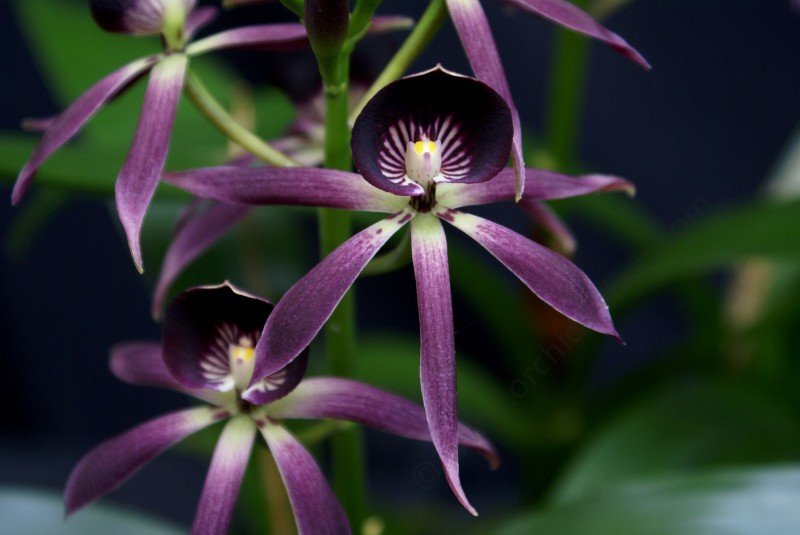
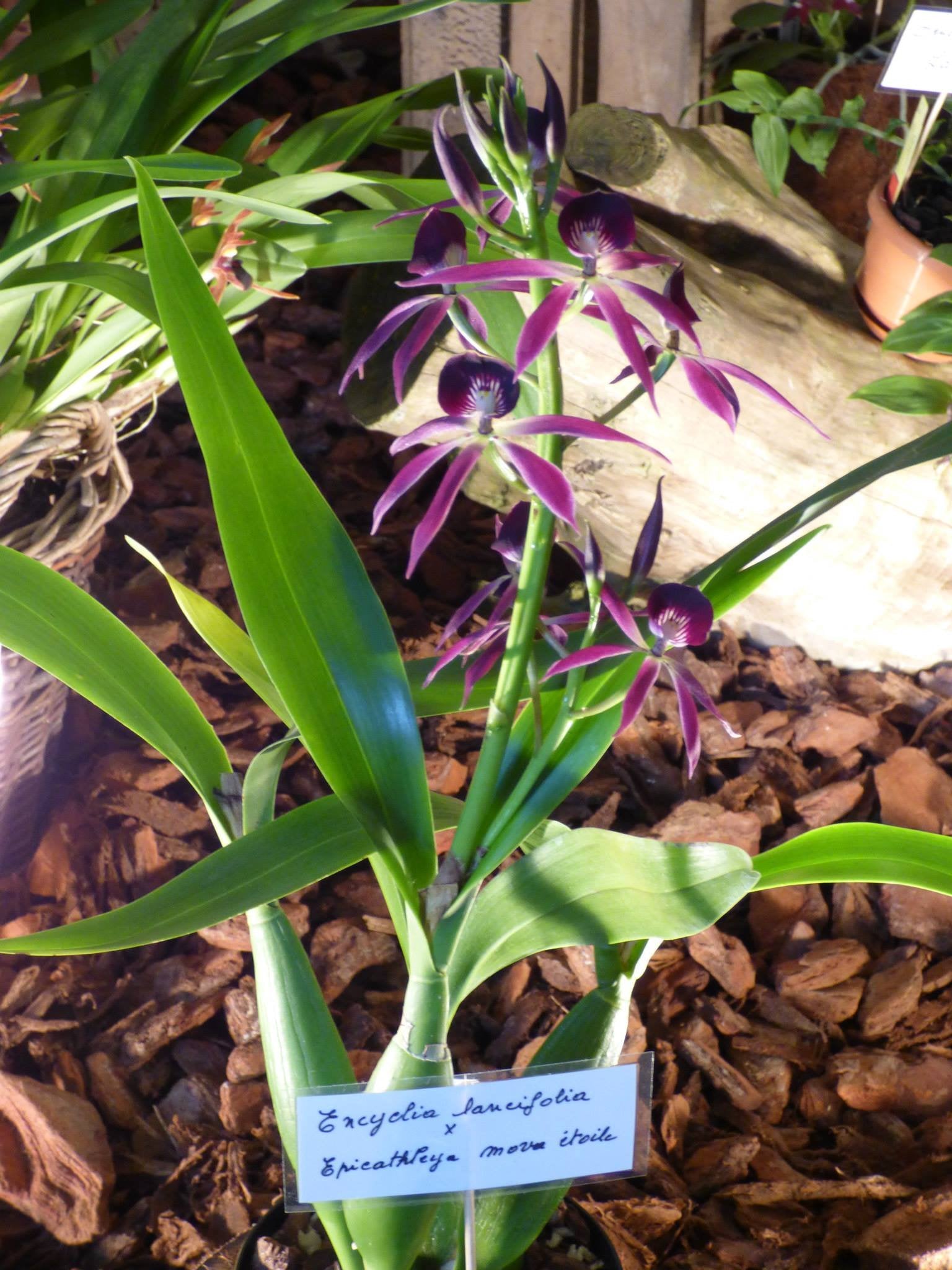
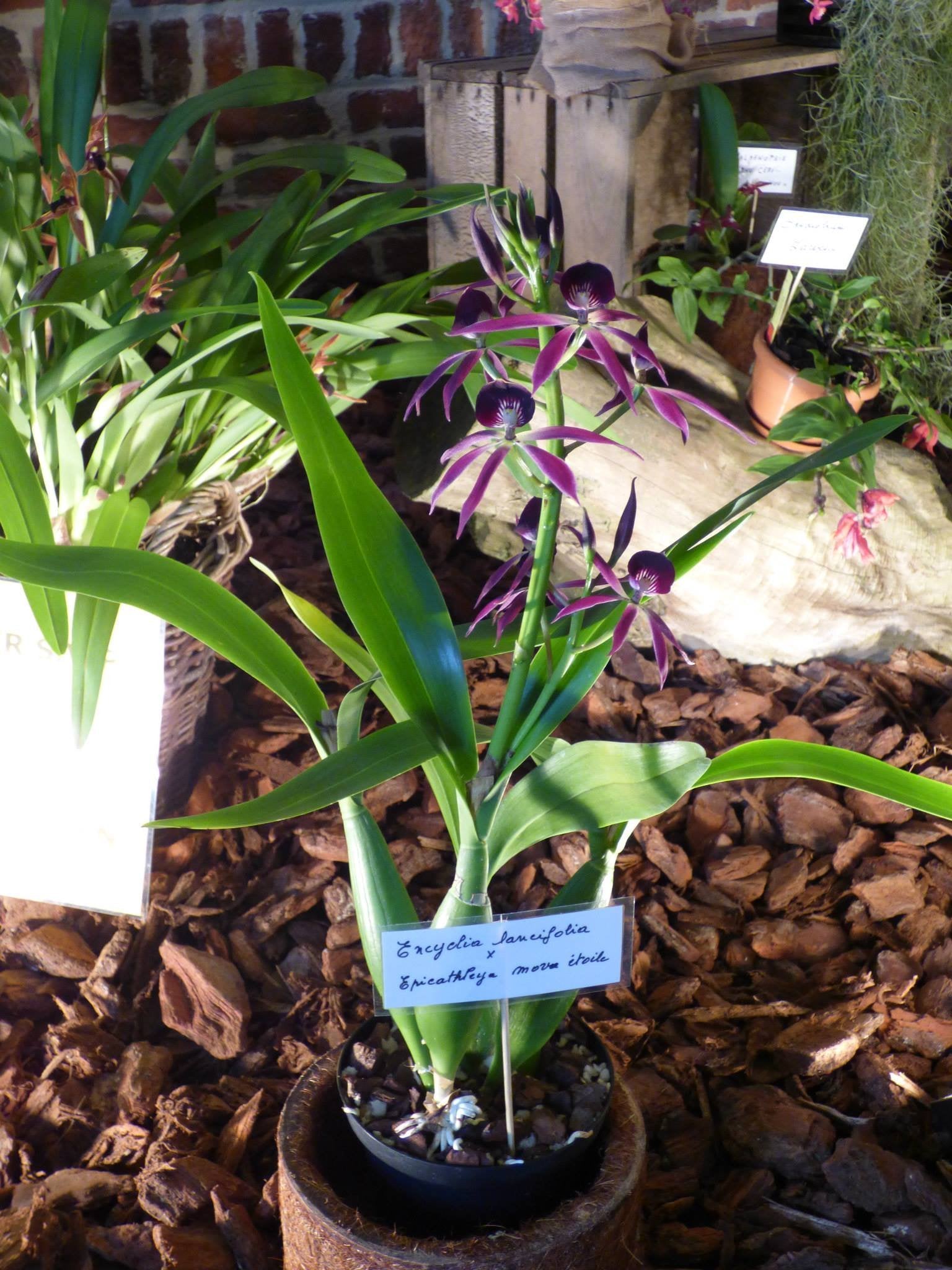
Encyclia lancifolia × Epicattleya Miva Etoile is a striking orchid hybrid with dark wine-red to nearly black-purple flowers. The narrow petals hang like arms around the prominent lip, giving the flowers the appearance of a small squid or octopus. They are also highly fragrant and can bloom one after another on the same flower spike for an extended period.
The combination of the unique flower shape, deep color, and distinct fragrance makes this orchid appealing to collectors seeking something different from a classic large-flowered Cattleya. The plant itself remains relatively compact, although the flower spikes may extend well above the foliage.
Name and Taxonomy
The plant is marketed as Encyclia lancifolia × Epicattleya Miva Etoile. However, due to various botanical reclassifications, both names are now obsolete.
Encyclia lancifolia is now considered a synonym of Prosthechea cochleata. The other parent, Epicattleya Miva Etoile Noire, is also classified under the modern name Guarechea Miva Etoile Noire. This parent, in turn, is a primary hybrid between Guarianthe bowringiana and Prosthechea cochleata.
The complete cross is registered as Guarechea Black Comet. As a result, approximately three-quarters of its genetic background consists of Prosthechea cochleata and one-quarter of Guarianthe bowringiana. This explains both the characteristic squid-like flower shape and the dark purple coloration.
Since many enthusiasts and growers still use the older name, Encyclia lancifolia × Epicattleya Miva Etoile remains an important search and trade name.
Origin
This is a man-made orchid hybrid and therefore has no natural range of its own. Its parents are native to the tropical regions of North, Central, and South America.
Prosthechea cochleata grows from southern Florida and the Caribbean through Mexico and Central America to northern South America. There, the species grows primarily as an epiphyte on trees. Guarianthe bowringiana occurs naturally from southern Mexico to Honduras and grows, among other places, on rocks and in sunny locations in humid tropical regions.
In terms of care, this background means that the hybrid prefers a sunny location, warm to moderate temperatures, and regular watering. At the same time, the roots must receive sufficient air and be allowed to dry out slightly between waterings.
Characteristics
The plant grows sympodially and forms sturdy, flattened to somewhat spindle-shaped pseudobulbs. One or more elongated, leathery leaves emerge from the top of each mature pseudobulb. New shoots develop from the base of older pseudobulbs, causing the plant to gradually spread across the pot.
The flower stalk emerges from the top of a mature pseudobulb. Several flowers may open one after another on this stalk. The flowers are typically a dark wine-red, reddish-purple, or nearly blackish-purple color. How dark they actually appear depends on the individual plant, the age of the flower, and the lighting conditions. In bright daylight, more reddish-purple hues usually become visible, while in indirect light the flowers can appear almost black.
A characteristic feature is the non-resupinate flower form. As a result, the striking lip is positioned at the top rather than at the bottom of the flower. The narrower sepals and petals hang below it, giving the flower its typical squid-like appearance.
The scent is also an important part of the plant’s appeal. It can be particularly noticeable during the day and at slightly warmer temperatures. The exact intensity and scent perception may vary by plant and flowering stage.
Care
This hybrid is generally easier to care for than its specialized appearance might suggest. It combines the vigor of Prosthechea cochleata with the color and profusion of blooms characteristic of Guarianthe bowringiana. This makes it an excellent choice for enthusiasts looking to make the transition from standard living-room orchids to botanically striking Cattleya relatives.
The most important considerations are sufficient light, a well-aerated growing medium, and watering that matches the plant’s active growth phase. A location that is too dark often results in healthy leaves but few or no flowers. Conversely, a constantly wet growing medium can damage the roots.
Light
Provide this orchid with plenty of bright, filtered light. A light level suitable for Cattleya orchids is a good starting point. Direct morning or evening sun is generally well tolerated and helps the pseudobulbs mature firmly. However, on hot summer days, protect the leaves from intense midday sun through a window.
With sufficient light, the leaves remain medium green and compact, sturdy pseudobulbs develop. A slight reddish-purple discoloration may be normal under strong lighting. If, on the other hand, the leaves become very dark green and elongated, the plant is likely too dark to bloom reliably.
An east- or west-facing window is often suitable. If the window faces south, light shading during the hottest hours is advisable. Under plant grow lights, the orchid can be placed relatively close to the light source, provided the leaves do not overheat.
Temperature
A warm to moderate growing environment suits this hybrid best. During the day, temperatures of about 20 to 28 °C are suitable, while at night the temperature may drop to approximately 15 to 19 °C. This difference between day and night supports the maturation of new pseudobulbs and can stimulate flower bud formation.
The plant can tolerate temporarily higher temperatures, provided there is air circulation and the roots do not dry out completely. At temperatures above 30 °C, special attention should be paid to ventilation and humidity. Prolonged exposure to cold and wet conditions is more harmful than a brief period of warmth.
Substrate and Cultivation Method
An airy epiphytic growing medium is important. A mixture of medium-sized orchid bark with pumice, perlite, or charcoal provides the roots with sufficient oxygen and does not remain wet for too long. A small amount of moisture-retaining material can be added if the plant is kept in a warm, dry living room, but the growing medium must never become compacted.
The mature plant offered here is in a 12-centimeter pot. When repotting, do not choose a pot that is much larger, as too much growing medium will dry out too slowly around the limited root system. Ensure there is only enough space for one or two new growth directions.
Prosthechea-like roots are sensitive to old, decomposed substrate and to unnecessary disturbance. Therefore, it is best to repot when new root tips appear at the base of a young shoot. At that point, the plant can establish itself most quickly in the fresh substrate.
Place the base of the pseudobulbs on or just above the substrate. If young shoots are planted too deeply, water can easily pool around the growth points.
Humidity
A humidity level between approximately 50 and 70 percent is generally sufficient. In a warm greenhouse or plant room, this level may be higher, as long as there is a constant, gentle air current.
In a normal living room, extremely high humidity is not necessary. An open arrangement with good ventilation is actually safer than a closed, constantly humid space. Do not place the plant too close to other plants if the leaves and young shoots remain wet for a long time after watering.
Watering
Water generously during the development of new shoots and roots. Moisten the entire growing medium thoroughly and then allow excess water to drain away completely. Wait until the mixture has mostly dried out before watering again. The pseudobulbs should remain firm and not become severely wrinkled.
Once the new pseudobulbs are fully grown, watering can be reduced slightly. However, the plant does not require a strict, completely dry dormant period. Especially when a flower stalk is actively growing, it is important not to let the plant dry out for extended periods.
During the dark winter months, the growing medium dries out more slowly, so less water is needed. Therefore, check the pot rather than following a fixed weekly schedule. Preferably use soft water and water in the morning so that young shoots and leaf axils can dry out before nightfall.
Fertilization
During active growth, a diluted orchid fertilizer can be applied regularly. A quarter to half the recommended dose once every one to two weeks is usually sufficient. When the plant is barely growing in winter, fertilization can be reduced.
Rinse the growing medium with clean water from time to time to remove accumulated fertilizer salts. This is especially important with hard tap water, as the delicate, active root tips can be sensitive to excessively high salt concentrations.
Flowering
One of the most attractive features of this hybrid is its long-lasting, successive flowering. The flowers do not necessarily all open at the same time. Instead, the flower stalk at the top can continue to grow and form new buds over several weeks or even months.
Therefore, do not cut off a green flower stalk after the first flowers have faded. As long as the tip remains green and alive, the stalk can continue to grow. Do not remove it until it has turned completely brown and dry.
Under European conditions, the flowering period can occur in the spring, summer, or fall. In a stable, well-lit greenhouse or grow room, the plant can also bloom at other times. Furthermore, a mature plant with multiple fully developed pseudobulbs can produce several flower stalks, significantly extending the total flowering period.
Flower color can vary within this hybrid. Some specimens bloom dark wine-red, while others appear deep purplish-brown to nearly black. The width of the lip and the length of the pendulous flower parts may also vary slightly.
Care Level
This orchid has a moderate care requirement but is relatively forgiving compared to other more unusual orchid hybrids. With sufficient light and a well-aerated growing medium, the plant is also suitable for an enthusiast who already has some experience with Phalaenopsis or Cattleya and wants to try something a little more unusual.
The specimens offered are mature and therefore developed enough to bloom under suitable conditions. The plants were recently imported, have been acclimated here, and are showing active root growth. Therefore, after receiving the plant, first provide it with a stable location. Repot only when the growing medium truly warrants it or when new root growth has clearly begun.
Depending on the variety chosen, the plant will be delivered as Blooming or non-Blooming. A non-Blooming specimen may, after transitioning to a new environment, first direct its energy toward roots and new shoots before a new flower stalk appears.
Who is this plant suitable for?
This hybrid is particularly well-suited for enthusiasts of dark-colored, fragrant orchids and for collectors who appreciate unusual flower shapes. The nearly black color and squid-like flowers make the plant striking without requiring an enormous orchid.
It’s also an interesting choice for anyone who values prolonged blooming over a single, short, massive flowering peak. Because new flowers can appear successively on the same stem, the plant often remains attractive for an extended period.
Those looking exclusively for large, round Cattleya flowers may find this hybrid too unconventional. It’s also less suitable for a dark windowsill, as the chances of flowering decrease significantly without sufficient light. For a well-lit home, sunroom, or greenhouse, however, it is a robust and relatively easy-to-care-for collector’s plant.
Experience growing it indoors or in a greenhouse
Indoors, the plant does best when placed close to a bright window. Keep in mind the flower spike, which can grow significantly taller than the compact plant body. A light support prevents a long spike from bending over or resting against the window.
In a greenhouse, the plant can be placed among warm- to temperate-climate Cattleya and Prosthechea species. There, it benefits from plenty of filtered light, higher humidity, and good air circulation. As a result, mature plants can produce several sturdy new shoots each year.
This hybrid is less suitable for a traditional enclosed terrarium. The size of the mature plant, the longer flower stalks, and the need for a root zone that dries out periodically are better suited to an open planting area, a sunroom, or a well-ventilated greenhouse.
Additional care tip
Always leave a spent but still green flower stalk attached to the plant. It is precisely the plant’s ability to continue extending the stalk and successively open new flowers that ensures this hybrid’s long blooming period.
At the same time, keep an eye on the base of new shoots. As soon as fresh green or white root tips appear there, the most important growth phase begins. That is the right time to water and fertilize more regularly and, if necessary, repot the plant.
Brief Product Description
Encyclia lancifolia × Epicattleya Miva Etoile, now registered as Guarechea Black Comet, is a mature orchid hybrid with fragrant, dark wine-red to nearly black-purple flowers. The squid-like flowers can bloom for an extended period, one after another, on the same flower spike. A unique yet relatively easy-to-care-for choice for a bright windowsill, sunroom, or greenhouse.