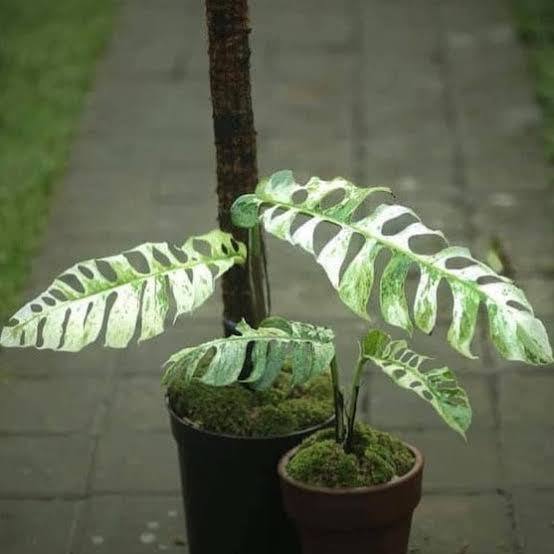
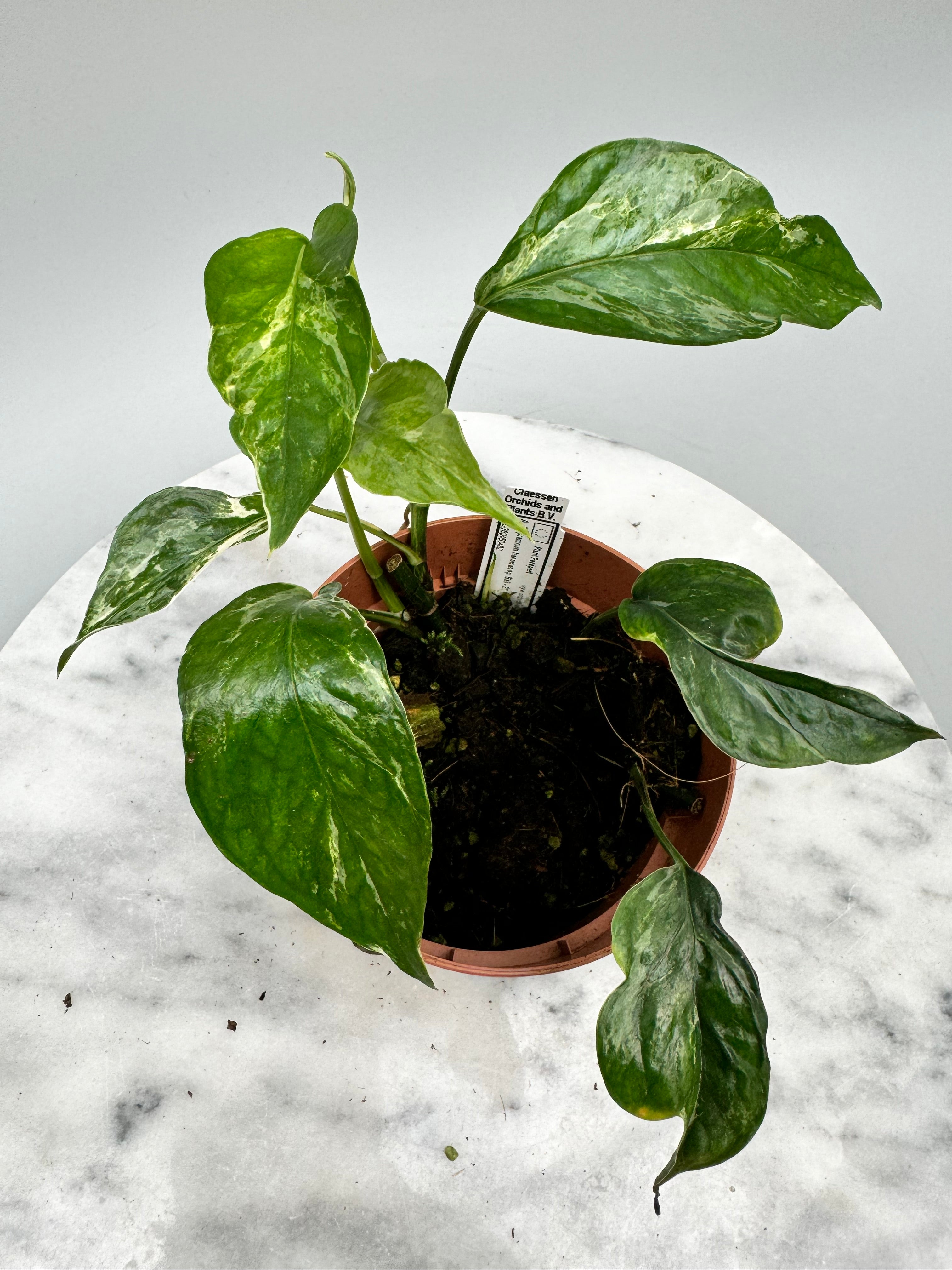
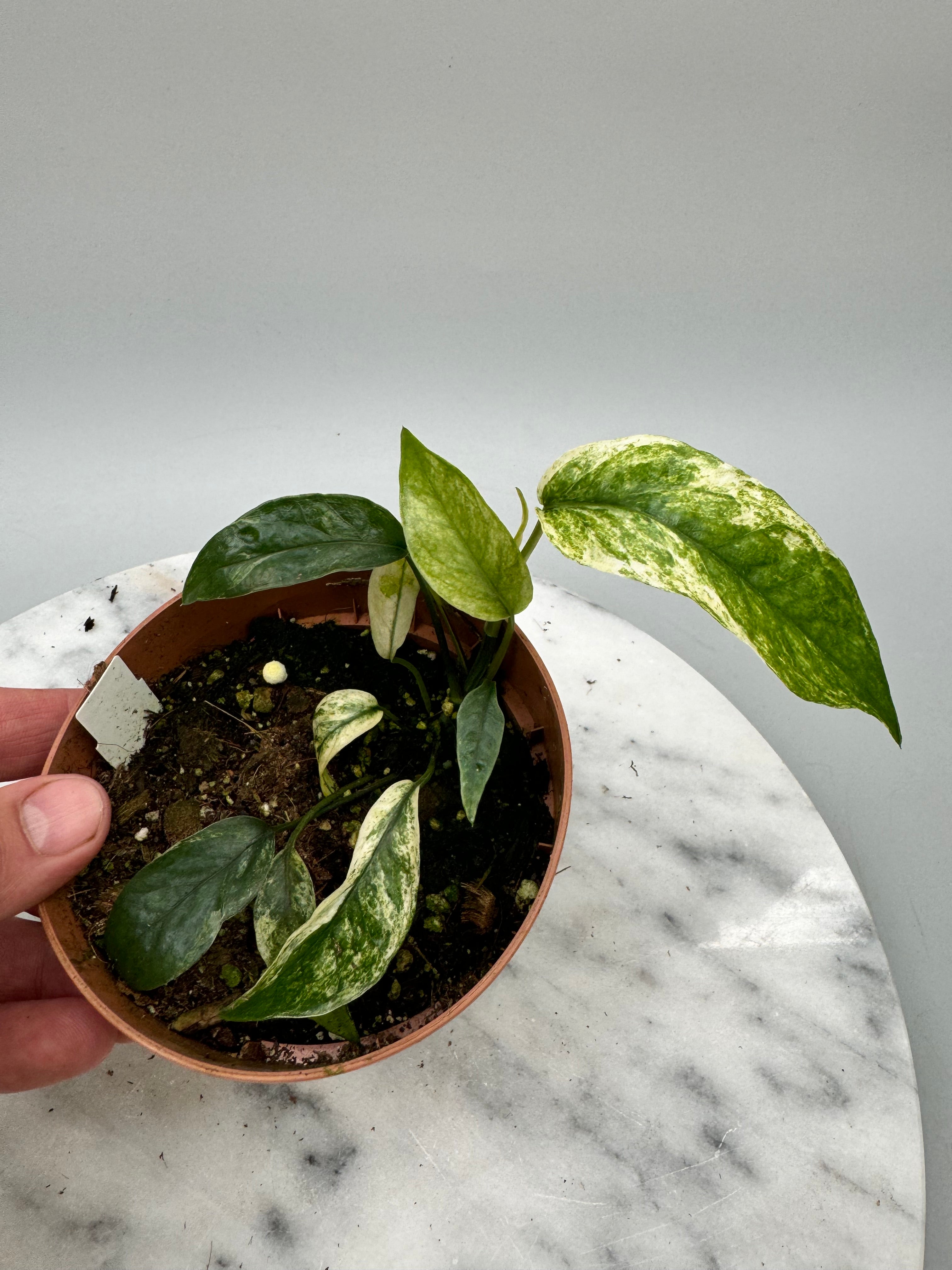
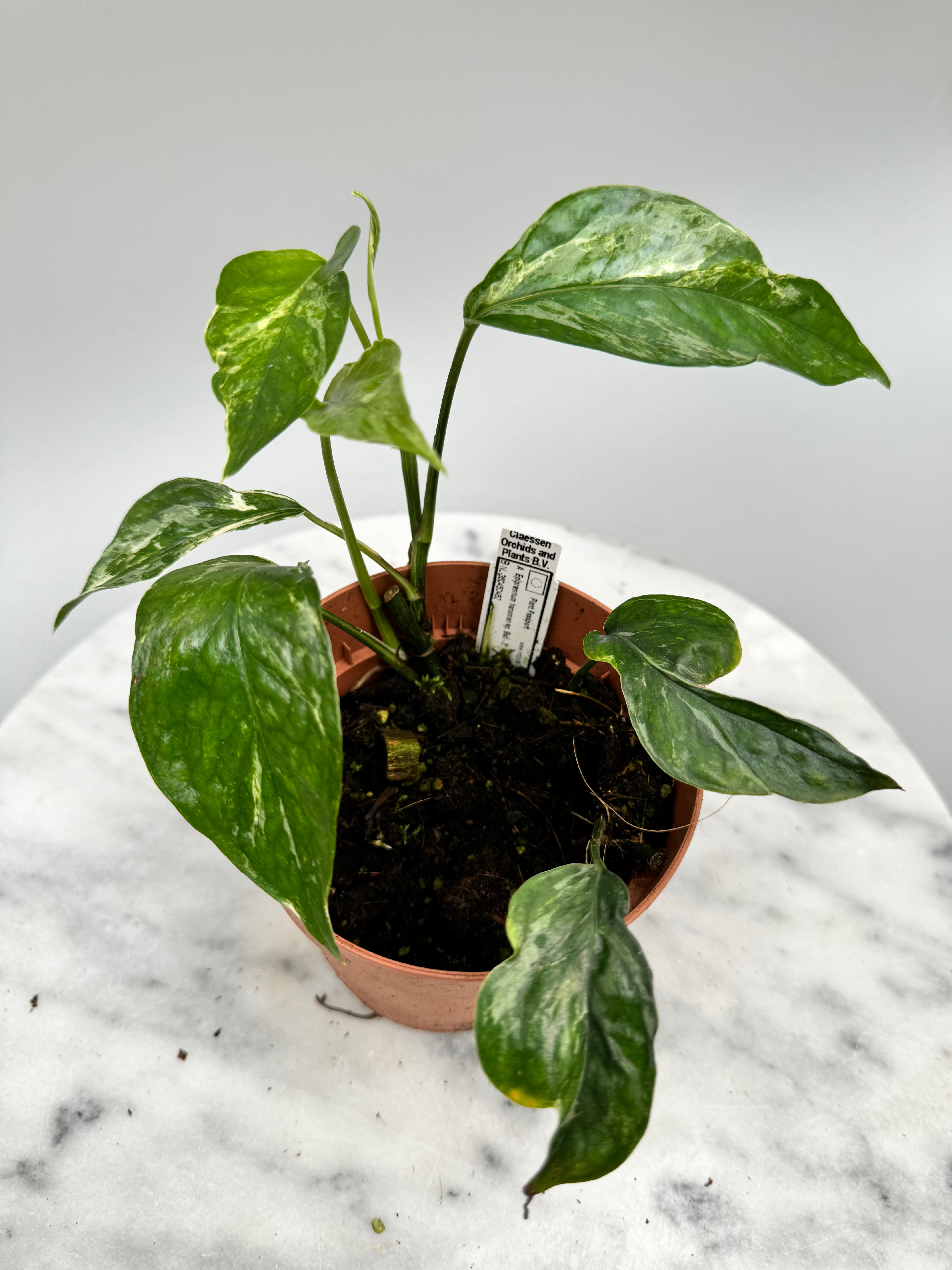
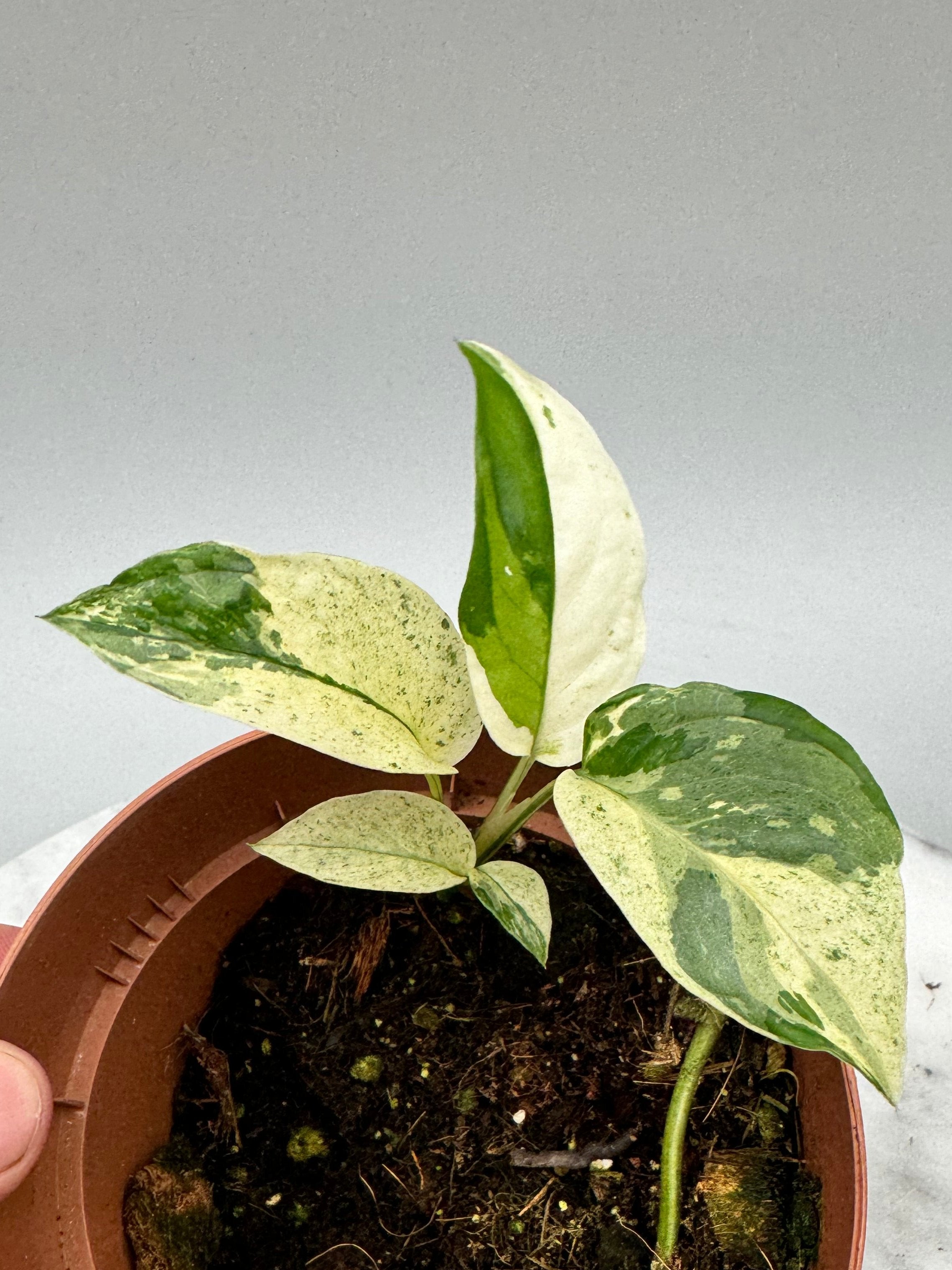
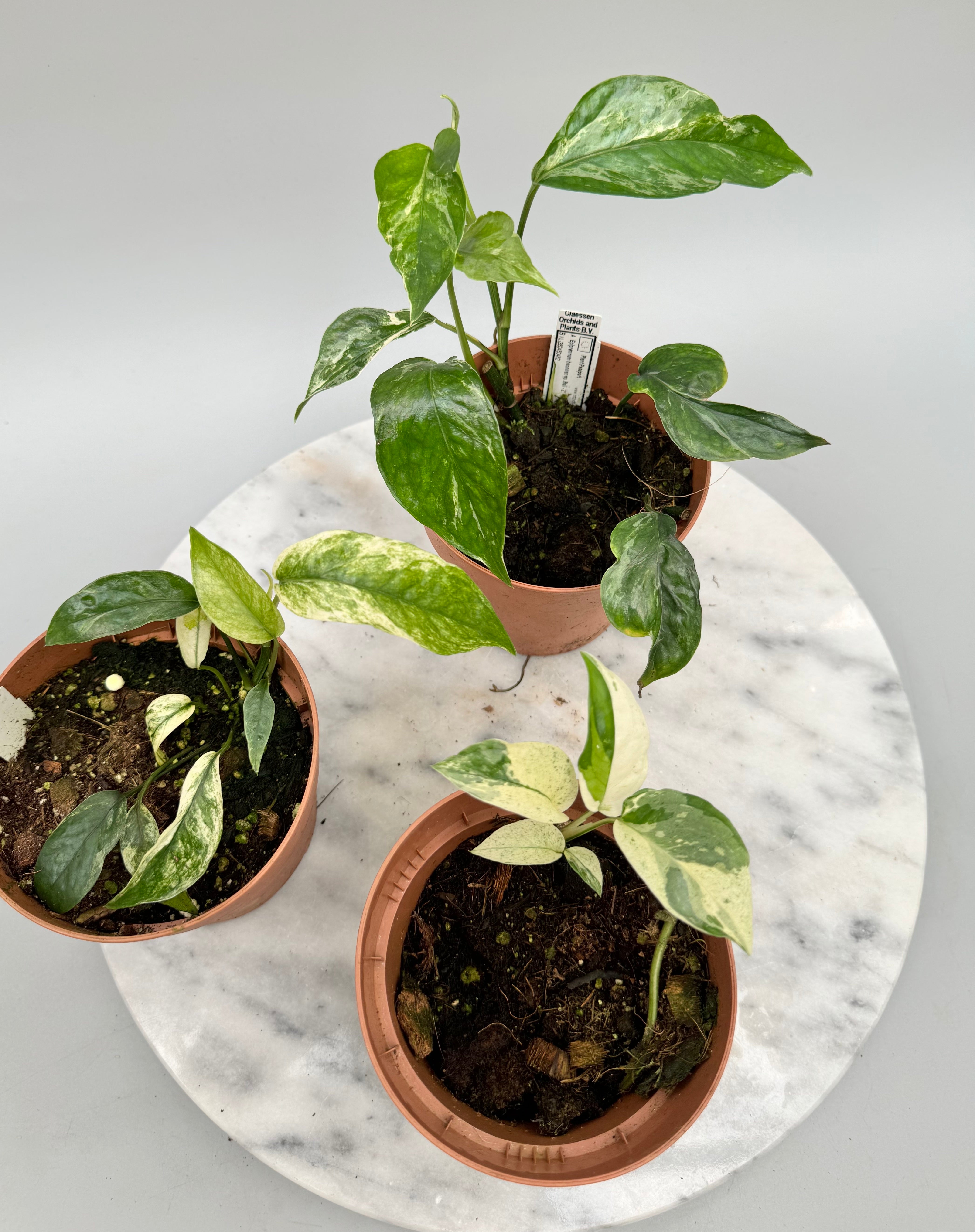
Epipremnum sp. “Bali Hanoman” is a unique climbing aroid that is primarily collected for its white-green marbled leaves and striking development as the plant matures. Young specimens still have relatively compact, sparsely lobed leaves. Once the plant is able to climb upward and gain a firm hold with its aerial roots, the new leaves can become increasingly longer and more mature in shape.
As a result, ‘Bali Hanoman’ is not a plant that reveals its full character on day one. It is precisely the transition from a young vine to a sturdy climbing specimen with larger, sometimes lobed leaves that constitutes a significant part of its collector’s value. Furthermore, each leaf has a unique pattern, meaning the ratio of dark green, light green, cream, and white can vary from plant to plant and from one growth stage to the next.
Name and Taxonomy
The correct commercial designation is Epipremnum sp. “Bali Hanoman”. The abbreviation sp. is used when a plant can be linked to the genus Epipremnum, but the exact species has not yet been formally determined. “Bali Hanoman” is therefore not an officially published botanical species name.
In the plant trade, this form is sometimes offered as Epipremnum pinnatum ‘Bali Hanoman’. However, there is currently insufficient taxonomic evidence to support this. Although the mature leaves may develop characteristics reminiscent of E. pinnatum, it is botanically more prudent to provisionally classify the plant as Epipremnum sp. “Bali Hanoman.”
Origin
The name “Bali Hanoman” refers to Bali, and the name Hanoman, the Balinese and Javanese form of Hanuman. However, because this plant has not been formally described botanically, its original natural range cannot be determined with the same certainty as that of an accepted wild species. It is therefore wiser to treat “Bali” as part of the trade name and not automatically as a scientifically proven region of origin.
What is clear, however, is that the plant exhibits the typical growth behavior of a tropical climbing aroid. At each node, the vine produces aerial roots that allow it to attach itself to trunks and other moist surfaces. Once these roots establish a lasting connection with a suitable climbing support, the growth typically changes from a thin, exploratory vine to a more robust mature form.
Characteristics
Young leaves are generally heart-shaped to elongated and have smooth leaf margins. The pattern consists of irregular clouds, speckles, and marbled zones in various shades of green, cream, and white. Some leaves are predominantly green with light marbling, while others may develop significantly more light-colored areas. Since these are living plants, the sample photo is therefore not a guarantee of the exact pattern on every leaf delivered.
As the plant matures, the leaves may become longer, narrower, and noticeably larger. In a well-climbing specimen, notches and localized openings may also develop in the leaves. However, this is not caused solely by age. Sufficient light, warmth, nutrients, and—above all—good contact between the aerial roots and a climbing support also play an important role.
The specimen offered is in a 10-centimeter pot and is in a Adolescent growth stage. Therefore, expect a young plant that has yet to fully develop its mature leaf shape. The eventual leaves and tendrils may grow much larger than the current Potsize suggests.
Care
Epipremnum sp. ‘Bali Hanoman’ is hardier than its rare appearance might suggest. However, achieving beautiful mature growth requires more than just keeping the plant alive. For larger leaves, short distances between leaf nodes, and balanced variegation, bright light, a well-aerated growing medium, and a good climbing support are especially important.
If you let the plant hang without support, you’ll typically get longer tendrils with smaller leaves that remain juvenile for longer. While this can be decorative, it doesn’t fully showcase the ultimate leaf development for which this selection is cultivated.
Light
Place the plant in bright, indirect light. An east- or west-facing window is usually suitable, while a south-facing window may require some protection from the intense midday sun. Gentle morning or evening sun is generally well tolerated, provided the plant is gradually acclimated to it.
Sufficient light supports the growth of the green leaf tissue and prevents the stem from developing excessively long sections between the leaves. However, additional light cannot force white variegation; the exact pattern is determined within the plant itself. Light primarily helps the existing variegation to develop beautifully and compactly.
Excessively bright sunlight can damage the cream and white parts relatively quickly, as they contain little to no protective chlorophyll. On the other hand, a dark location often leads to slower growth, smaller leaves, and less pronounced variegation.
Temperature
A temperature between approximately 20 and 28 °C is ideal. The plant grows most actively when conditions remain warm and stable for extended periods. The temperature may drop slightly at night, but try to avoid temperatures below 15 °C.
Cold drafts can cause young plants in particular to stop growing, turn yellow, or damage new leaves that are still unfolding. Therefore, do not place the plant directly next to an exterior door or against cold window glass. In winter, a warm, well-lit location is more important than high humidity alone.
Potting Mix and Cultivation Method
Use an airy but somewhat moisture-retaining aroid mix. A combination of high-quality potting soil or coconut fiber with orchid bark, perlite, and possibly some pumice provides a good balance. The finer components retain sufficient moisture, while the coarser parts prevent the mix from becoming compacted around the roots.
A mixture made entirely of coarse bark can dry out too quickly in a warm living room. In contrast, regular compact potting soil often stays wet for too long, which can lead to oxygen deprivation and root rot. The right mixture feels moist after watering but remains visibly airy.
For the most vigorous foliage growth, it’s best to train the plant along a moss stake or another climbing support that allows for rooting. A dry coconut fiber stake does provide mechanical support, but a slightly moist moss stake gives the aerial roots more opportunity to actually grow into the stake. This sends a stronger signal to the plant that it should climb upward, allowing it to reach its full leaf size more quickly.
Humidity
A relative humidity of about 50 to 70 percent is ideal. This makes it easier for new leaves to unfurl and generally helps the light-colored parts of the leaves stay attractive longer. However, the plant can also adapt to a normal living space, as long as it is not placed directly next to a radiator or in a constant stream of dry air.
Higher humidity must always be accompanied by some ventilation. Stagnant, constantly moist air can promote mold growth around the leaf stalks, the climbing support, and the top layer of potting mix. Especially in a plant cabinet, a small fan is therefore more beneficial than striving for extremely high humidity.
Watering
Water again when the top two to four centimeters of the growing medium have mostly dried out. Then thoroughly wet the entire root ball and allow excess water to drain out of the pot. Never leave the inner pot standing in a layer of water for an extended period.
Do not base watering on a fixed weekly schedule. In a warm, bright environment with active growth, the plant consumes significantly more water than during dark winter weeks. Therefore, check both the top layer and the weight of the pot.
Wilted, dry leaves and a very light pot usually indicate dehydration. Yellow, soft leaves combined with a substrate that has been wet for a long time are more likely signs of overwatering or insufficient oxygen around the roots. Brown edges on the white parts of the leaves can also be caused by dry air, irregular watering, or a buildup of fertilizer.
Fertilization
During active growth, apply a diluted, balanced houseplant fertilizer about once every three to four weeks. Half the recommended dose is usually sufficient. This provides the plant with enough nutrients for larger leaves without quickly causing a high salt concentration around the roots.
During the dark winter months, you can reduce the frequency of feeding or skip it temporarily. Also, rinse the potting mix occasionally with plenty of clean water. The lighter-colored parts of the leaves, in particular, can be sensitive to damaged roots and an excessive buildup of nutrient salts.
Flowering
Under normal living room conditions, Epipremnum sp. ‘Bali Hanoman’ is grown almost exclusively for its foliage. Only very mature plants can develop an inflorescence under tropical conditions, consisting of a spike surrounded by a bract. However, flowering is not the plant’s primary ornamental feature and should not be expected in a houseplant.
The true beauty of this plant lies in the transition from small, young leaves to a mature, climbing growth form. For most collectors, the appearance of the first distinctly larger or lobed leaf is therefore more interesting than any potential inflorescence.
Care Level
The care level is easy to moderate. The plant is more forgiving than many rare Anthuriums or velvety-leaved Philodendrons and adapts well to a normal living space. Therefore, if you simply want to keep it healthy and growing, you do not need a specialized greenhouse.
Achieving the impressive mature leaf shape requires more attention. The plant must receive sufficient light, be able to climb actively, and maintain contact with the climbing support at each new node. Consistent watering is also important, as drought stress can permanently deform an unfurling leaf.
Who is this plant suitable for?
This plant is suitable for enthusiasts who enjoy watching a young climbing plant gradually transform. Collectors of unusual Epipremnums, Monstera, and other climbing aroids will particularly appreciate the combination of variegation and mature leaf development.
In addition, ‘Bali Hanoman’ is a good choice for anyone looking for a unique foliage plant without immediately bringing home the sensitivity of some exclusive greenhouse plants. On the other hand, anyone expecting large, fully lobed leaves right away should be prepared for a growth period. The Adolescent specimen offered here first needs to continue climbing and reach maturity.
Like other members of the arum family, the plant contains irritating calcium oxalate crystals. Therefore, keep it out of reach of children and pets that might chew on plants. The sap can also cause skin irritation.
Growing Experience Indoors, in a Greenhouse, or in a Plant Cabinet
Indoors, this Epipremnum grows well near a bright window, preferably with a vertical climbing support. Since the leaves can grow larger and larger with proper care, it’s wise to leave space above the plant from the start. Otherwise, a moss pole that’s too short will need to be extended quickly.
In a warm greenhouse or spacious plant cabinet, the plant will generally root more quickly and develop larger leaves more easily. Be sure to provide air circulation and do not let the root ball remain constantly wet. The plant is less suitable for a small terrarium, as the vine and leaves will eventually become too large. It can, however, be used in a large tropical display case, provided it is regularly trained or pruned.
Extra care tip
Don’t just place the vine against the moss pole; specifically position the side with the aerial roots toward the pole. Then, loosely secure the stem at the nodes and never tie a leaf stalk too tightly. When each new node makes contact with the moist climbing support, a much stronger root network develops, and the new leaves generally grow larger more quickly.
Short product description
Epipremnum sp. ‘Bali Hanoman’ is a unique climbing aroid with variegated white-and-green marbled leaves. As the plant climbs higher, the leaves can become longer, larger, and increasingly mature in shape. An accessible collector’s plant for enthusiasts who enjoy watching the leaves develop from juvenile to mature.