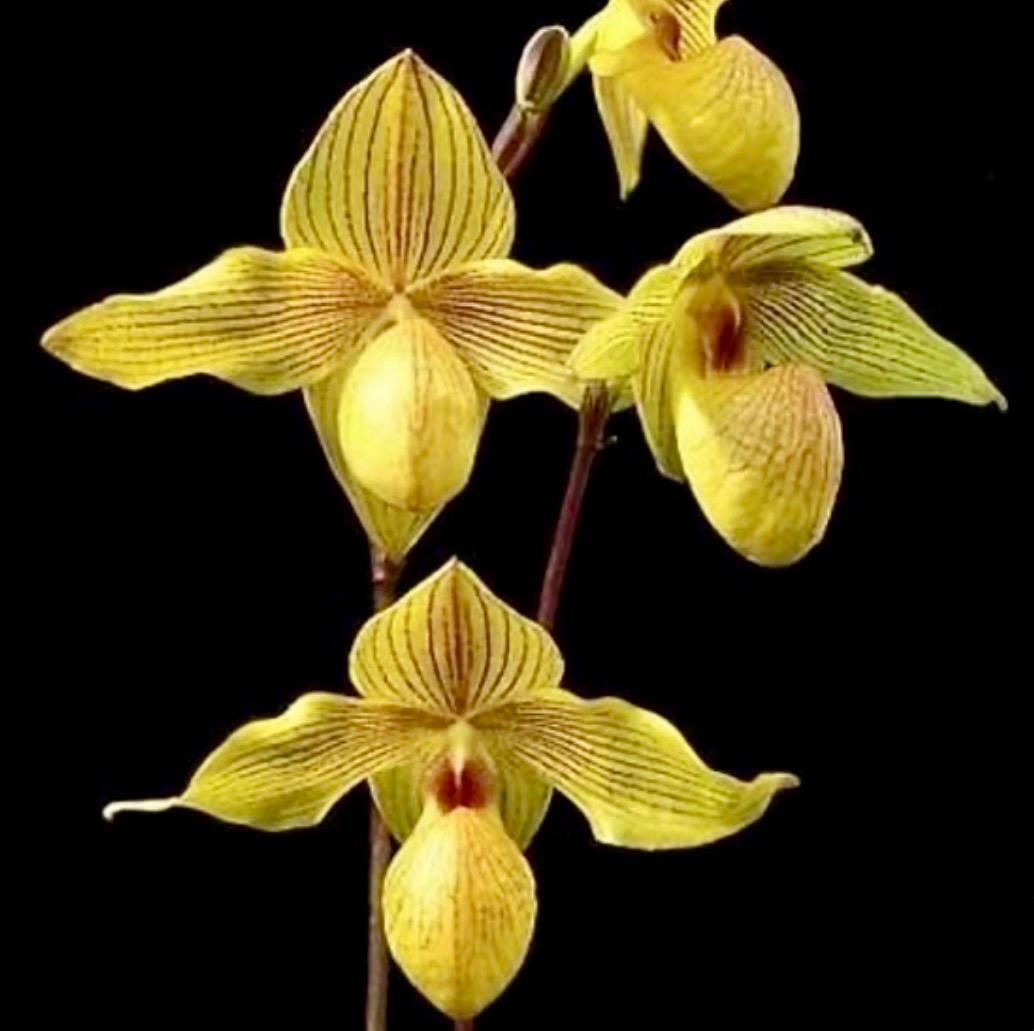
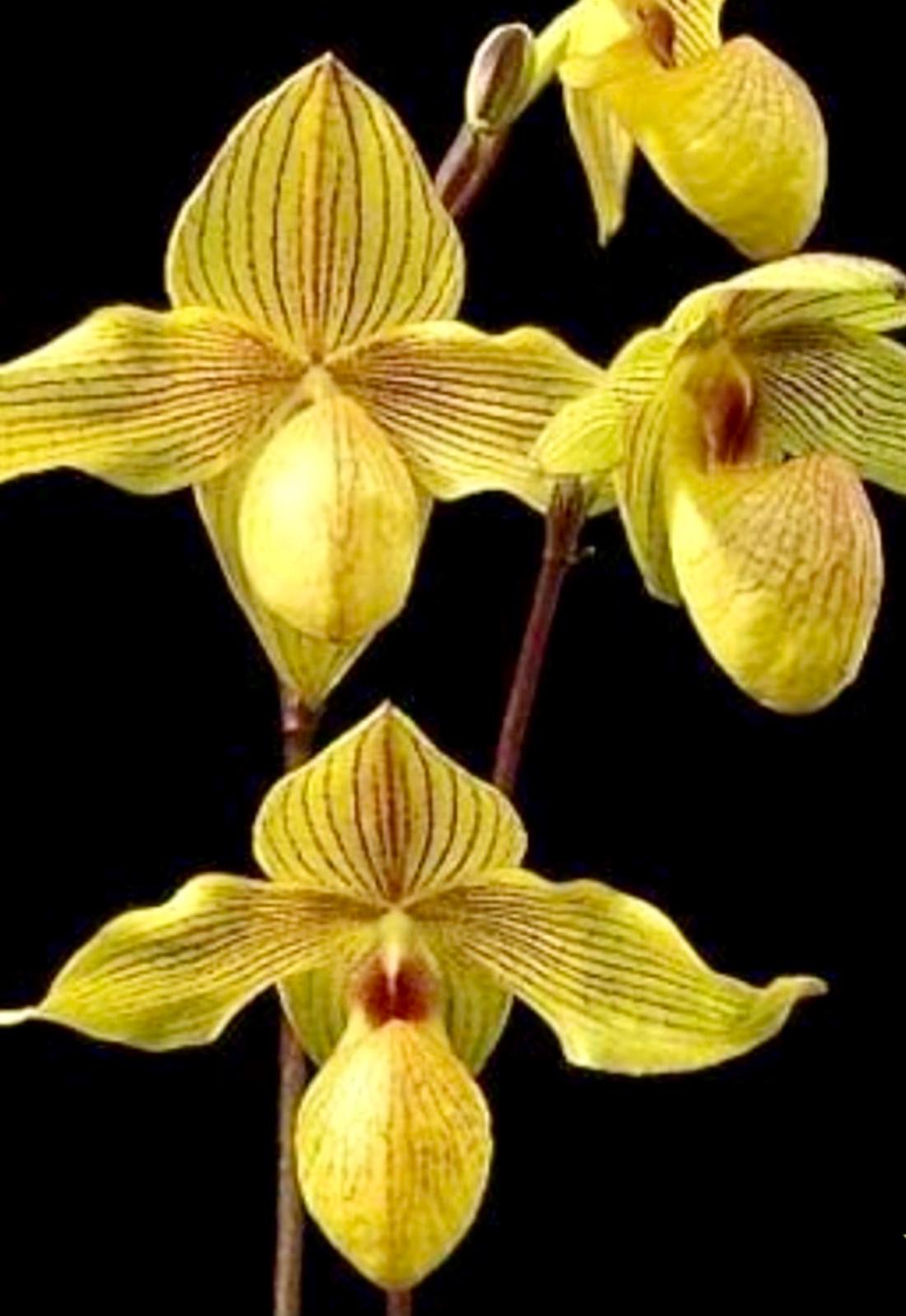
Paphiopedilum Memoria Rex VanDelden is a striking collector's hybrid in which the broad, striped flowers of Paphiopedilum Lady Isabel are combined with the golden-yellow color and marbled foliage of Paphiopedilum armeniacum. The result is a relatively compact Venus slipper with large yellow-green to golden-yellow flowers, fine mahogany-brown longitudinal stripes, and a full, pale yellow shoe-shaped lip.
It is precisely the combination of a Parvisepalum species with two famous multifloral Paphiopedilums that makes this hybrid botanically and visually interesting. Furthermore, a mature plant can produce multiple flowers per stem, while the foliage retains its decorative value even outside the blooming period.
Name and Parent Combination
The parent combination Paphiopedilum Lady Isabel × Paphiopedilum armeniacum has been officially registered since 2001 as Paphiopedilum Memoria Rex VanDelden. That is therefore the correct grex name for this plant.
Lady Isabel herself is a historic primary hybrid between Paphiopedilum rothschildianum and Paphiopedilum stonei, registered in 1897. Genetically, Memoria Rex VanDelden is therefore 50% Paphiopedilum armeniacum, 25% from Paphiopedilum rothschildianum, and 25% from Paphiopedilum stonei.
“Green Valley” is the clone name of the Armeniacum parent used. This name therefore does not describe the final seedling, but indicates which specific parent plant was used in this remake of the grex.
Origin
Paphiopedilum Memoria Rex VanDelden, as a hybrid, does not occur in nature. Nevertheless, the natural background of the three species is important for understanding their growth habits and care requirements.
Paphiopedilum armeniacum is native to Yunnan in southwestern China, where the species grows in humus-rich crevices on limestone slopes. The roots spread shallowly and horizontally through a thin layer of organic material. In addition, this species often produces stolons, which give rise to new growth points some distance from the mother plant.
Paphiopedilum rothschildianum and Paphiopedilum stonei are native to Borneo. Both species belong to the multifloral Paphiopedilums and bear their flowers on sturdy, upright stems. Lady Isabel therefore imparts to this hybrid larger flowers, darker markings, and the ability of mature plants to produce multiple flowers per stem.
Characteristics
The plant forms fan-shaped rosettes of sturdy leaves. Due to the influence of Paphiopedilum armeniacum, the leaves may display a light to distinct marbling pattern. The intensity of this pattern varies from plant to plant and often becomes more visible as new leaves grow under well-filtered light.
Although Memoria Rex VanDelden generally remains more compact than Lady Isabel, a well-developed plant may eventually become wider as it produces new shoots next to or at some distance from the old rosette. A growth point appearing at the edge of the pot is therefore not necessarily a sign that the plant is growing incorrectly. It may be a hereditary stolon-like growth habit.
Each mature rosette blooms once. Afterward, however, the old rosette remains important for storing water and nutrients, while new shoots emerge from the base. Therefore, do not remove older rosettes until they have completely died off.
The flowers can grow to be about 12 to 16 centimeters wide. During the first flowering, sometimes only one flower appears, while an older, stronger plant can bear two or three flowers per stem. In some seedlings, the yellow color also becomes deeper and warmer the longer the flower remains open.
Care
Due to the diverse backgrounds of its parents, this hybrid requires balanced care. On the one hand, the plant prefers consistent moisture during active growth, like its multifloral parents. On the other hand, it benefits from a cooler, slightly drier winter period, which is similar to Paphiopedilum armeniacum.
The goal is therefore not to put the plant into a strict dormant period. However, watering and fertilization should be reduced once growth has matured and the winter days grow shorter.
Light
Provide Paphiopedilum Memoria Rex VanDelden with bright, filtered light. About 12,000 to 20,000 lux is a good starting point. This means the plant receives more light than many standard marbled-leaf Paphiopedilums, but is still protected from direct midday sun.
Gentle morning or evening sun is usually well tolerated. However, hot sun through a window can quickly turn the leaves yellow-green or scorch them. If the plant is kept in a location that is too dark, the leaves will become long and limp, and a flower spike may fail to develop.
A healthy plant has firm leaves of a medium green color. A subtle lightening of the leaf color toward the end of summer is not necessarily a problem, as long as no sharp yellow or brown scorch marks appear.
Temperature
This hybrid grows best under moderate conditions. During the day, a temperature of about 20 to 26 °C is suitable, while at night the temperature should ideally drop to 14 to 18 °C.
On hot summer days, the temperature can temporarily rise toward 28 °C, provided the roots remain evenly moist and there is sufficient ventilation. However, prolonged heat without nighttime cooling can slow growth.
In the fall and winter, a period with nighttime temperatures around 12 to 15 °C can aid in flower bud formation. Nevertheless, this hybrid does not need to be grown in conditions as cold as those experienced by some high-altitude Armeniacum populations in the wild. Especially at lower temperatures, the growing medium must remain loose and be allowed to dry out slightly more.
Substrate and Cultivation Method
Use a fine- to medium-grained, airy Paphiopedilum growing medium that retains moisture evenly without becoming compacted. A combination of fine orchid bark, pumice, or perlite and a limited amount of loose sphagnum moss or coconut fiber works well.
Since all three species originate from areas with mineral or limestone influences, a small amount of dolomite lime, crushed shell, or limestone grit can be added to the mixture. This is especially helpful if you use only rainwater or reverse-osmosis water. However, add lime sparingly, as a high pH or an accumulation of minerals can also inhibit root growth.
Preferably choose a pot that is slightly wider than it is deep. This gives any horizontal shoots more room to grow. At the same time, the pot should not be unnecessarily large, because a large amount of wet substrate surrounding a small root ball can easily become oxygen-deprived.
The plants offered are in an 8-centimeter pot. That size may seem small for a mature Paphiopedilum, but Paphiopedilums often grow better in a relatively compact pot. The term “mature” refers to the stage of development and not to a large pot size or a fully grown perennial plant.
Humidity
A humidity level of approximately 55 to 75% is suitable. This allows this hybrid to be kept in a normal, not overly dry living space, although a greenhouse or well-ventilated plant cabinet provides more stable conditions.
Ventilation remains important, especially around the base of the rosettes. Stagnant, humid air can cause mold and rot. At the same time, a fan should not continuously blow harsh, dry air directly over the plant, as this can cause young leaves and root tips to dry out.
Do not mist the leaves daily. Water that pools deep between the young leaves can damage the central growing point.
Watering
Keep the growing medium evenly slightly moist during active growth. Water again when the top layer begins to dry out, but before the entire root ball becomes bone dry. Paphiopedilums do not have pseudobulbs and therefore have limited ability to store water.
After each watering, allow all excess water to drain out of the pot. A permanently wet saucer or decorative pot will quickly cause root problems.
In the fall and winter, allow the growing medium to dry out slightly more, especially when the plant is kept in a cooler location and is not producing new roots. However, this is not a strict, dry dormant period. Completely dried-out roots will recover, but slowly.
Preferably use rainwater, reverse-osmosis water, or other relatively soft water. If you use only water that is very low in minerals, calcium and magnesium must also remain available through fertilizer or a small amount of calcareous material.
Fertilizer
During active leaf and root growth, apply a low dose of orchid fertilizer about once every two to three waterings. A quarter to at most half of the recommended concentration is usually sufficient.
It is also important to rinse the substrate regularly, as Paphiopedilum roots are sensitive to accumulated fertilizer salts. Therefore, rinse the substrate thoroughly with clean water about once a month.
Once growth clearly slows down in the winter, you can reduce the amount of fertilizer. Resume more regular fertilization when fresh root tips or a new shoot become visible.
Flowering
Flowering can occur at various times of the year, but often falls between late winter and summer. The exact period depends on the development of the rosette, temperature fluctuations, and the origin of the parent plants used.
A first-time flowering seedling may produce a single large flower. As the plant becomes stronger, two or three flowers may develop on the same stem. The flowers do not always open at exactly the same time, which can extend the total flowering period.
The example flower has a yellow-green to golden-yellow base color with numerous mahogany-brown longitudinal stripes. The broad lateral petals clearly show the influence of Lady Isabel, while the round, pale yellow spathes and warm flower color refer to Paphiopedilum armeniacum.
Because this is a seedling cross, flower shape, number of flowers, color intensity, and stripe width may vary from plant to plant. The clone name ‘Green Valley’ refers to the armeniacum parent and therefore does not mean that all offspring will bloom identically.
Care Level
The care level is moderate to advanced. Although this hybrid is generally hardier than a pure Paphiopedilum armeniacum, it does not grow as easily as a standard commercial Paphiopedilum hybrid.
In particular, the combination of a well-aerated, calcareous substrate, consistent moisture, and a cooler winter requires some attention. Additionally, due to the influence of *armeniacum*, new shoots may appear at the pot’s edge or even outside the existing pot.
The plants are imported and may need to use their energy for root recovery upon arrival. Therefore, it is wise not to repot them immediately. It is best to wait until new root tips or a fresh shoot indicate that the plant is actively growing again.
Furthermore, a mature, non-flowering plant will not necessarily produce a flower stalk immediately after delivery. First, the roots must recover sufficiently, and a rosette must fully mature.
Who is this plant suitable for?
Paphiopedilum Memoria Rex VanDelden is particularly well-suited for collectors who appreciate the form of multifloral Paphiopedilums but are looking for a more compact plant, marbled leaves, and a distinct golden-yellow flower color. This hybrid is also of interest to enthusiasts of Paphiopedilum armeniacum, as it combines some of that species’ color and growth habit with the larger flower and potential for multiple blooms of Lady Isabel.
On the other hand, this plant is less suitable for someone looking for a low-maintenance windowsill orchid with predictable annual blooming. Although it can be grown indoors, the plant requires ample light, a noticeable drop in temperature at night, and careful watering.
Experience growing indoors, in a greenhouse, or in a plant cabinet
Indoors, this Paphiopedilum thrives best near a bright east- or west-facing window in a room that cools down at night. A permanently warm spot above a radiator is less suitable. Additionally, there must be enough space above the leaves for the upright flower stalk.
A moderately warm greenhouse generally offers the best conditions. There, it is easier to maintain a balance of light, ventilation, humidity, and temperature fluctuations.
A spacious plant cabinet can also be suitable, as long as the temperature does not remain constantly high. In fact, a slightly cooler night can improve the chances of flowering. The plant should remain in its own pot so that the moisture content of the growing medium can be controlled.
Despite its potential stolon-like growth, this is not a trailing plant. A shoot that grows over the edge of the pot is looking for a new place to take root and should therefore be guided into a wider pot or an adjacent pot.
Additional Care Tip
If a new shoot appears at the tip of a horizontal runner, do not cut it off immediately. First, place a small pot filled with airy Paphiopedilum growing medium beneath the young growth. Once the shoot has formed its own roots and is firmly established, it can be separated from the mother plant if desired. This preserves its vigor and prevents a valuable new rosette from being left without roots.
Short product description
Paphiopedilum Memoria Rex VanDelden is the registered name for Lady Isabel × armeniacum ‘Green Valley’. This exceptional collector’s hybrid combines marbled foliage with large yellow-green to golden-yellow flowers, mahogany-brown longitudinal stripes, and a full, pale yellow spathe. Mature plants can produce two or three flowers per stem, while color and flower shape may vary from seedling to seedling.