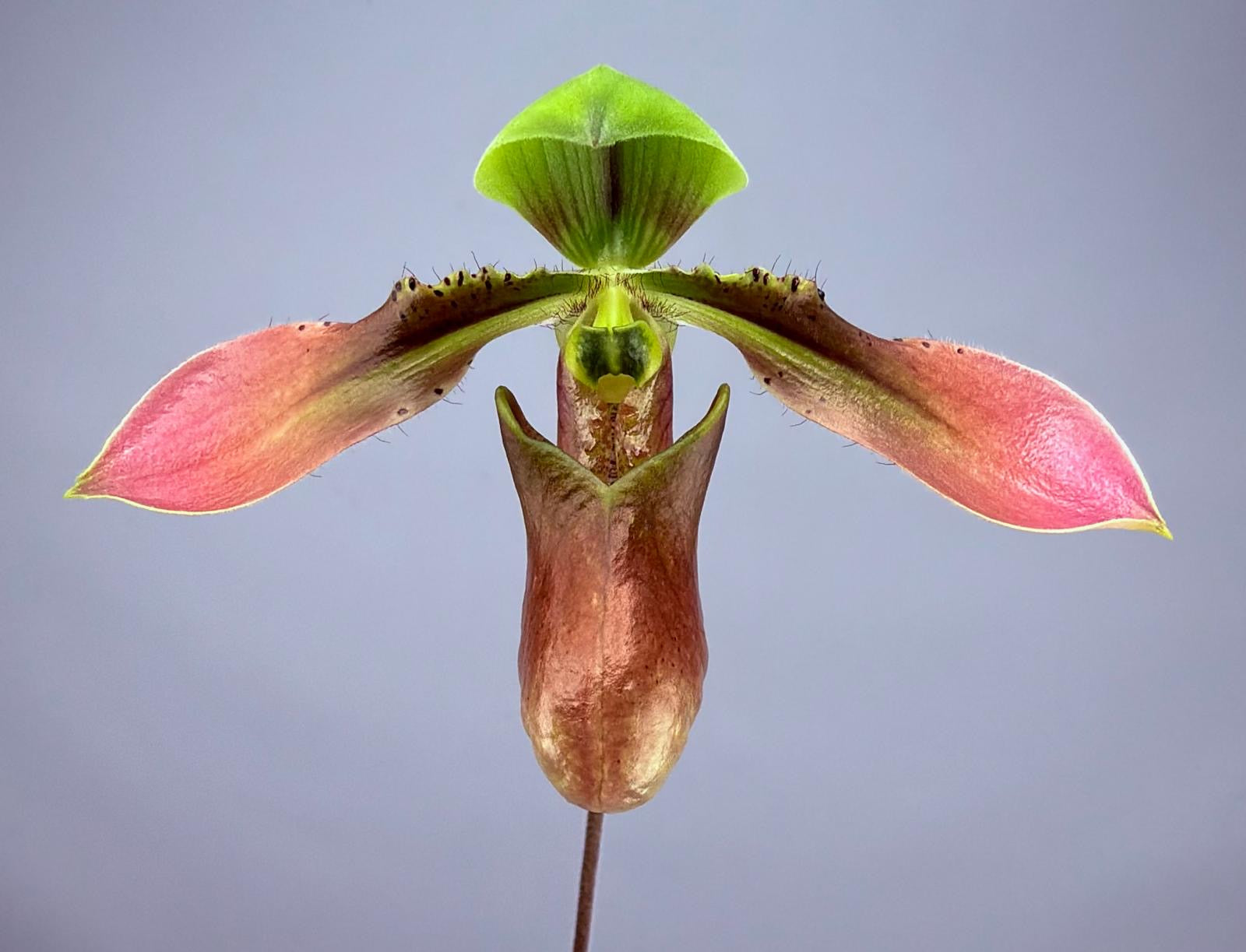
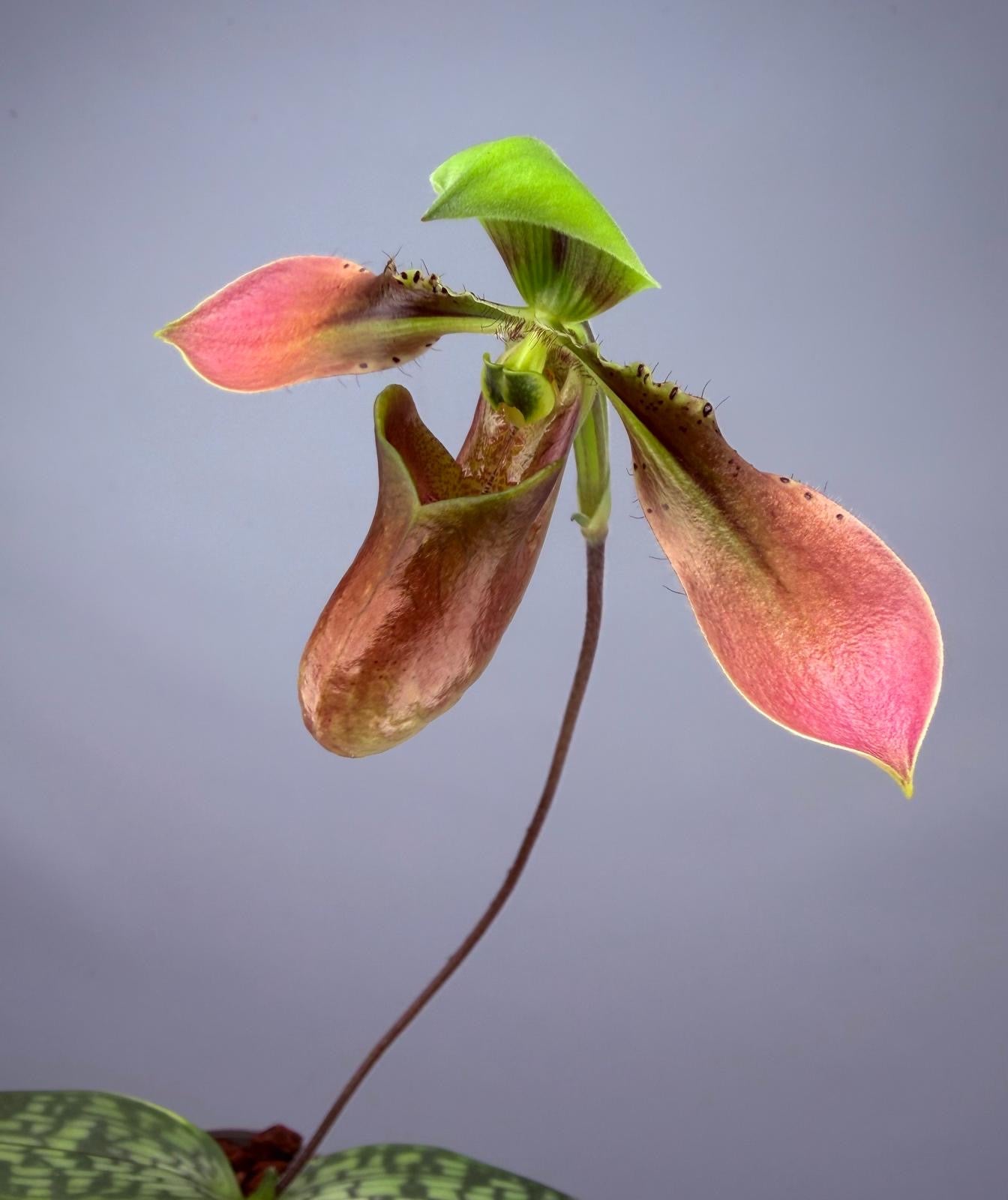
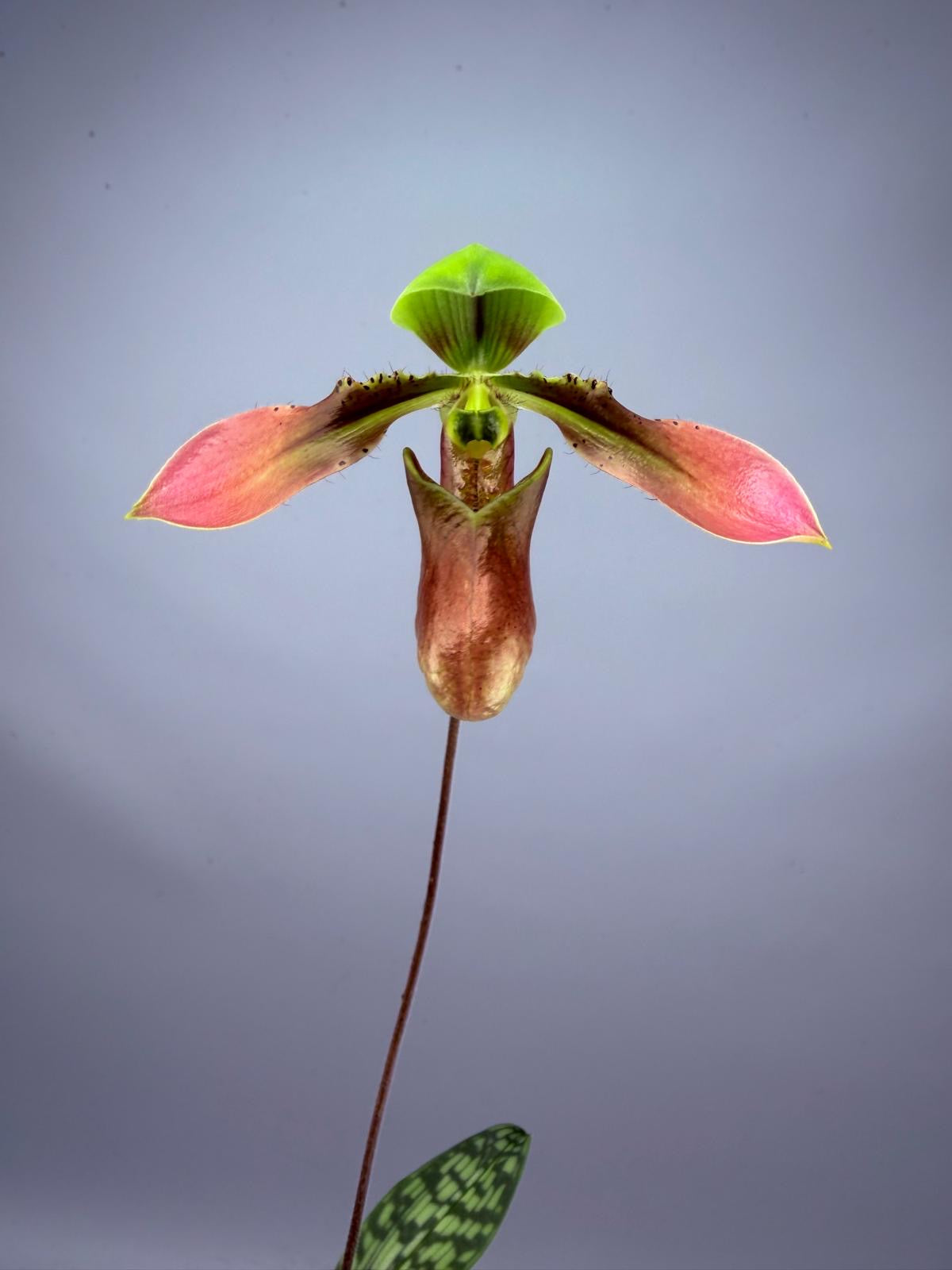
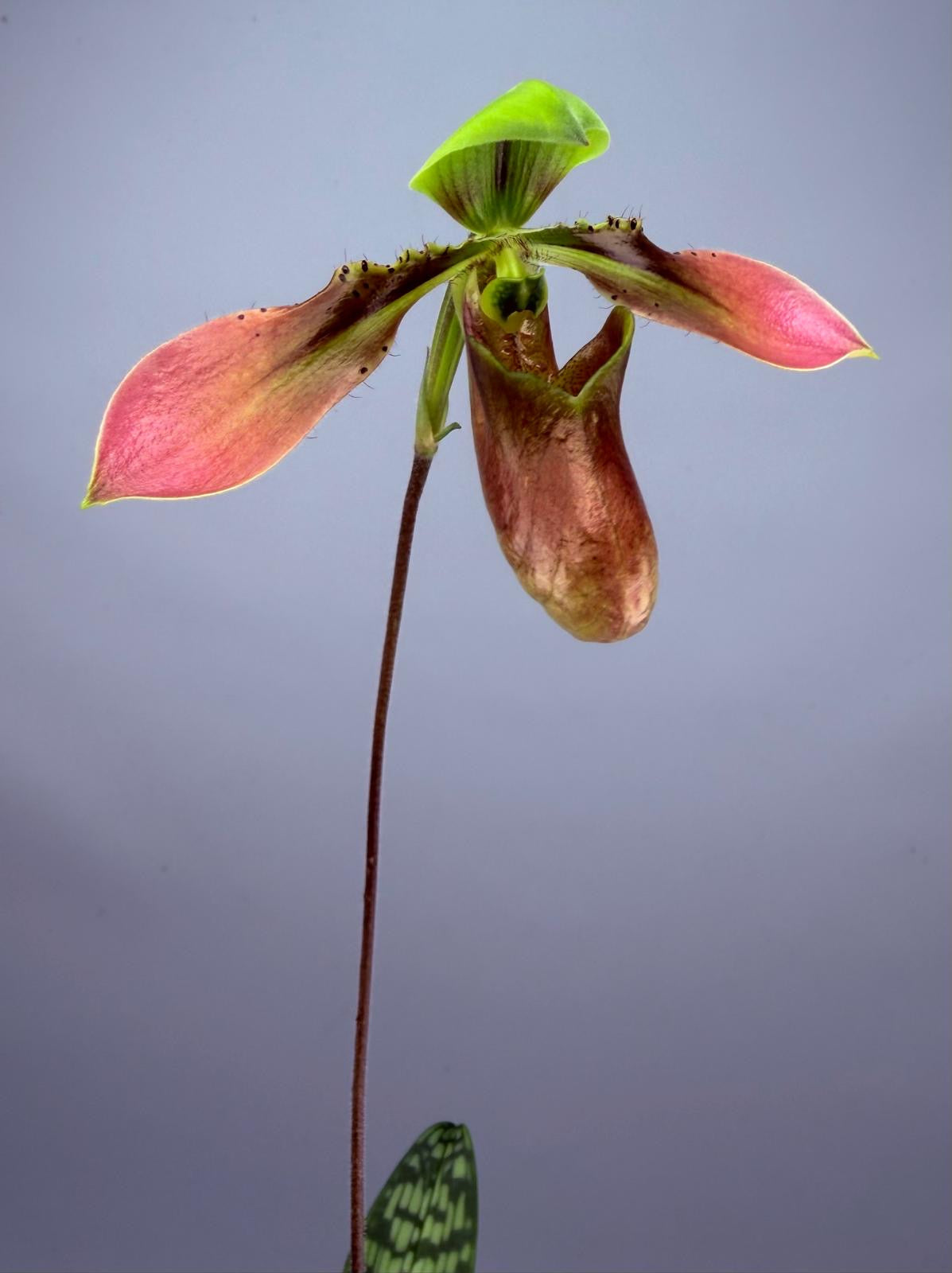
Paphiopedilum appletonianum is a compact botanical shoe orchid that remains attractive even outside its blooming season. The leaves form a low fan and are irregularly marked in various shades of green. Above them, on a mature shoot, a strikingly long, slender flower stalk emerges, usually bearing a single green-pink to purplish-brown slipper flower.
It is precisely the contrast between the subdued marbled foliage, the tall flower stalk, and the distinctive flower shape that gives this species its collector’s value. Moreover, the plant itself remains a manageable size and can thrive under normal living room conditions. This makes it appealing to both novice Paphiopedilum enthusiasts and collectors seeking a pure botanical species.
Name and Taxonomy
Paphiopedilum appletonianum (Gower) Rolfe is an accepted botanical species. The plant was initially described as Cypripedium appletonianum and placed in the genus Paphiopedilum in 1896. The species name refers to W.M. Appleton, who was one of the first in Europe to cultivate the plant.
This species has a complex taxonomic history. Names such as Paphiopedilum hainanense, P. cerveranum, and P. tridentatum have been used in the past to refer to distinct populations or forms, but are now often classified under the broader P. appletonianum. Since this product is not marketed as a specific geographic form, the neutral species name Paphiopedilum appletonianum is the most appropriate here.
Origin
The species occurs from southwestern China to Vietnam, Laos, Cambodia, and Thailand. Within this vast range, it grows at various elevations, roughly between 700 and 2,000 meters. As a result, some populations grow in relatively warm conditions, while others experience cooler mountainous conditions.
Paphiopedilum appletonianum is primarily found in moist forests, shaded river gorges, and on slopes with granite, sandstone, or other silicate-rich rocks. The plants grow terrestrially among leaf litter and humus, but can also establish themselves on moss-covered rocks and sometimes in organic material on trees.
The roots are thus located in a loose, moist layer where water can drain away quickly while still allowing plenty of air to remain. Because the species is not specifically tied to limestone, it does not need to be planted in a highly calcareous mixture as a matter of course when cultivated.
Characteristics
The plant forms compact fans with typically six to eight narrow, elliptical leaves. These can grow to about 10 to 25 centimeters long and 2 to 5 centimeters wide. The upper surface is light to medium green with more or less distinct dark green marbling. Purple-red markings may be present on the underside and around the base of the leaves.
Because the leaf pattern varies from plant to plant, each specimen is recognizable even without flowers. Some plants have a subtle pattern of soft green spots, while others are more distinctly marbled. This variation is characteristic of the species and means that a plant you receive may not have exactly the same leaf pattern as the example shown.
From the center of a mature fan, a slender, often purplish-brown flower stalk grows, which can reach a length of about 20 to 50 centimeters. Usually, a single flower appears, though vigorous specimens may occasionally produce a second flower. The flower is typically 6 to 10 centimeters wide.
The uppermost sepal is light green to nearly white and is crisscrossed by green or brownish-red veins. The sideways-facing petals often start out greenish and change color to pink, mauve, or purple, with darker spots and small wart-like structures around the base. Below this hangs a rounded, shoe-shaped lip in shades of olive green, pink, brown, and purple. The exact color distribution and arrangement of the flower parts may vary from seedling to seedling.
Care
This species lacks pseudobulbs capable of storing water. Therefore, the root system must not be allowed to dry out for extended periods. At the same time, the hairy Paphiopedilum roots require plenty of oxygen, so a constantly waterlogged or compacted growing medium will also cause problems.
The plant grows best when kept evenly slightly moist in an airy mixture. It also prefers moderate daytime temperatures, slightly cooler nights, and bright but filtered light. Under these conditions, it can gradually form several fans and grow into a compact, flowering clump.
Light
Place Paphiopedilum appletonianum in bright, indirect light. An east- or northeast-facing window is ideal. A west- or north-facing window can also work, provided the plant receives sufficient daylight. With a south-facing window, some filtering against the bright midday sun is necessary.
About 10,000 to 18,000 lux is a good starting point. That’s brighter than a dark spot in the back of the room, but considerably softer than the light a Cattleya or Vanda needs. A few hours of mild morning or evening sun is usually well tolerated.
Too much light can cause reddish-purple leaf margins, pale green leaves, or dry, scorched spots. With too little light, new leaves often become longer and darker, while a mature fan fails to form a flower stalk. An even light-green leaf color with a clearly visible dark-green pattern usually indicates a suitable location.
Temperature
This species grows best under moderate to moderately warm conditions. During the day, temperatures of about 20 to 26 °C are suitable, while at night the temperature should ideally drop to 15 to 20 °C. A daily temperature difference of a few degrees supports robust growth and can promote the maturation of a mature fan.
During hot summer days, the plant can temporarily tolerate higher temperatures, provided that humidity and air circulation are increased. However, prolonged heat above 30 °C combined with warm nights can slow growth.
In the fall and winter, the temperature may drop slightly. A period of severe cold dormancy is not necessary, and temperatures below approximately 12 °C carry an unnecessary risk of root and crown rot. Imported plants, in particular, that are still forming new roots, are best kept warm and at a stable temperature at first.
Growing Medium and Cultivation Method
Use a fine to medium-coarse, airy Paphiopedilum mixture. A good base consists of fine orchid bark, supplemented with perlite or fine pumice and a limited amount of chopped sphagnum moss or coconut fiber. This keeps the growing medium evenly moist without compacting around the roots.
Regular potting soil is too compact, while using only coarse bark in a warm living room often dries out too quickly. The ideal mixture therefore contains both airy and somewhat moisture-retaining components.
Although some general care guidelines for Paphiopedilums recommend adding lime to the substrate, this is not automatically necessary for this species. Paphiopedilum appletonianum also grows naturally on silicate-rich soils, granite, and sandstone and is not strictly a limestone specialist. Therefore, do not routinely use large amounts of shell grit or limestone. A balanced fertilizer containing calcium and magnesium is usually sufficient when using soft water.
Choose a pot that is only slightly larger than the root system. Paphiopedilums often grow better in a relatively small pot where the growing medium dries out evenly. Repot approximately every one to two years, preferably when a new rosette at the base begins to produce fresh root tips.
Humidity
A relative humidity of between approximately 50 and 70 percent is suitable. This keeps the leaves firm and allows new roots to grow more easily. However, the species can also adapt to an average living room environment, as long as it is not placed directly next to a radiator and watering remains consistent.
When humidity is higher, always ensure gentle ventilation. Stagnant air around a wet leaf base can cause bacterial infection. Therefore, do not routinely mist the center of the plant, and do not let water that gets between the leaves during watering sit overnight.
Watering
Keep the growing medium evenly slightly moist. Water again as soon as the top layer begins to dry out, but before the entire mixture has dried out. Water generously so that the entire root ball is moistened, and then allow the excess water to drain completely from the pot.
Do not follow a fixed weekly schedule, as drying time depends heavily on temperature, light, Potsize, and the potting mix used. Therefore, check both the top layer and the weight of the pot. A moist top layer and a noticeably heavy pot indicate that the roots do not yet need more water.
During dark winter weeks, the plant uses less moisture. The time between waterings may be extended, but a complete dry rest period is not necessary. Rainwater, reverse-osmosis water, or other low-mineral water is safest. Avoid softened water, as the added salts can damage the sensitive, hairy roots.
Fertilizer
During active growth, apply a low dose of balanced orchid fertilizer every two to three waterings. About a quarter of the recommended concentration is usually sufficient. This ensures the plant receives regular nutrients without quickly forming a harmful salt buildup in the small pot.
Rinse the growing medium with plenty of clean water about once a month. Reduce fertilization when growth slows during the winter and resume it as soon as a new fan or fresh root tips appear.
A phosphorus-rich bloom booster is not necessary. A healthy, fully mature frond, sufficient light, and a moderate difference between day and night temperatures are more important for flower formation.
Flowering
The natural flowering period occurs mainly in the spring, peaking around March through May. Under cultivated conditions, however, the flower stalk may also appear in winter, fall, or early summer. The exact timing depends on the plant’s geographic origin and the conditions under which it is kept.
At stable temperatures, the flower typically remains beautiful for several weeks. During bud development, avoid cold drafts, sudden repositioning, and widely fluctuating watering. These factors can cause a bud to turn yellow or stop developing prematurely.
Each fan blooms only once. However, after flowering, leave the old fan in place as long as the leaves are green and firm. It will continue to supply the new shoot with water and energy. Only when an old fan has turned completely yellow and dry should it be carefully removed.
Care Level
The care level is easy to moderate. Paphiopedilum appletonianum belongs to the botanical group of Paphiopedilums that can adapt reasonably well to a brightly lit living space. Its compact size and moderate light requirements also make this species more practical than many large, multifloral slipper orchids.
The plants offered are mature and are potted in a 9-centimeter pot. Depending on the selected variety, the plant may or may not be delivered with a Blooming. However, a mature specimen without Blooming will not necessarily produce a flower spike immediately; first, a fully developed fan must receive the correct seasonal signal.
In addition, these are imported plants whose roots may continue to recover after arrival. Keep conditions stable at first and try not to compensate for a limited root system by keeping the growing medium constantly wet. New leaves and fresh root tips are the most reliable signs that the plant has taken root successfully.
Who is this plant suitable for?
This species is suitable for enthusiasts looking for a true botanical Paphiopedilum without immediately needing a large greenhouse or very high light intensity. Thanks to its marbled leaves, the plant has ornamental value even outside the blooming period. This makes it attractive to collectors who don’t want to wait exclusively for a short flowering period.
For someone with some experience with Phalaenopsis or other orchids, Paphiopedilum appletonianum be a good first botanical slipper orchid. The most important requirement is that the owner learns to distinguish between evenly moist and constantly wet conditions.
Those who water very irregularly or plan to place the plant in a closed decorative pot without drainage should choose a more forgiving houseplant. This is because the roots recover slowly once they have been damaged by prolonged drought or lack of oxygen.
Growing Experience Indoors, in a Greenhouse, or in a Plant Cabinet
Indoors, this species generally thrives on a bright windowsill without harsh afternoon sun. The plant itself remains compact, but the flower stalk can grow 20 to 50 centimeters tall. Therefore, be sure to leave sufficient space above the leaf rosette.
In a moderately warm greenhouse, the species also grows well, especially when placed low among other plants and protected from direct sunlight. A plant cabinet is suitable provided there is adequate ventilation and the leaves dry quickly after watering.
This Paphiopedilum is less suitable for a permanently wet, enclosed terrarium. A spacious tropical display case with air circulation can work, but the plant should remain in a separate, well-draining pot. This allows the moisture level of the root system to be controlled independently of the environment.
Additional Care Tip
Check the position of the youngest fan during each repotting. New Paphiopedilum roots appear near the base and must be able to reach the substrate immediately. If the plant is positioned too high, these root tips will dry out before they reach the mix. Therefore, plant the base just deep enough for the young roots to make contact, but never bury the center of the fan.
Short product description
Paphiopedilum appletonianum is a compact botanical slipper orchid with decorative marbled foliage and a long-lasting green-pink to purple-brown flower. This species grows well in bright, filtered light and a consistently moist, well-aerated growing medium. An accessible collector’s plant for the windowsill or a moderately warm greenhouse.