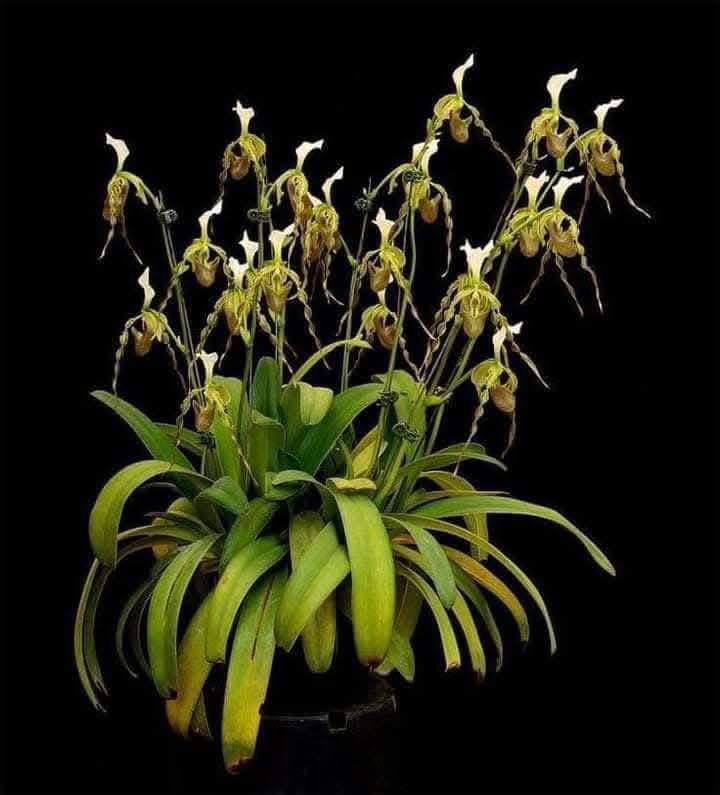
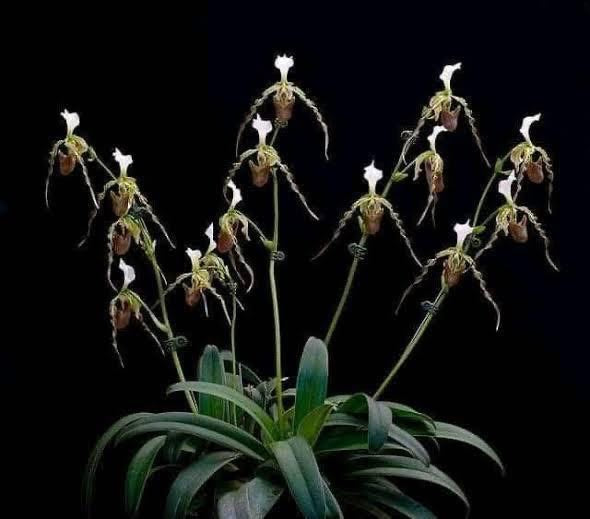
Paphiopedilum Dianthum is a striking botanical lady’s slipper orchid for collectors who appreciate a distinctive, almost graphic flower shape. From a fan of long green leaves, a mature plant produces a tall, slightly overhanging flower stalk bearing multiple flowers. The exceptionally long, twisted petals are particularly defining of this species: they hang down like dark ribbons along the greenish-brown, shoe-shaped lip.
The combination of multiple flowers, long petals, and an elegant, relatively large plant makes Paphiopedilum Dianthum quite different from the compact, single-flowered Paphiopedilums that are more commonly sold as houseplants. Even when not in bloom, the species has a serene, architectural appearance due to its long, ribbon-like leaves and fan-shaped growth habit.
Origin
Paphiopedilum dianthum is a botanical species native to southern China and northern Indochina. Its natural range includes parts of Yunnan, Guizhou, and Guangxi and extends into Laos and Vietnam. There, the plants grow in moist tropical and subtropical forests, often on steep, heavily weathered limestone slopes.
In this environment, the roots are found among moss, humus, fine plant debris, and crevices in the limestone. Although the species is sometimes recorded as an epiphyte, it is also found in the field on rocks and in rock crevices filled with organic material. In terms of care, this means that the roots need air and good drainage, but must not be allowed to become bone-dry for extended periods.
The species was officially described in 1940 by Tang and F.T. Wang. Paphiopedilum parishii var. dianthum is an older synonym that still appears on some plant labels and in older literature. Paphiopedilum Dianthum is now the accepted species name.
Characteristics
The plant grows sympodially and forms fans of typically three to six elongated, uniformly green leaves. A mature fan can become considerably wider than those of many compact Paphiopedilums. New shoots emerge from the base, causing a vigorous plant to form a larger clump with multiple fans over time.
Each fan blooms only once. Afterward, the old growth remains important for a long time for the storage and processing of water and nutrients, while new shoots produce future flowers. Old fans therefore do not need to be removed until they are completely brown and dry.
The flower stalk can be long and slightly curved and usually bears multiple flowers. Botanical descriptions mention two to five flowers per cluster, while studies of cultivated plants observed an average of about three flowers per stalk. The final number depends on the age, size, vigor, and care of the individual plant.
The flowers combine shades of green, yellow-green, and brownish-purple. The uppermost sepal stands relatively upright and is usually light in color with clearly visible veins or stripes. The shoe-shaped lip is marked with greenish-brown to darker brown hues. The most distinctive feature is the narrow petals, which droop further and twist as the flower opens. This gives each flower its characteristic elongated silhouette.
No reliable, consistently present, distinct scent has been documented for this species. Paphiopedilum Dianthus is therefore chosen primarily for its distinctive flower shape and multi-flowered nature.
Care
Paphiopedilum Dianthus requires an airy root environment in which some moisture is always available. The plant lacks pseudobulbs and therefore cannot rely on stored water for as long as, for example, a Cattleya. Complete and repeated drying out can damage delicate root tips and slow the development of new shoots.
At the same time, the roots are sensitive to old, compacted, or constantly waterlogged substrate. The best balance is achieved with an airy mixture that remains evenly slightly moist but also contains sufficient oxygen after each watering.
Allow a newly received plant to acclimate undisturbed for a few days. Check the growing medium before watering again, and do not automatically give a full watering immediately upon arrival. Especially during transport, the inside of the pot may still be considerably more moist than the surface suggests.
Light
Provide Paphiopedilum dianthum with bright, filtered light. As a green-leaved, multi-flowered species, it can tolerate slightly more light than many Paphiopedilums with marbled leaves. Sufficient light is important for robust growth and the development of a flower spike, but harsh, direct midday sun can scorch the leaves.
An east- or west-facing window is usually suitable. If the window faces south, the plant can be placed slightly farther from the glass or shielded during sunny summer afternoons. Behind a north-facing window, supplemental grow lights are often needed to encourage a mature plant to bloom again.
Healthy foliage is typically medium green. Very dark and soft leaves, combined with weak growth or a prolonged lack of flowers, may indicate insufficient light. Yellow-green discoloration, pale spots, or dry, scorched patches are more likely signs of too much direct sunlight or a too-sudden move to a brighter location.
Temperature
Paphiopedilum Dianthus is best grown in moderately warm to warm conditions. During the day, temperatures of about 20 to 28 °C provide a good baseline, with nighttime temperatures around 15 to 20 °C. A moderate temperature drop between day and night supports a natural growth rhythm.
On hot summer days, the temperature can temporarily rise if there is sufficient air circulation and humidity. However, above about 30 °C, the plant’s growth often slows down if the roots become too dry or too hot at the same time.
Protect the plant from cold drafts and prolonged temperatures below approximately 13 to 15 °C. In particular, the combination of low temperatures and wet growing medium increases the risk of root and crown rot. A cool winter dormancy period during which the plant is kept dry for an extended period is not necessary for this species.
Potting Mix and Repotting
Use a well-aerated but moderately moisture-retaining Paphiopedilum mixture. Medium-fine bark can be combined with perlite, pumice, or fine lava rock and a small amount of sphagnum moss. The mixture should absorb water evenly while also draining excess water quickly.
Since Paphiopedilum dianthum naturally comes into contact with limestone, a small amount of dolomite lime, calcite, or fine shell grit. This is particularly important when using only soft rainwater or reverse osmosis water. Add lime sparingly: maintaining an airy and healthy root environment is more important than significantly raising the pH.
Repot approximately every one to two years or as soon as the bark becomes soft and the mixture loses its airy structure. The safest time to repot is when a new shoot begins to form fresh roots at the base. Do not choose an unnecessarily large pot, as a large amount of unused substrate can remain wet for a long time.
Place the base of the new growth just at or very slightly below the surface. If the plant is placed too high, new roots will have difficulty reaching the moist potting mix. Conversely, if planted too deep, water will pool around the center of the shoot.
Humidity and Ventilation
A relative humidity of about 50 to 70 percent supports steady growth. The plant can adapt to slightly drier indoor air, as long as the potting mix does not dry out completely all the time and the plant is not placed directly above a radiator.
Air circulation is especially important at higher humidity levels. Damp, stagnant air around young shoots and leaf axils can cause bacterial or fungal problems. In a greenhouse or plant cabinet, a small fan is therefore helpful. Indoors, normal airflow is usually sufficient, provided the plant isn’t crowded in among other plants.
Daily misting is not a complete substitute for stable humidity levels. Water that remains on the leaves in the evening can actually cause problems. Only mist the plant when the leaves can dry off quickly afterward.
Watering
Keep the growing medium evenly slightly moist, without allowing the pot to remain constantly saturated. Water again when the top begins to dry out and the pot feels noticeably lighter. Do not allow the root system to dry out completely repeatedly.
The exact frequency depends on temperature, light, Potsize, and growing medium. During active growth in the spring and summer, the plant will absorb water more frequently. During the darkest winter months, the growing medium dries out more slowly, and watering can be reduced, but even then, a prolonged dry dormant period is not recommended.
Preferably use rainwater, reverse-osmosis water, or other low-mineral water. If only very soft water is used, sufficient calcium and magnesium can be supplemented through fertilizer or by adding a small amount of calcareous material to the growing medium.
Water early in the day and allow the pot to drain completely. Ensure that no water remains at the bottom of a closed decorative pot, and prevent the young growing core from remaining wet for extended periods overnight.
Fertilizer
During active root and leaf growth, apply a lightly dosed orchid fertilizer regularly. About one-quarter to one-half of the recommended dosage is usually sufficient, depending on the composition of the fertilizer used and the frequency of watering.
A low, regular concentration works better than occasional heavy fertilization. Paphiopedilum roots are sensitive to accumulated fertilizer salts, especially as the growing medium ages or when a small pot repeatedly dries out partially.
Therefore, thoroughly rinse the mixture with clean water on a regular basis. White deposits on the bark, along the pot rim, or at the base of the leaves may indicate an excessively high concentration of minerals. During periods of low light and slow growth, reduce the amount of fertilizer as well.
Growth and Development
New shoots appear at the base of older fans. At first, such a shoot grows slowly, after which the leaves and root system continue to develop. Only when a fan is fully mature and strong enough can a flower stalk emerge from its center.
It is best to allow a plant to grow into a clump with multiple fans. The older growth supports the development of younger shoots and increases the plant’s overall reserves. Dividing a small clump too early can delay flowering for several years.
A healthy plant has sturdy green leaves and roots with light-colored, active growth tips. If a new shoot produces leaves but forms hardly any roots, pay particular attention to the condition of the growing medium, the planting depth, and the moisture level around the base.
Flowering
Paphiopedilum Dianthus is a multi-flowered species. A mature plant can develop an arched flower stalk on which two to five flowers usually appear. Not all buds necessarily open at exactly the same time, allowing the overall display to build up gradually.
In studies conducted under Chinese growing conditions, the plants bloomed in the fall. In a European greenhouse or living room, however, the exact flowering time may vary depending on temperature, light, the plant’s origin, and previous growing conditions. A specific flowering month cannot therefore be guaranteed.
The long petals continue to develop as the flower opens. Allow the flower stalk plenty of space and move a plant with developing buds as little as possible. A sudden change in temperature, light, or watering can cause young buds to stop developing.
Do not cut back a spent flower stem until all flowers have wilted. The fan in question will not bloom again, but it remains important to the plant and can support several new shoots.
Care Level
Paphiopedilum Dianthus has a moderate to advanced care level. The species is not exceptionally difficult to care for when light, temperature, and watering are balanced, but it is less forgiving of old potting mix, prolonged drought, or constantly wet roots than many common hybrid orchids.
In addition, a mature plant requires more space than a compact Paphiopedilum. The leaves grow long, and the flower spike must be allowed to develop freely. It is therefore particularly well-suited for enthusiasts who already have some experience with Paphiopedilums or are willing to check the growing medium regularly.
Who is this plant suitable for?
This species is ideal for collectors who appreciate the natural forms found within Paphiopedilum and enjoy cultivating a plant to produce an impressive multi-flowered bloom. The long, drooping, twisted petals give Paphiopedilum dianthum a silhouette that is hardly comparable to that of a modern compact hybrid.
This plant is less suitable for someone looking for a small windowsill orchid or who wants to care for it strictly according to a fixed weekly watering schedule. Especially during the development of new roots and shoots, it’s worth checking the actual condition of the growing medium.
Growing Experience Indoors or in a Greenhouse
Indoors, Paphiopedilum dianthum grows well near a bright east- or west-facing window. Leave enough space around the foliage and make sure the plant isn’t placed directly above a heater. Supplemental grow lights can help maintain even growth during the darker months.
In a moderately warm greenhouse or spacious orchid cabinet, humidity and ventilation are easier to regulate. There, the plant can grow into a wider clump with multiple fans. Keep in mind that the flower stalk and the long petals also need free vertical space.
A closed terrarium without air circulation is less suitable. The combination of a permanently moist substrate, wet leaf axils, and stagnant air poses a greater risk than a temporary, slightly lower humidity level.
Additional care tip
Pay special attention to the base of new shoots. Fresh root tips often don’t appear until the young growth has already developed somewhat. Ensure these roots can easily reach the airy, slightly moist substrate, and don’t delay repotting once the old mix has lost its structure.
At the same time, be careful when handling young root tips. Paphiopedilum roots recover slowly when they break. A stable plant in fresh, airy potting mix generally thrives better than one that is repeatedly lifted or replanted.
Short product description
Paphiopedilum dianthum is a rare botanical lady’s slipper orchid native to southern China and northern Indochina. A mature plant produces a long, slightly curved flower stalk with multiple greenish-brown flowers and exceptionally long, twisted petals. This species grows best in a well-aerated, slightly moist growing medium in a bright location without harsh midday sun. An impressive choice for collectors of botanical and multi-flowered Paphiopedilums.