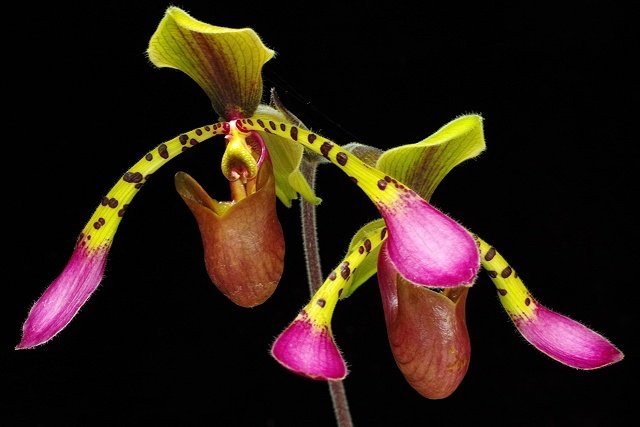
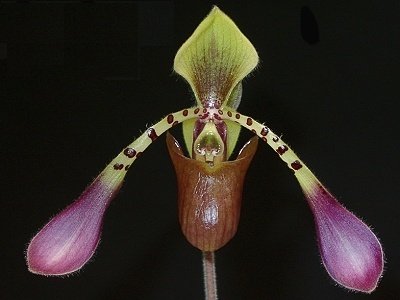
Paphiopedilum lowii 4N ‘US Type’ is a selected variety of one of the most colorful multi-flowered lady’s slipper orchids. From a fan of fresh green, strap-shaped leaves, a mature plant develops a long flower stalk bearing several striking flowers. The combination of yellow-green hues, dark markings, and purple-pink tips in particular makes each flower exceptionally expressive.
In orchid breeding, the designation 4N refers to a tetraploid selection line. Such plants have four sets of chromosomes and are typically selected for their robust growth, broader flower parts, and more substantial flower structure. In addition, the colors may appear richer than in a typical form. “US Type” is a horticultural selection designation and not a separate botanical variety. The plant therefore remains a pure Paphiopedilum lowii and is not a hybrid.
Origin
Paphiopedilum lowii occurs naturally on the Malay Peninsula and on the islands of Sumatra, Java, Borneo, and Sulawesi. This gives the species a remarkably large range for a Paphiopedilum. This broad distribution partly explains why there can be variation within the species in flower color, size, and growth habit.
Unlike many other shoe orchids, Paphiopedilum lowii often grows epiphytically in the wild on moss-covered branches and in tree forks. In addition, the species is found locally on rocks. There, the roots are situated among moss, leaf litter, and other airy organic material. As a result, they remain moist but at the same time receive plenty of oxygen. It is precisely this natural growth habit that is important when choosing the right substrate.
Characteristics
The plant forms sturdy fans with four to six narrow, dark green leaves. A mature leaf can easily grow to more than 30 centimeters in length. Although the plant is grown in a relatively modest pot, its total leaf span can be quite substantial as a result. It is therefore not a compact windowsill orchid.
From the center of a mature fan, a long, usually upright to slightly curved flower spike emerges. This can grow to over 60 centimeters in length and, in vigorous plants, even approach one meter. The stem typically bears three to five flowers, while well-developed specimens can sometimes bear six or more.
The individual flowers are usually about 8 to 14 centimeters wide. The uppermost sepal is yellow-green and marked with dark longitudinal stripes. The sideways-facing petals start out green to yellow-green, are dotted with dark brown spots, and gradually change color toward the tips, becoming increasingly pink, purple, or magenta. Below these is the characteristic brown- to green-colored, shoe-shaped lip. With this 4N selection line, you can especially look forward to sturdy flowers with a vivid color distribution, although some natural variation between plants is possible.
Care
Although Paphiopedilum lowii is among the more accessible multifloral slipper orchids, the species requires more light and space than the well-known compact-growing Paphiopedilums. In addition, the growing medium must remain consistently slightly moist without becoming compacted. When light, moisture, and air circulation are well balanced, the plant grows reliably and can develop into an impressive multi-stemmed specimen.
Light
Place this Paphiopedilum in a bright spot with bright, filtered light. Gentle morning or evening sun is generally beneficial, while bright midday sun through a window can cause leaf burn. An east- or west-facing window is therefore often suitable. If the window faces south, some filtering during sunny periods is advisable.
Paphiopedilum lowii can be placed in noticeably brighter light than a variegated Maudiae-Paphiopedilum. Although insufficient light often still results in green leaves, the plant may then grow for years without producing a flower stalk. Sturdy, light-green new leaves and a mature fan that does not become excessively long and limp are good indicators that the amount of light is appropriate.
Temperature
This species grows best under moderately warm conditions. During the day, temperatures of about 21 to 28 °C are suitable, while at night the temperature should preferably drop to 15 to 20 °C. A clear difference between day and night temperatures supports the maturation of new fans and can promote flower bud formation.
During hot summer days, the plant can temporarily tolerate higher temperatures, provided that humidity, air circulation, and watering are adjusted accordingly. However, prolonged heat combined with warm nights and stagnant air can slow growth. Also protect the plant from cold drafts and avoid exposing a wet plant to temperatures below approximately 13 °C for extended periods.
Substrate and Cultivation Methods
Because Paphiopedilum lowii often grows on trees in the wild, this species requires a more airy mix than many terrestrial Paphiopedilums. A good base consists of fine to medium-coarse orchid bark, supplemented with perlite, pumice, or a similar airy material. A small amount of chopped sphagnum moss or fine coconut fiber can be added to help retain moisture more evenly.
Do not use regular potting soil, and do not pack the substrate tightly around the roots. A mixture that is too compact remains wet around the center of the pot for too long, which can lead to oxygen deprivation and root rot. Additional limestone is not typically necessary for this primarily epiphytic species.
Also, choose a pot that is only slightly larger than the root system. A pot that is too large dries out unevenly and makes it harder to gauge when to water. Repot preferably when the substrate begins to break down or when new root growth becomes visible. This is usually necessary once every one to two years.
Humidity
A humidity level of about 60 to 80 percent is ideal. In a normal living space, the plant can also grow at slightly lower humidity levels, as long as watering remains consistent and it is not placed directly next to a radiator. However, high humidity is only beneficial if there is also sufficient air circulation.
Therefore, make sure to let a gentle breeze circulate around the leaves regularly. This helps any remaining water dry faster and reduces the risk of bacterial or fungal infections. Be especially careful to ensure that no water remains in the center of a new fan leaf in the evening.
Watering
Keep the potting mix evenly slightly moist during the active growth period. Water generously each time and allow the excess water to drain completely from the pot. Afterward, let the top layer of the mix dry out slightly, but do not allow the entire root system to become bone-dry for extended periods.
During the dark winter months, the plant uses less water. As a result, the time between waterings may be longer, although Paphiopedilum lowii does not require a strict, dry dormant period. During this period, be sure to check the center of the pot, as it can remain wet considerably longer than the visible top layer.
Rainwater, reverse-osmosis water, or other low-mineral water is safest. If you use tap water, you can regularly rinse the substrate with plenty of clean water to remove accumulated fertilizers and minerals.
Fertilization
During active growth, apply a low dose of balanced orchid fertilizer every two to three waterings. About a quarter of the usual recommended concentration is generally sufficient. This ensures the plant receives regular nutrients without harmful salts quickly accumulating around the sensitive roots.
Avoid highly concentrated fertilizers and do not use heavy, phosphorus-rich bloom boosters. Thoroughly rinse the growing medium about once a month. During the winter, the feeding frequency can be reduced, and then gradually increased again as soon as a new frond or new root tips begin to grow actively.
Flowering
Paphiopedilum lowii naturally blooms mainly in the spring and summer, although the exact timing may shift under cultivated conditions. The flowers open gradually along the long stem, allowing the overall display to remain attractive for several weeks.
Each individual fan blooms only once. After flowering, a new shoot takes over growth, while the old fan continues to provide the plant with energy for a long time. Therefore, do not cut it away as long as the foliage is green and firm. As the plant forms multiple mature fans, it can become fuller and eventually bloom more regularly.
The designation 4N does not mean that every plant will immediately produce more flowers. The main expectations lie in the firmness, width, and substance of the flowers. Furthermore, tetraploid selections may grow somewhat more slowly, so patience during the development of a mature fan is rewarded.
Care Level
The care level is moderate. Among the multifloral Paphiopedilums, P. lowii is considered a relatively accessible species, but the plant does require sufficient light, a well-aerated growing medium, and consistent watering. Additionally, the plant’s eventual leaf span and long flower spike must be taken into account.
The plants offered are in an adolescent growth stage. Furthermore, these are imported plants whose root systems may continue to develop after arrival. Therefore, initially provide the plant with a stable, warm location and avoid overwatering to compensate for limited root mass. New leaf and root growth is the clearest sign that the plant has established itself well.
Who is this plant suitable for?
Paphiopedilum lowii 4N ‘US Type’ is particularly well-suited for enthusiasts seeking a striking, multi-flowered species orchid who have sufficient space for a large mature specimen. This selection also holds special value for collectors of multifloral Paphiopedilums, as the 4N line is bred for vigorous growth and flowers with a more substantial form.
For an absolute beginner, this plant is less straightforward than a standard Phalaenopsis. Nevertheless, it’s an interesting next step for someone who already has experience with orchids and can maintain consistent humidity levels. Those looking exclusively for a small windowsill plant or expecting blooms every year should opt for a more compact and faster-maturing variety.
Growing experience indoors, in a greenhouse, or in a plant cabinet
Indoors, this species grows well near a spacious, bright east- or west-facing window. When placing it, consider not only the Potsize, but especially the long leaves and the future flower stalk. A spot where the stem can grow freely upward prevents buds from coming into contact with glass, lighting, or a shelf.
A moderately warm greenhouse generally offers the best combination of light, humidity, and air circulation. A large plant cabinet is also an option, but many standard cabinets eventually become too small for the plant’s leaf spread and tall flower stalk. This species is therefore not suitable for a closed terrarium.
Additional Care Tip
Place a sturdy stake early on, as soon as the flower stalk clearly begins to elongate. Heavy flowers, in particular, can pull the stalk to one side. Also, rotate the plant as little as possible once the buds begin to develop, as they will turn toward the light. By keeping the light-facing side consistent, the flowers will remain more naturally and neatly arranged along the stem.
Short product description
Paphiopedilum lowii 4N ‘US Type’ is a selected multifloral species orchid with long flower stalks and colorful yellow-green, brown-marked, and purple-pink flowers. The 4N designation refers to a tetraploid selection line that is valued for its robust growth and flowers with a fuller, more substantial form. A distinctive collector’s plant for a bright windowsill or a moderately warm greenhouse.