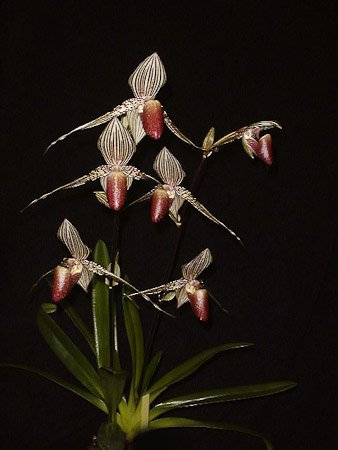
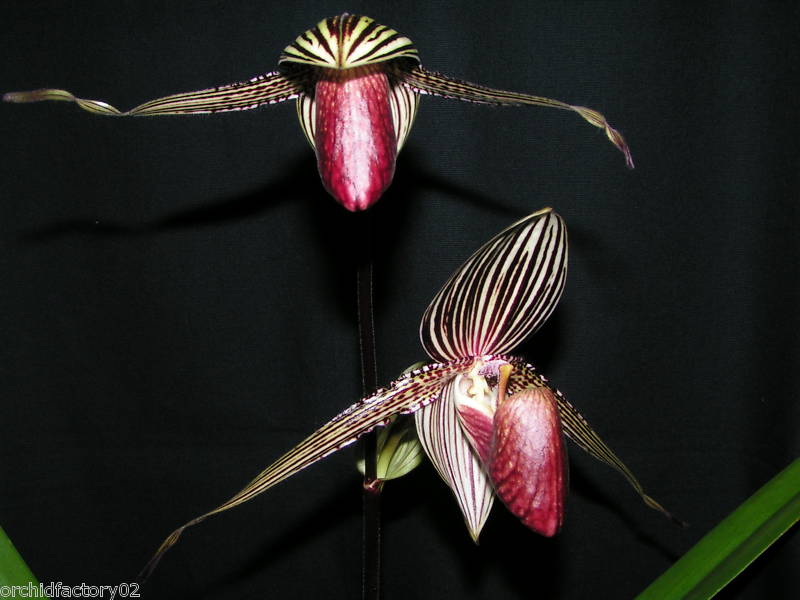
Paphiopedilum rothschildianum is one of the most famous and impressive lady’s slipper orchids in the world. This botanical species from Sabah, Borneo, is known for its large flowers, broad striped dorsal sepal, and extremely long, horizontally borne petals. Because of this characteristic flower shape, this species has a stately, almost architectural appearance.
This is not a standard Paphiopedilum variety for rapid flowering, but a true collector’s plant. Paphiopedilum rothschildianum grows slowly, requires patience, and needs time to develop full flowering potential. For enthusiasts of botanical Paphiopedilum species, this is precisely one of the most valuable species to have in a collection.
Origin
Paphiopedilum rothschildianum is native to Sabah on Borneo, particularly the area around Mount Kinabalu. In its natural habitat, the species grows on steep slopes and rocky areas, often among organic material, moss, and moist but well-drained soil layers. There, the roots have access to moisture but are not immersed for long periods in heavy, oxygen-poor substrate.
The species occurs at medium elevations, where warm to intermediate conditions are combined with high humidity, good air circulation, and bright but filtered light. This natural origin explains why Paphiopedilum rothschildianum prefers consistently moist conditions in cultivation but absolutely cannot tolerate wet, compacted potting soil.
Characteristics
Paphiopedilum rothschildianum forms large fans of long, strap-shaped green leaves. Unlike marbled-leaved Paphiopedilums, this species usually has uniformly green leaves. The plant has no pseudobulbs and therefore stores less water than many other orchids. As a result, the growing medium must remain evenly slightly moist.
The flowering is spectacular. A mature plant can produce a sturdy, upright flower spike bearing several large flowers. The flowers have a broad, often striped dorsal sepal, a striking shoe-shaped lip, and long, horizontally spreading petals. The colors are usually shades of yellow-green, cream, brown-red, mahogany, purple-brown, and dark streaking.
A vigorous plant can bear multiple flowers at once. The flowers open in a way that visually greatly increases the plant’s width. This makes Paphiopedilum rothschildianum one of the most recognizable multifloral Paphiopedilums.
Care
Light
Paphiopedilum rothschildianum requires more light than many marbled-leaved Paphiopedilums, but should not be placed in harsh midday sun. Bright, filtered light is ideal. Morning sun or late afternoon sun is often fine, especially when humidity is sufficient.
Insufficient light is a common cause of slow growth and failure to bloom. The leaves should remain a fresh green. Very dark leaves may indicate insufficient light, while yellow leaves or dry spots may indicate too much direct sun. Kew notes that for Paphiopedilum on Mount Kinabalu, P. rothschildianum grows where dappled sunlight reaches the plants, especially in the afternoon, indicating that this species does not grow in extremely dark conditions.
Temperature
This species grows best in moderate to warm conditions. A daytime temperature of approximately 20 to 28°C is suitable. At night, the temperature may drop to about 15 to 20°C. A slight nighttime drop is beneficial, but cold, wet conditions should be avoided.
The American Orchid Society classifies multifloral, strap-leaf Paphiopedilums as warmer-growing types and warns that cold can cause rot, especially when moisture remains on the leaves or in the crown. Therefore, keep the plant in a stable, well-ventilated environment and never allow it to remain cold for extended periods with wet substrate.
Substrate
Use an airy Paphiopedilum mixture that retains moisture but remains well-aerated. A suitable mix consists, for example, of fine to medium-coarse bark, perlite, pumice, or Seramis, some sphagnum moss, and possibly a small amount of a lime or mineral component. The growing medium must never become compacted or oxygen-deprived.
Because Paphiopedilum rothschildianum does not have pseudobulbs, the mixture must not be allowed to dry out completely. At the same time, the roots are susceptible to suffocation in wet, dense potting soil. A tall, well-draining pot and regular repotting into fresh substrate usually work better than leaving the plant in decomposed bark for years.
Humidity
A humidity level of about 60 to 80% is ideal. The plant prefers stable humidity but does not like stagnant, stuffy air. Good air circulation is important, especially at higher humidity levels and warm temperatures.
In dry living room air, growth may be slow and leaf tips may dry out. A greenhouse, conservatory, plant room, or bright spot with more stable humidity is often more favorable. Be sure, however, that no water remains in the crown for extended periods.
Watering
Keep the potting mix evenly slightly moist. Water again when the top layer begins to dry out, while the mix deeper in the pot is still slightly moist. Do not let the plant dry out completely for long periods, but also prevent the roots from being constantly wet and deprived of oxygen.
Preferably use rainwater, demineralized water, or soft water at room temperature. Water preferably in the morning so that any moisture on the leaves or in the leaf axils can dry off during the day. Rinse the growing medium thoroughly from time to time to limit the buildup of fertilizer salts.
Fertilization
Paphiopedilum rothschildianum grows slowly but steadily and benefits from regular, light fertilization. During active growth, apply an orchid fertilizer at about one-quarter to one-half the recommended dosage. Heavy fertilization is unnecessary and can damage the roots.
Because this species grows in nature in habitats that are exceptionally rich in minerals but low in nutrients, regular, light fertilization is safer than occasional high concentrations. Rinse the substrate regularly with clean water. During slower growth in winter, fertilization may be reduced.
Flowering
Paphiopedilum rothschildianum does not bloom well until the plant is mature and strong enough. A plant ready to flower forms a sturdy, upright flower stalk with several large flowers. Flowering develops slowly but is very impressive once the flowers are fully open.
This species does not rebloom from old flower stalks. After flowering, the flower stalk can be removed once it begins to dry out. The plant then continues to grow by producing new shoots. Each fan typically blooms only once; future blooms will come from new, mature shoots.
Care Level
Paphiopedilum rothschildianum requires moderate to advanced care. The plant is not extremely delicate, but it grows slowly and is less forgiving of care mistakes. In particular, insufficient light, old, compacted substrate, damp cold, and over-fertilization can cause problems.
This is a plant for patient enthusiasts. Don’t expect rapid flowering like you would with a commercial Phalaenopsis. The real value lies in building up a strong plant that can eventually produce an impressive multifloral bloom.
Who is this plant suitable for?
Paphiopedilum rothschildianum is suitable for collectors and advanced enthusiasts of Paphiopedilum, botanical orchids, and rare collector plants. The plant is a good fit for someone who can provide a stable, bright, and well-ventilated location and understands that this species grows slowly.
For absolute beginners or customers expecting flowers quickly, this plant is less suitable. For someone actively seeking an iconic species with genuine collector’s value, Paphiopedilum rothschildianum is one of the most exceptional choices within the genus.
Growing Experience Indoors or in a Greenhouse
In a greenhouse, conservatory, or plant room, Paphiopedilum rothschildianum is usually easier to keep stable than on a dry windowsill. The plant thrives in consistent humidity, bright filtered light, and good air circulation. It can also be grown on a windowsill, provided the spot is bright enough and the growing medium never dries out completely or remains too wet.
This plant requires patience. New shoots must be allowed to grow steadily to full size before flowering is possible. Those who nurture its growth properly year after year will eventually be rewarded with one of the most impressive flowering forms among the Venus slipper orchids.
Extra care tip
Pay special attention to the roots and the growing medium. Paphiopedilum rothschildianum likes moisture, but not oxygen-deprived wetness. Repot in a timely manner when the growing medium begins to break down. A fresh, airy mixture and consistent watering are often more important than extra fertilizer.