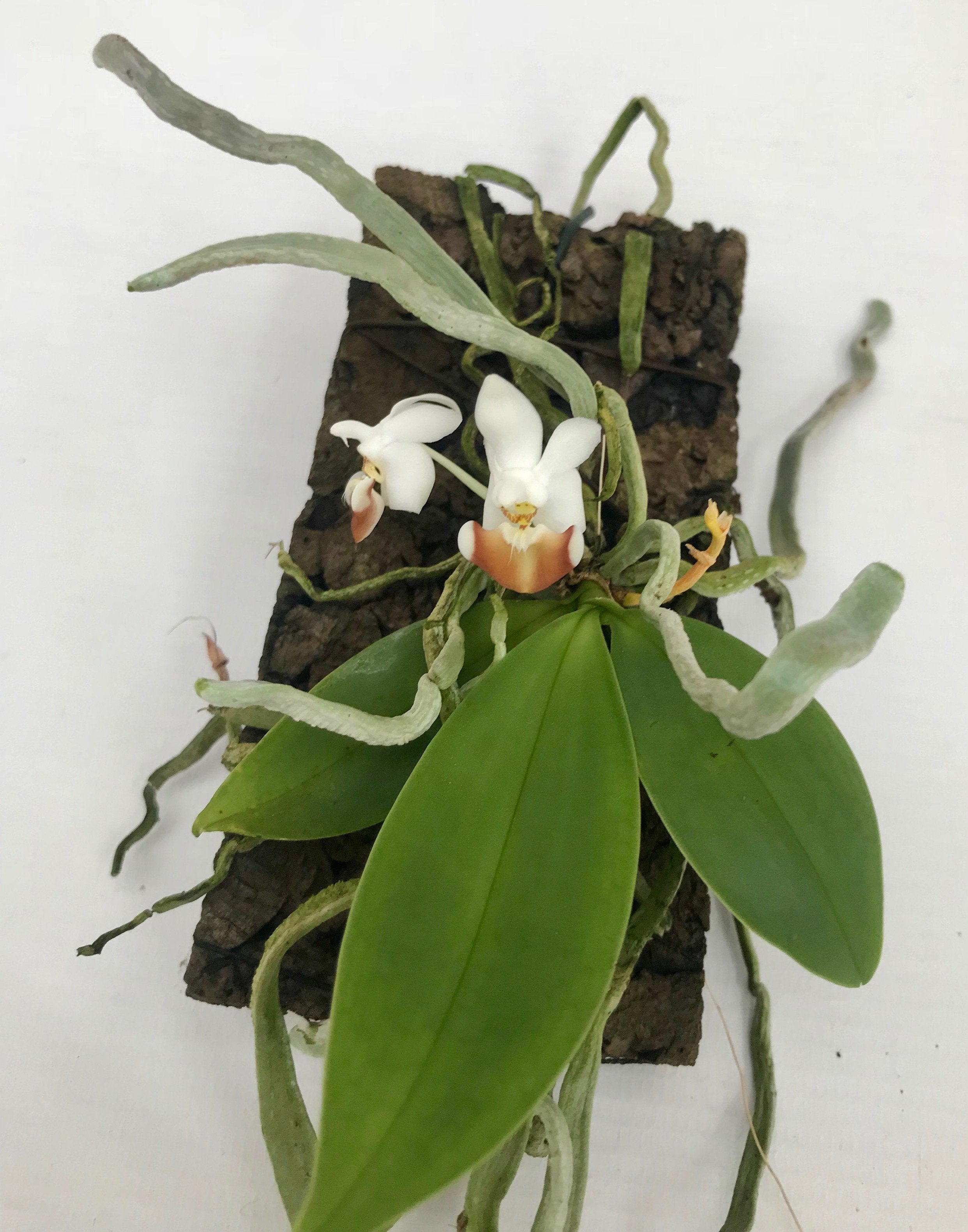
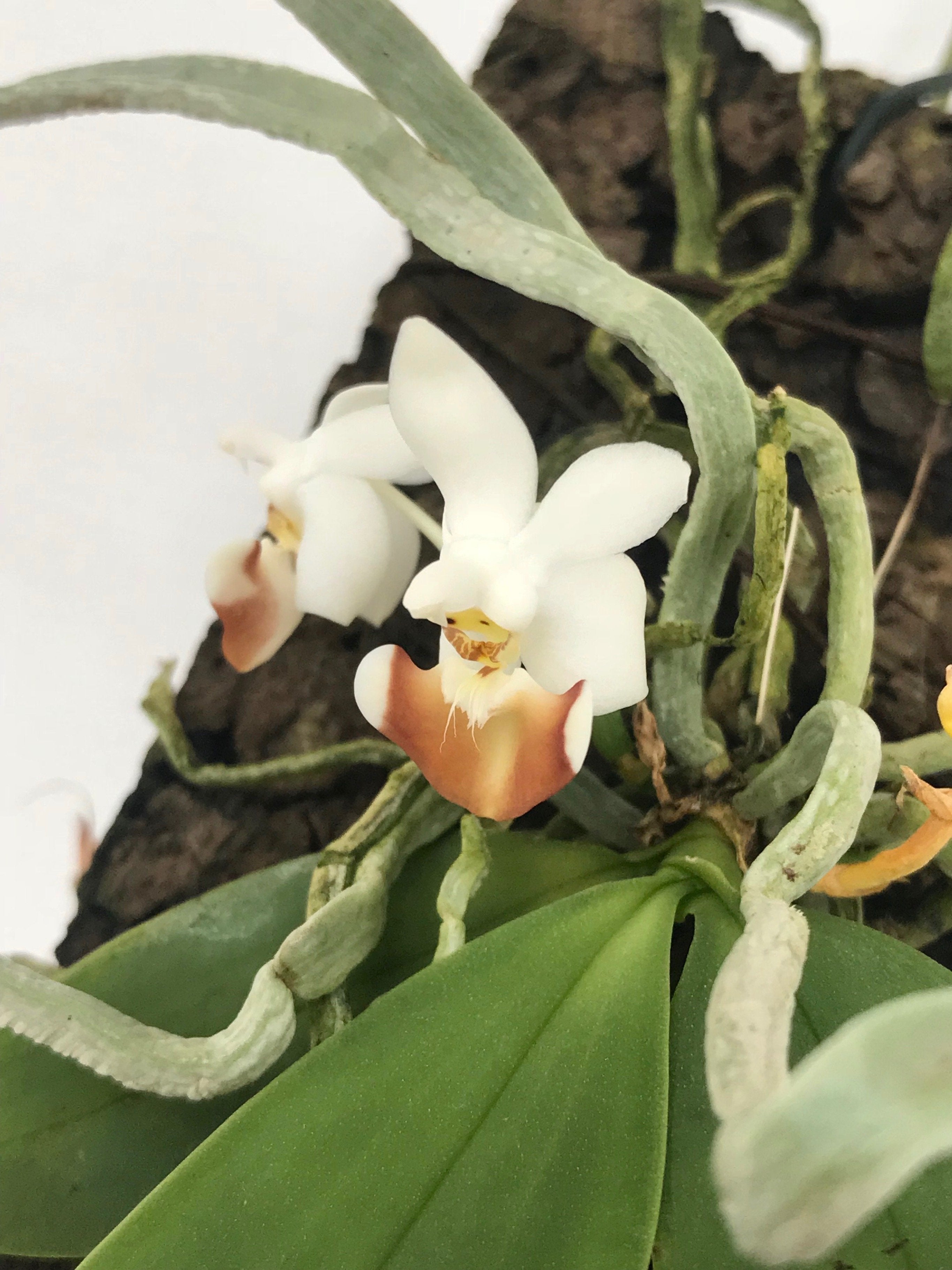
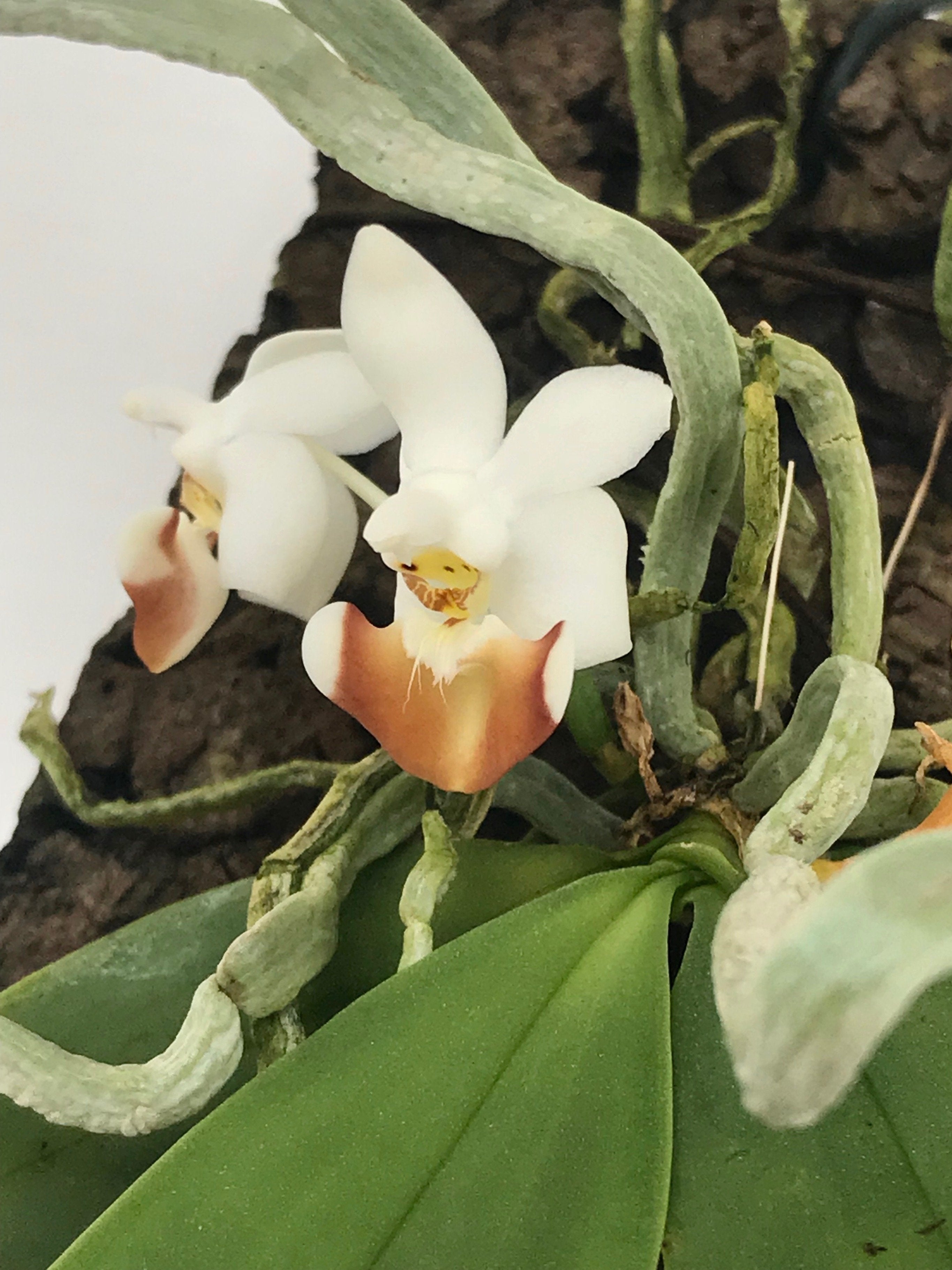
Phalaenopsis Lobbii is a charming miniature orchid for lovers of botanical Phalaenopsis species. While many modern Phalaenopsis hybrids are cultivated for large, long-lasting flowers, this species stands out precisely because of its small size, natural growth habit, and delicate blooms. The plant remains compact, produces short flower stalks, and blooms with small, graceful flowers that are instantly recognizable by their shape and lip markings.
This is not a standard supermarket Phalaenopsis, but a true variety for collectors who appreciate subtle details. The flowers are usually white to cream-white, with a striking lip in shades of yellow, orange, and brownish-red. Due to its small size, Phalaenopsis lobbii fits well in a display case, small greenhouse, plant room, or on a bright windowsill with sufficient humidity.
Origin
Phalaenopsis lobbii is native to parts of Asia, including the eastern Himalayas, northeastern India, Bhutan, Myanmar, Vietnam, and southern China. In the wild, this species grows as an epiphyte on tree trunks and branches, often in moist forests with plenty of air movement and filtered light.
The plant does not grow in heavy potting soil, but with its roots on rough bark, moss, and organic material that dries out quickly after rain or dew. This natural growth habit explains why Phalaenopsis lobbii requires well-aerated roots, soft water, and consistent but not excessive watering when grown in cultivation.
Phalaenopsis lobbii is closely related to other small species such as Phalaenopsis parishii. In older literature and in the trade, the names were sometimes used interchangeably, but today Phalaenopsis lobbii is treated as a distinct species.
Characteristics
Phalaenopsis lobbii is a true miniature. The plant forms short stems with small, sturdy leaves. When growing healthily, the leaves remain compact and slightly fleshy. The roots are relatively fine and tend to attach themselves to airy materials such as bark, cork, or moss.
The flowers are small but remarkably expressive. They usually have white to cream-white sepals and petals, with a striking lip that may be marked with yellow, orange, brown-red, or darker hues. It is precisely this contrasting lip that makes the flower stand out, despite its modest size. The flower stalks remain short and usually bear one to a few flowers at a time.
With proper care, Phalaenopsis lobbii can bloom regularly. Flowering often occurs in the spring, but in cultivation this can shift due to temperature, light, and growth rhythm. The plant can also produce keikis or side shoots, causing older plants to form a small clump over time.
Care
Light
Phalaenopsis lobbii prefers bright, filtered light. Provide the plant with more light than a very shade-loving orchid, but avoid harsh midday sun through a window. Morning sun or late afternoon sun is often fine, especially when humidity is sufficient.
If there is too little light, the plant will grow slowly and may fail to bloom. If there is too much direct sunlight, the small leaves may turn yellow or get scorched. A bright, filtered windowsill, a display case with grow lights, or a shaded spot in a warm greenhouse is usually suitable.
Temperature
This species grows well in moderate to warm conditions. A daytime temperature of about 20 to 27°C is suitable. At night, the temperature may drop to about 16 to 20°C.
Phalaenopsis lobbii can tolerate slightly cooler nights than many modern warm Phalaenopsis hybrids, but prolonged cold combined with wet roots should be avoided. A slight drop in temperature at night can actually have a positive effect, especially on vigorous growth and flowering.
Substrate and Cultivation Method
Phalaenopsis lobbii grows well in a small pot filled with fine to medium-coarse bark, possibly mixed with some sphagnum moss and perlite. The mixture must remain loose and should not become compacted. The roots are fine and require oxygen.
Mounted cultivation on cork or wood with some sphagnum moss also works well for this species. This mimics its natural growth habit but does require more attention when it comes to watering. A mounted plant dries out faster than a potted plant and is therefore best suited for a display case, greenhouse, or grower who can mist it regularly.
For standard living room cultivation, a small, well-aerated pot is often more practical than growing the plant entirely mounted.
Humidity
A humidity level of about 60 to 80% is ideal. For mounted plants or plants grown in a very open setup, the humidity may be higher, as long as there is sufficient air circulation.
In dry indoor air, the fine roots may stop growing more quickly, and leaf tips or young root tips may dry out. A display case, plant cabinet, small greenhouse, or a cluster of plants together can help keep the humidity more stable.
Watering
Keep Phalaenopsis lobbii evenly slightly moist, but never wet for long periods. Water again when the substrate is almost dry, but before the plant dries out completely. This happens more quickly in a small pot than with large Phalaenopsis hybrids.
For mounted plants, watering may be needed frequently during hot periods, sometimes several times a week. Water preferably in the morning so that leaves and growing tips can dry off during the day.
Preferably use demineralized water, rainwater, or other soft water at room temperature. The fine roots are sensitive to salt buildup, especially in small pots or when over-fertilized.
Fertilization
During active growth, apply a light dose of orchid fertilizer regularly. A quarter of the recommended dose is usually sufficient. Phalaenopsis lobbii is small and does not require heavy fertilization. Too much fertilizer can damage the fine roots.
Rinse the substrate or roots regularly with clean water to limit the buildup of fertilizer salts. In winter or during slower growth, fertilization may be reduced, but the plant does not need a strict, dry dormancy period.
Flowering
Phalaenopsis lobbii blooms with small, delicate flowers on short flower stalks. The flowers are usually white to cream-white with a striking yellow-orange to brown-red lip. The contrast between the light-colored parts of the flower and the colored lip gives the flower a lot of character, despite its small size.
Flowering is usually stimulated by sufficient light, healthy roots, and a slight drop in temperature at night. Do not cut off flower stalks too soon while they are still green. In some miniature Phalaenopsis, flower stalks may remain active longer or show renewed growth.
Care Level
Phalaenopsis lobbii is of moderate difficulty. The plant isn’t extremely difficult, but it requires a different approach than a standard Phalaenopsis hybrid. Its small root system dries out more quickly, while at the same time the plant is sensitive to overly wet, stuffy conditions.
The biggest challenge is finding the right balance: well-aerated roots, regular watering, sufficient humidity, and no heavy potting mix. Anyone accustomed to miniature orchids, botanical Phalaenopsis species, or display-case cultivation will generally be able to care for this plant well.
Who is this plant suitable for?
Phalaenopsis lobbii is suitable for enthusiasts looking for a small botanical orchid with subtle, distinctive flowers. The plant is a good fit for collectors of miniature orchids, botanical Phalaenopsis, and varieties suitable for a display case or small greenhouse.
For someone looking for a large, long-blooming windowsill orchid, this isn’t the most logical choice. Phalaenopsis lobbii blooms more delicately and modestly, but that is precisely what gives it so much charm. For customers who love true species, natural growth, and small details, this is a very interesting plant.
Growing Experience at Home or in a Greenhouse
In a display case or warm greenhouse, Phalaenopsis lobbii often grows more easily than on a dry windowsill. Humidity remains more stable there, and the fine roots stay more active. The plant can also grow well on a windowsill, but in that case, a small, well-ventilated pot is often more practical than mounted cultivation.
The plant takes up very little space, making it ideal for small collections or areas where larger orchids would take up too much room. Because of its compact size, you can quickly see how the plant is doing: new root tips, firm leaves, and short flower stems are signs that conditions are right.
Extra care tip
Pay special attention to the roots. For Phalaenopsis lobbii, healthy, active roots are more important than plenty of fertilizer or a large pot. It’s better to choose a small pot with a well-aerated growing medium than a pot that’s too spacious and stays wet for too long. When the roots remain firm and regularly produce new green tips, the plant is usually doing well.