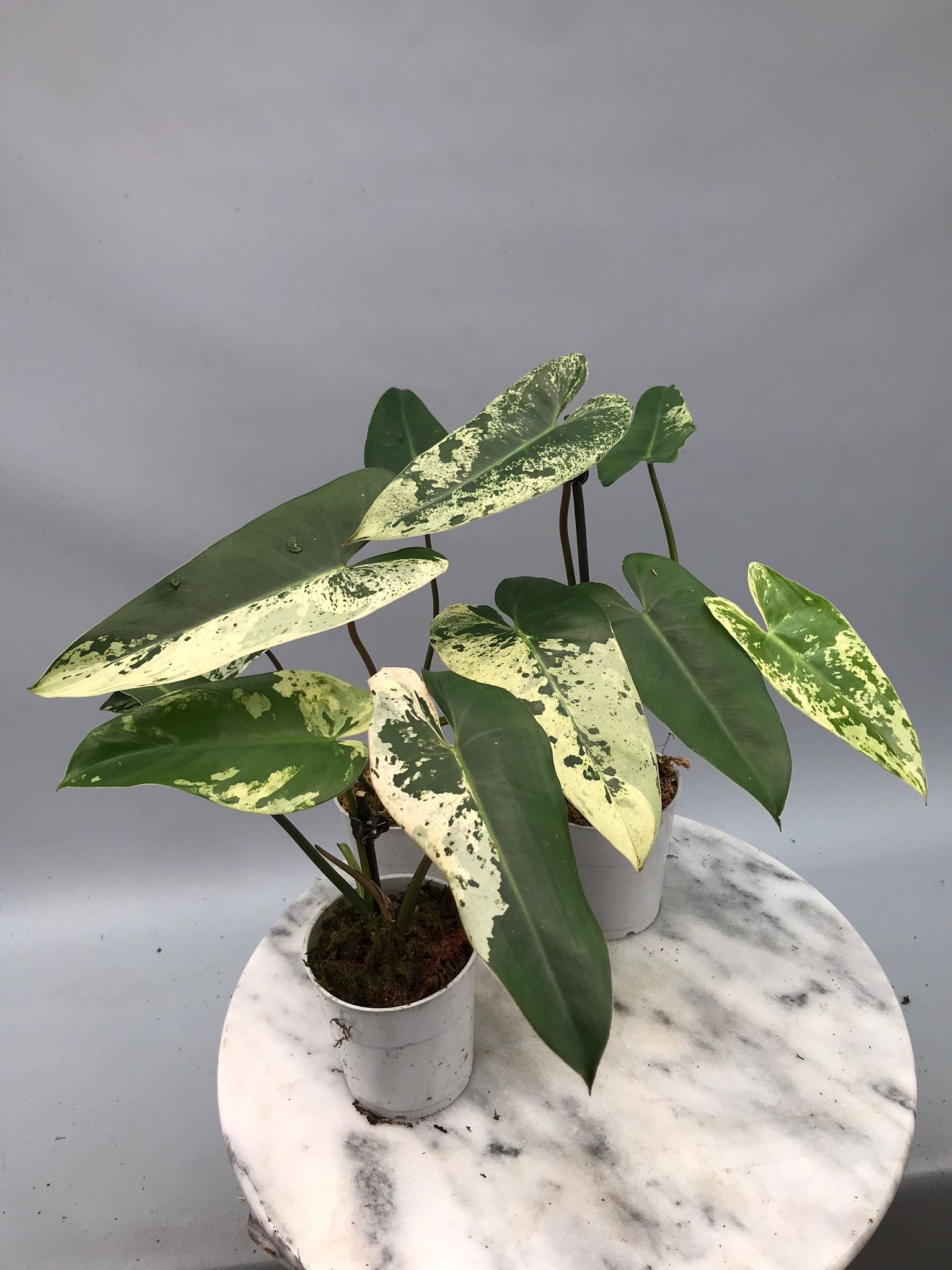
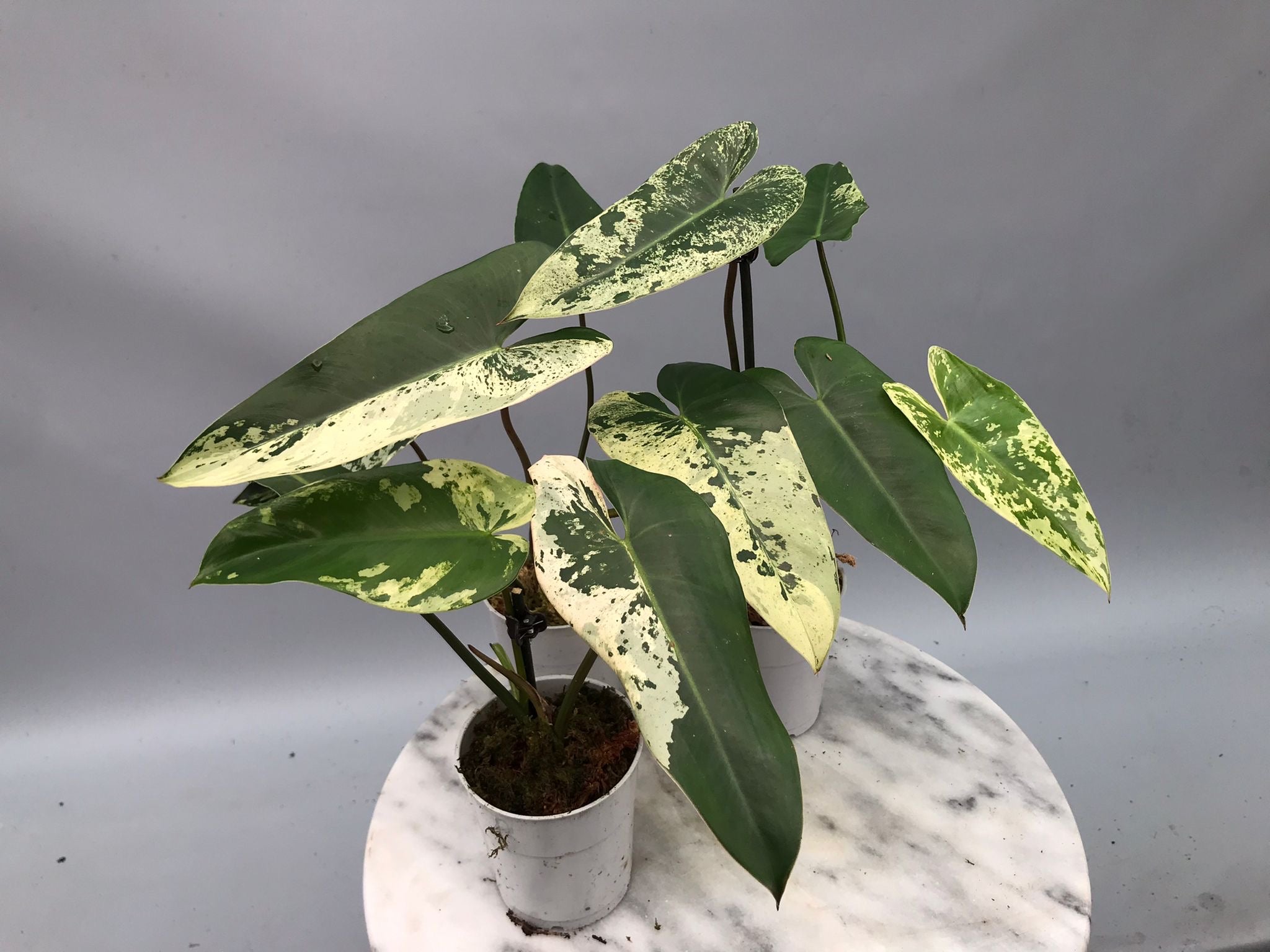
Philodendron ilsemanii is a rare and highly prized Philodendron among collectors of unusual aroids. This plant is particularly notable for its elongated, arrow-shaped leaves with an irregular variegated pattern in green, cream, and white. No two leaves are alike: some display fine marbling, while others may develop larger light spots or patches.
In the trade, this plant is often sold under the name Philodendron ilsemanii, although the name is not always treated consistently in botanical circles. That is precisely what makes it particularly interesting to collectors: it is a historic, rare plant name that has become well-known primarily for its striking variegation and its exclusive status within the rare-plant world.
Origin
Philodendron ilsemanii is used in the plant trade to refer to a rare, variegated Philodendron with a climbing growth habit. Botanically, the name is not always accepted as a distinct species; in modern taxonomic sourcesPhilodendron ilsemanii is treated as a synonym of, among othersPhilodendron sagittifolium.
The related wild forms are native to the tropical regions of Central and South America, where Philodendrons often grow as epiphytes or climbing plants in humid forests. There, they attach themselves to trees with aerial roots and develop larger, sturdier leaves as they climb higher. Indoors or in a greenhouse, Philodendron ilsemanii exhibits the same basic behavior: the plant thrives best when provided with support and sufficient light, warmth, and humidity.
Characteristics
Philodendron ilsemanii has elongated to arrow-shaped leaves with a sturdy structure. The leaf pattern is its most distinctive feature. The variegation may consist of white, creamy yellow, or light green marbling on a dark green background. On some leaves, the pattern is subtle and speckled, while other leaves may exhibit much more pronounced variegation.
Because the variegation varies from leaf to leaf, each plant develops its own unique character. This makes Philodendron ilsemanii particularly attractive to collectors who appreciate unpredictable leaf patterns. The plant is a climber and, when supported by a moss stick, coconut stick, or other sturdy support, it can produce larger leaves and shorter internodes.
Due to the variegated sections, the leaves contain less chlorophyll than those of a fully green Philodendron. As a resultPhilodendron ilsemanii typically grows more slowly and requires more consistent care. Sufficient light is especially important for maintaining strong growth and beautiful variegation.
Care
Light
Philodendron ilsemanii needs plenty of bright, indirect light. A spot near a window with filtered light is ideal. Morning sun or late afternoon sun is often fine, but harsh midday sun through a window can damage the light-colored parts of the leaves.
Insufficient light usually results in slower growth, longer internodes, and smaller leaves. The variegation may also be less pronounced. A bright location is therefore important, but avoid harsh, direct sunlight on the leaves.
Temperature
This Philodendron grows best in warm, stable conditions. A temperature between 20 and 27°C is ideal. Avoid cold drafts, sudden drops in temperature, and prolonged periods below approximately 16°C.
In winter, do not place the plant against a cold window or directly above a radiator. Stable warmth helps young or recently rooted plants in particular to produce new roots and leaves.
Potting Mix
Use an airy aroid mix that retains moisture but drains quickly enough. A suitable mix consists, for example, of coarse potting soil, bark, coconut coir, perlite, and possibly some sphagnum moss or activated charcoal.
The most important thing is to ensure that oxygen reaches the roots. A substrate that’s too compact stays wet for too long and increases the risk of root rot.
Watering
Water when the top layer of the substrate has dried out slightly. It’s better to check with your finger or by the weight of the pot rather than following a fixed weekly schedule. In the summer, the plant usually needs water more often than in the winter.
Preferably use clean rainwater, demineralized water, or soft, balanced water at room temperature. Always allow excess water to drain completely. Water that remains at the bottom of a decorative pot can quickly cause root problems.
Humidity
Philodendron ilsemanii thrives in higher humidity. A humidity level of about 60% or higher is ideal, especially during active growth. In dry indoor air, the lighter parts of the leaves may develop brown edges more quickly.
A humidifier, a display case, or grouping plants together can help keep humidity levels more stable. However, always ensure there is some air circulation. High humidity without ventilation can cause mold or leaf problems.
Fertilizer
During the growing season, apply a very light dose of aroid or houseplant fertilizer regularly. A quarter of the recommended dose is usually sufficient. Because Philodendron ilsemanii tends to grow more slowly due to its variegation, heavy fertilization is not necessary.
In winter, when growth slows down, you can reduce or temporarily stop fertilizing. Rinse the potting mix occasionally with clean water to limit the buildup of fertilizer salts.
Climbing Support
A climbing support is highly recommended. Philodendron ilsemanii is a climbing aroid and develops more beautifully when provided with support. A moss stick, coconut fiber stick, or sturdy plant stake helps promote larger leaves, shorter internodes, and a fuller growth habit.
Tie the stem loosely and do not force the plant. New aerial roots can attach themselves to the support later. A moist moss stick can provide additional support, especially for plants that are already actively producing aerial roots.
Variegation and Consistency
The variegation of Philodendron ilsemanii can vary greatly from leaf to leaf and from growth point to growth point. Some leaves may show a lot of white or cream, while others turn out greener. This is part of the plant’s character.
A healthy balance between green and variegated foliage is important. Completely white sections are attractive but contribute little to growth. Therefore, don’t be too quick to trim away green or very light-colored leaves. First, observe how the plant develops across several new leaves. Pruning too much can weaken a young plant.
Flowering
Philodendron ilsemanii is primarily kept indoors as a foliage plant. Mature Philodendrons can produce arum-like inflorescences, but this rarely happens indoors. Its ornamental value lies almost entirely in its foliage: the elongated shape, the climbing growth habit, and especially the irregular cream-white variegation.
Additional Care Tip
Philodendron ilsemanii thrives best when conditions remain stable. Provide plenty of bright, indirect light, a well-aerated growing medium, consistent watering, and a sturdy climbing support. Above all, avoid overly wet soil, direct sunlight, and cold drafts. Patience is key with this plant: the most beautiful leaves often don’t appear until the plant is well-rooted and actively climbing.