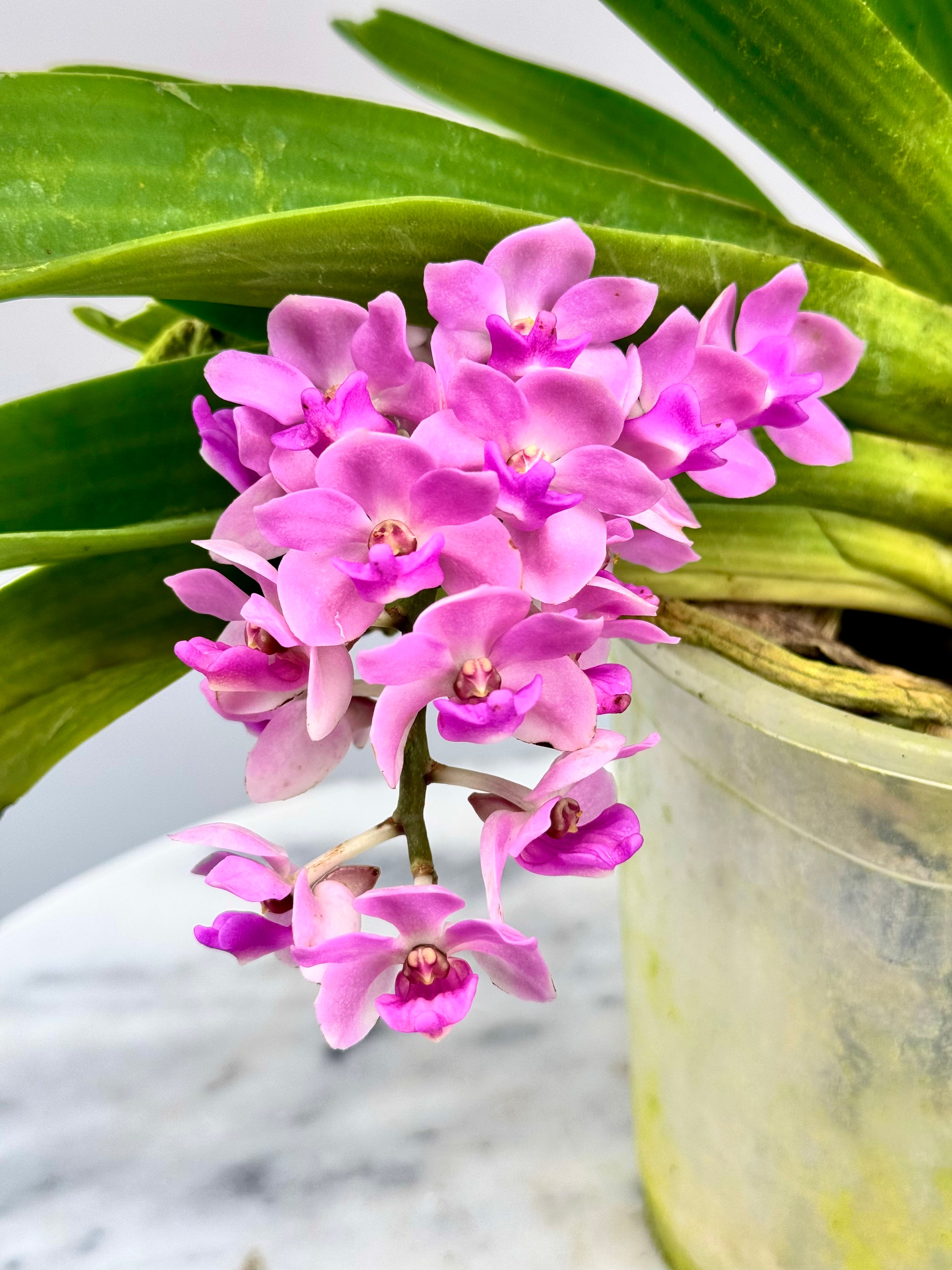
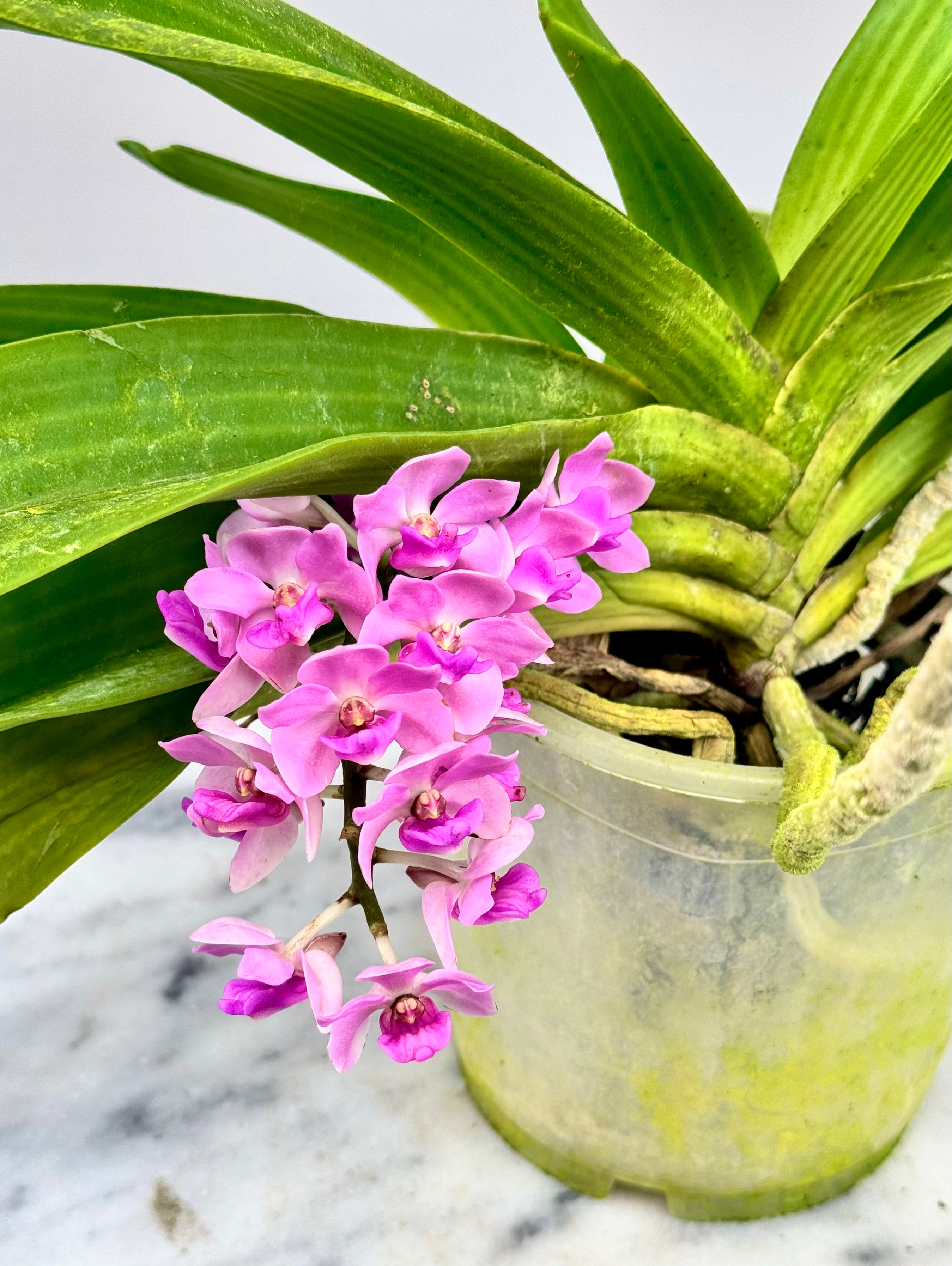
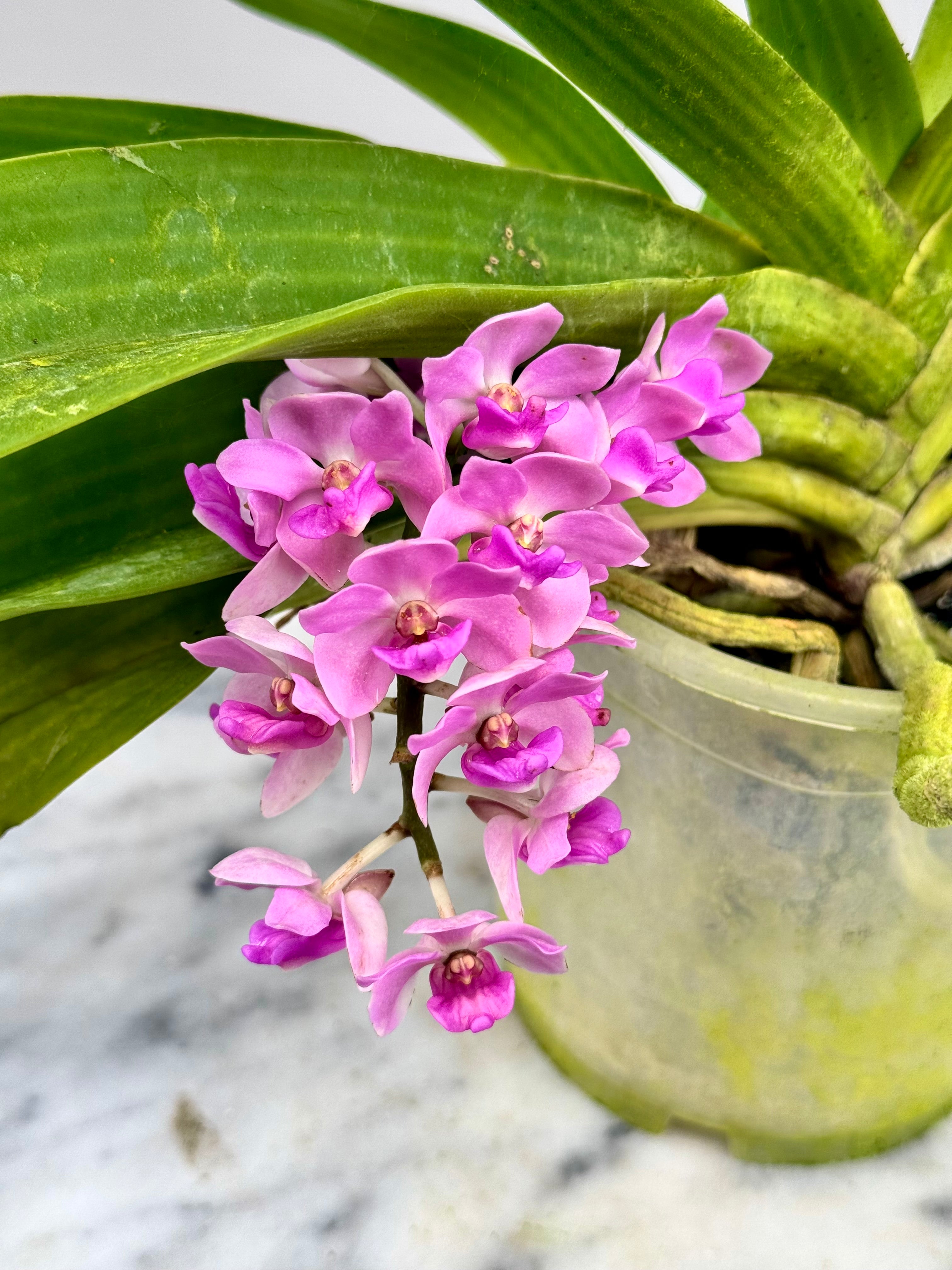
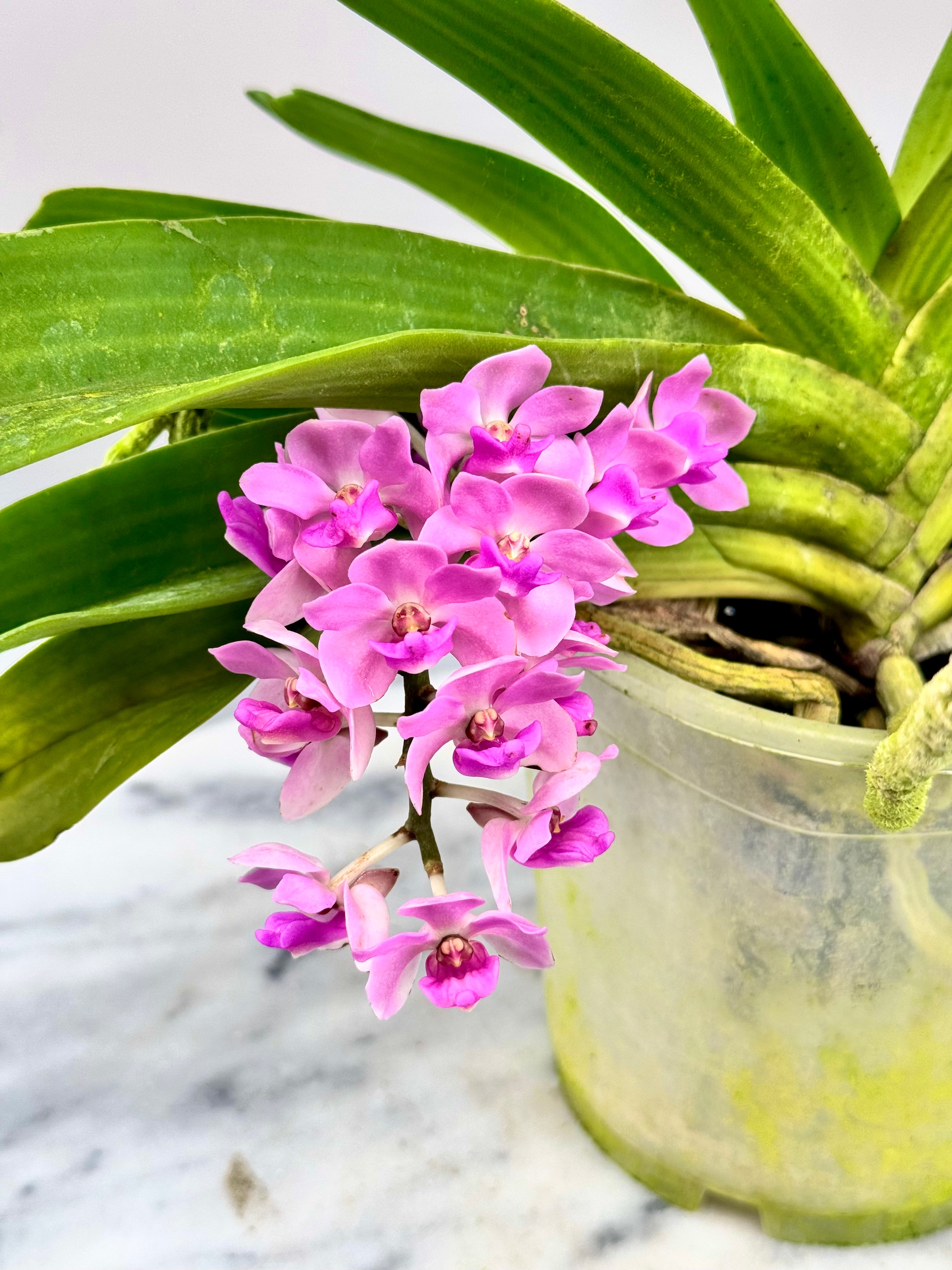
Rhynchostylis gigantea ‘Pink’ is a warm-climate orchid species with thick, leathery leaves and densely packed, pendulous flower clusters. The pink flowers have a waxy texture and emit a strong, spicy-floral fragrance. It is especially the combination of winter blooming, fragrance, and a rich pink color that makes this variety appealing to collectors.
‘Pink’ is a commercial designation for the pink color form and not a separate botanical variety. The exact color intensity and pattern may therefore vary slightly from plant to plant.
Origin
Rhynchostylis gigantea is found from Hainan and Myanmar to Laos, Thailand, Cambodia, Vietnam, Malaysia, and Borneo. There, the species grows as an epiphyte on trees in warm, humid tropical forests.
The plant does not grow in soil. Its thick roots attach to bark and become completely saturated during rainy periods, after which they dry out relatively quickly thanks to heat and air circulation. This natural growth habit explains why Rhynchostylis can tolerate a lot of water but reacts poorly to a constantly wet and confined substrate.
Rhynchostylis gigantea was originally described as Saccolabium giganteum. The pink, red, white, and spotted color forms are often referred to in the orchid world by informal variety or selection names, but botanically belong to the same species.
Characteristics
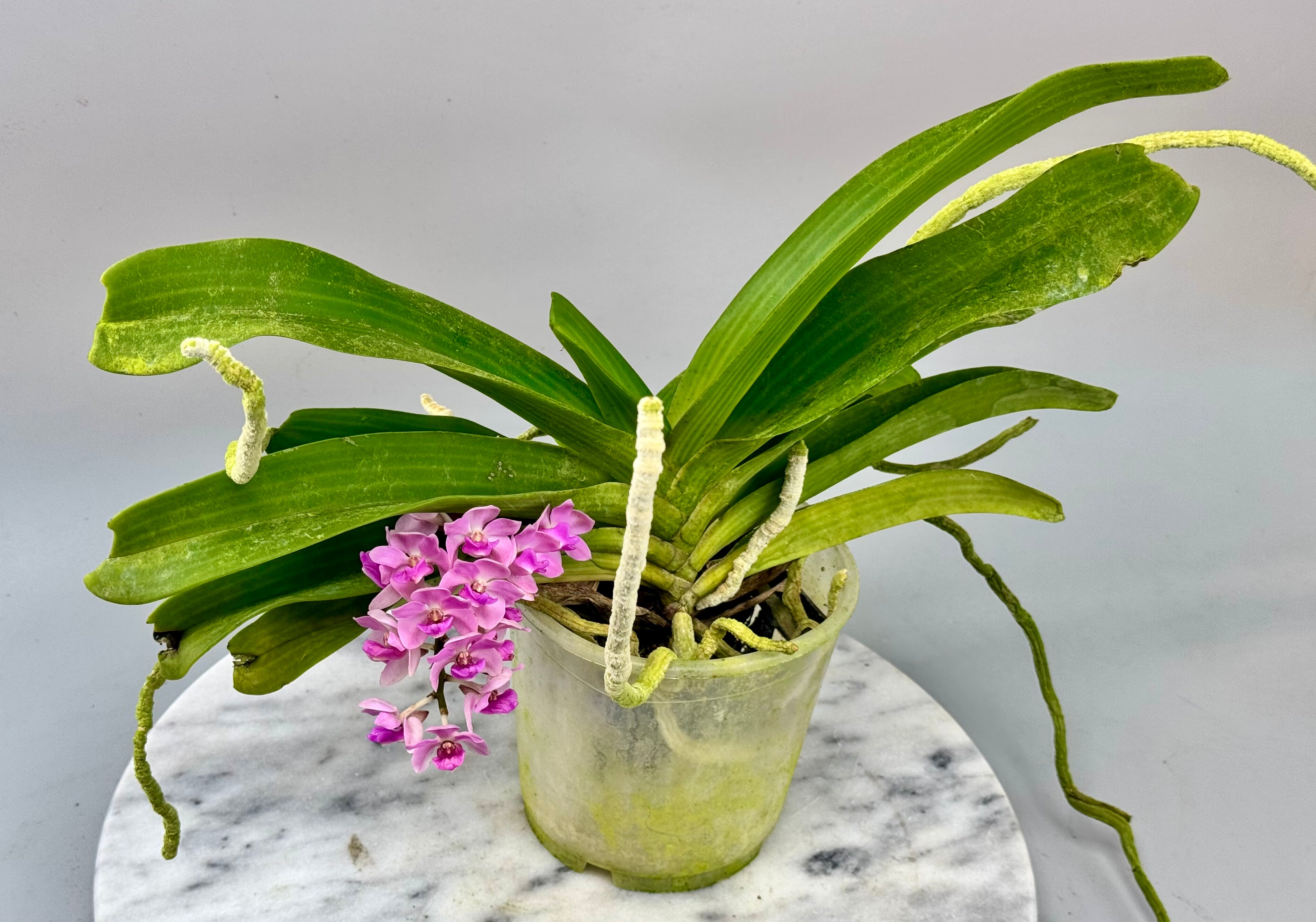
Rhynchostylis gigantea grows monopodially. This means that the plant grows upward from a single central stem and does not form pseudobulbs. Along this short, sturdy stem, broad, dark green leaves are arranged in two rows.
The leaves are thick, leathery, and sometimes feature lighter longitudinal stripes. A mature plant can develop a considerable leaf span. Despite its relatively compact size Potsize, this is therefore not a miniature orchid. Also take into account the thick aerial roots and the space required by the hanging flower spikes.
The flower spikes emerge from the leaf axils and can bear dozens of waxy flowers. Well-developed plants may produce multiple spikes at the same time. As the plant ages and becomes stronger, its ornamental value increases significantly.
Care
This species thrives in warmth, high humidity, bright filtered light, and plenty of air around the roots. Care is similar to that of a Vanda, but Rhynchostylis gigantea generally grows more slowly and requires slightly less intense light.
A fixed weekly watering schedule doesn’t work as well. Check the roots, the temperature, and how quickly the substrate dries out. Healthy, moist roots turn green; as soon as they turn silver-gray again, the plant is ready for another watering.
Light
Provide Rhynchostylis gigantea ‘Pink’ plenty of bright, indirect light. About 20,000 to 30,000 lux is usually suitable. A bright east- or west-facing window, a shaded greenhouse, or a spot under strong grow lights works well.
The plant needs more light than an average Phalaenopsis, but less direct sunlight than many Vandas. Protect the leaves from bright midday sun behind glass. Stagnant heat, in particular, can quickly cause pale or brown scorch marks.
Insufficient light is a common reason why a mature Rhynchostylis fails to bloom. Very dark green, increasingly elongated leaves without flower buds may indicate that the location is too dark.
Temperature
Rhynchostylis gigantea is a warm- to moderately warm-climate orchid:
During the day, approximately 22 to 30 °C
; at night, approximately 17 to 21 °C
During the winter, the nighttime temperature may gradually drop to 15 to 17 °C, but prolonged cold is poorly tolerated. Keep the plant warmer if the roots or growing medium are still wet.
Hot summer days are not a problem as long as the humidity remains sufficiently high and there is good ventilation. The combination of heat, dry air, and stagnant air can cause young root tips to dry out.
Substrate and Cultivation Method
The thick, stiff roots require plenty of oxygen. In a pot, a very airy mixture of coarse orchid bark, charcoal, and possibly coarse perlite or pumice works best. A small amount of loose sphagnum moss can help retain moisture slightly longer in a dry living room, but it must not seal off the root ball.
Do not use a fine, compact growing medium, and never pack sphagnum tightly around the roots. Especially during a cool, dark European winter, a dense core can remain wet for too long.
An open basket without substrate or with just a few large pieces of bark and charcoal closely mimics the plant’s natural growth habit. However, this method of cultivation requires much more frequent watering indoors. An open or perforated pot with coarse bark is therefore often more practical.
Rhynchostylis gigantea has stiff roots that break easily and does not respond well to unnecessary repotting. Therefore, let a healthy plant grow in the same pot or basket for as long as possible. Repot only when the growing medium has deteriorated or the pot has truly become unsuitable.
Humidity
A humidity level of approximately 60 to 80% is ideal. In warm conditions, this may temporarily be higher, provided there is a constant, gentle air movement.
Good ventilation not only helps the roots dry out but also prevents water from lingering in the leaf axils and crown. In an enclosed space without a fan, the risk of bacterial infection, mold, and crown rot increases rapidly.
Watering
Thoroughly wet the entire root ball and then allow the excess water to drain completely. Water again when the visible roots are mostly silver-gray and the coarse growing medium has almost dried out.
During warm, sunny periods, this may be necessary several times a week. A plant growing in a basket without substrate may need daily watering in the summer. In the winter, a potted plant dries out more slowly, and watering should be adjusted to account for lower evaporation.
Rhynchostylis gigantea does not have a strict, dry dormant period. During the cooler winter months, the plant may be kept slightly drier, but do not allow the thick roots to shrivel completely for extended periods.
Preferably use rainwater, reverse-osmosis water, or other soft water. Water preferably in the morning so that the leaf axils and growing tip can dry out before nightfall.
Fertilizer
During active growth, apply a low dose of orchid fertilizer regularly. About one-quarter to one-half of the recommended concentration every two to three waterings is usually sufficient.
Rinse the pot and roots regularly with clean water. The thick roots are sensitive to high concentrations of fertilizer salts. Reduce fertilization when the plant produces hardly any new roots or leaves during the dark winter months.
Flowering
Rhynchostylis gigantea is known as a winter bloomer. Under European conditions, the flower stalks usually appear between late fall and early spring, with peak blooming around January and February.
The compact, pendulous clusters bear numerous flowers measuring about 2.5 to 4 centimeters. Because the buds do not all open at once, the overall bloom can remain visible for several weeks to a few months.
The flowers emit a distinctively spicy-floral scent. This scent is often strongest during the day when the temperature rises slightly. The pink variety has a softer appearance than the dark red selections, but remains striking due to the density of the flower cluster.
Do not remove the flower stalk until it has completely dried out. Never cut into the central growing point or too close to the leaf axils.
Care Level
Moderate.
This species is suitable for enthusiasts who already have some experience with Vandas or other epiphytic orchids. The main considerations are sufficient light, warm conditions, and striking a balance between frequent watering and allowing the soil to dry out quickly enough.
These plants are imported and may initially focus their energy on developing new roots after arrival. This is normal. During this acclimatization phase, provide the plant with a stable, warm location and do not repot it unless absolutely necessary.
Rhynchostylis gigantea grows relatively slowly. A mature plant may be capable of flowering, but that does not mean it will produce a flower spike immediately after delivery. Light, root health, and seasonal rhythms determine when the next bloom will appear.
Who is this plant suitable for?
Rhynchostylis gigantea ‘Pink’ is a good fit for collectors who:
Are looking
for a fragrant species orchid that blooms in winter Appreciate
a distinct pink color form Have space for broad leaves, aerial roots, and hanging flower clusters
Have
a warm greenhouse, a sunny windowsill, or a well-ventilated plant cabinet Are willing to adjust
watering based on the condition of the roots Enjoy allowing a slow-growing plant to develop into a larger specimen
This species is less suitable for a dark room, a cold windowsill, or a closed terrarium. Those with limited space for aerial roots and hanging flower spikes should also opt for a more compact orchid.
Experience growing indoors, in a greenhouse, or in a plant cabinet
Indoors, Rhynchostylis gigantea ‘Pink’ best near a bright east- or west-facing window. Do not place the plant above a radiator, and make sure there is space under or next to the pot so the flower stalks can hang freely.
A warm greenhouse is ideal, as it’s easier to maintain a balance of light, humidity, and ventilation there. Be careful of excessive sunlight in the summer.
A spacious plant cabinet may also be suitable, but mature plants take up more space than the Potsize suggests due to their broad leaves and stiff roots. A small display case or terrarium will quickly become too cramped. In addition, ventilation must be sufficient to allow water to evaporate from the crown and leaf axils.
Additional care tip
Do not repot the plant until new green root tips appear at the base. Thoroughly wet the old roots beforehand so they become slightly more flexible, and try to move them as little as possible. A broken Rhynchostylis root will not regrow in the same place; the plant must then form new roots from a different point.
Short product description
Rhynchostylis gigantea ‘Pink’ is a fragrant species orchid from Southeast Asia with sturdy leaves and densely packed, pendulous flower clusters. The waxy pink flowers usually appear in winter and give off a strong, spicy-floral scent. A mature collector’s plant for a warm, bright, and well-ventilated location.