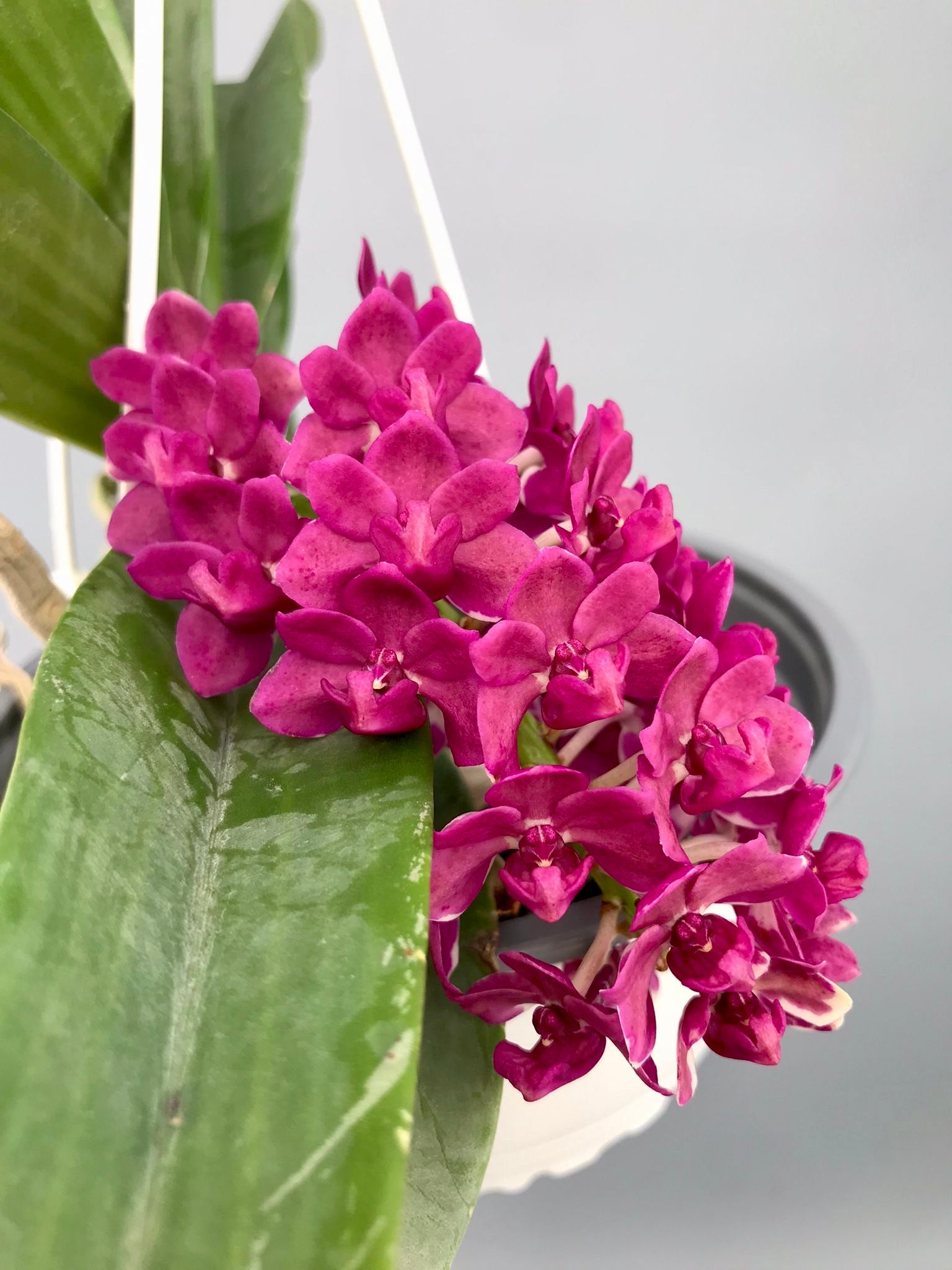
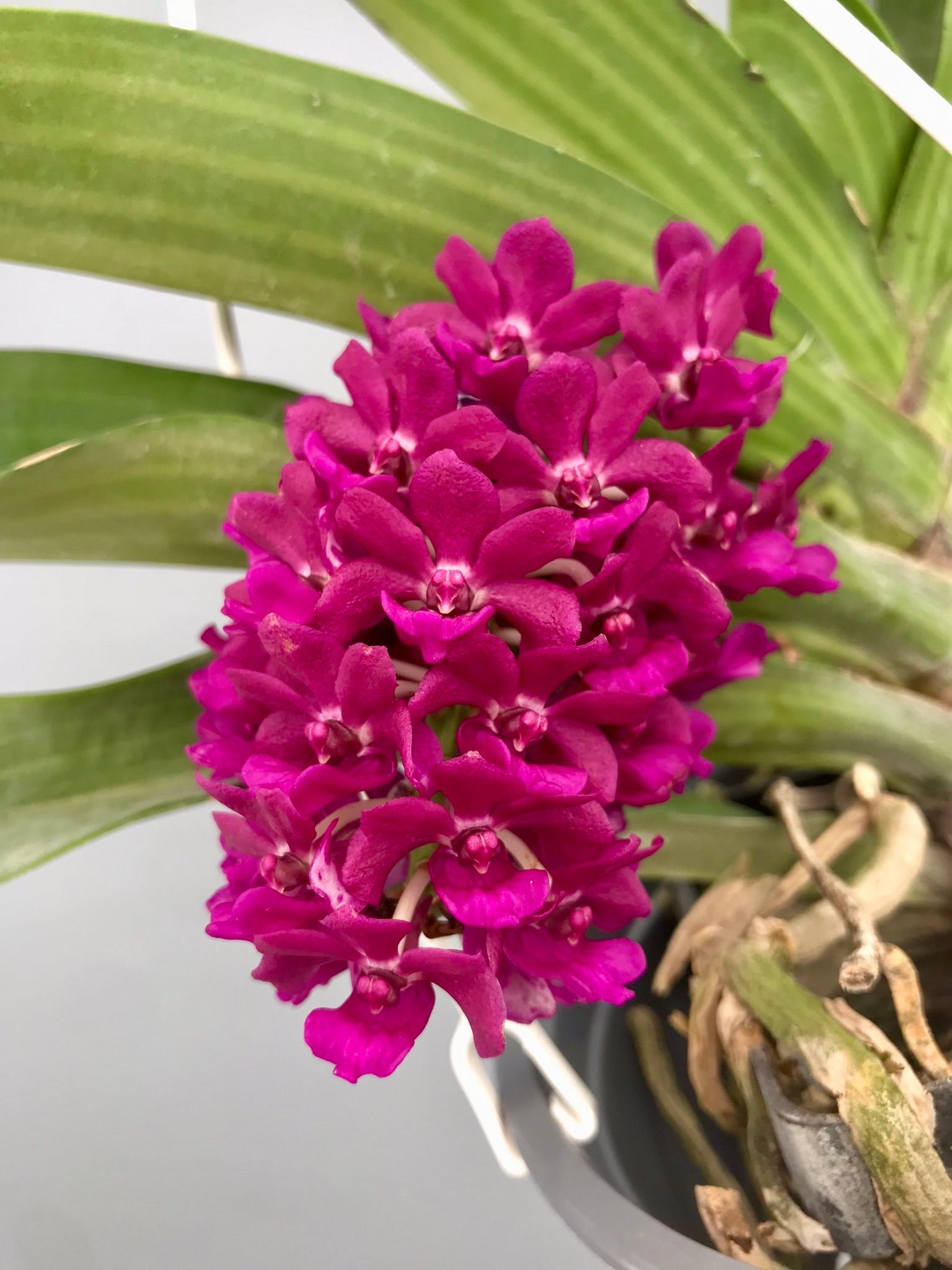
We have been growing and importing the Rhynchostylis gigantea for 20 years now, and it remains a rewarding plant. The plant is robust, blooms profusely, and has a delightful fragrance. The older and larger the plant becomes, the more flowers it produces. Artificial pollination has expanded the color range of this plant to include orange, red, and peach tones. Rhynchostylis gigantea is native to Myanmar, Thailand, Malaysia, Laos, Cambodia, Vietnam, China, Borneo, and Indonesia.
Characteristics and Appearance
The Rhynchostylis orchid has typical Vanda characteristics. It is a monopodial plant (growing from a single point) with leathery leaves that grow in opposite directions. The plant has silvery-green roots with a thick outer layer and blooms in hanging clusters.
Growth habit
It is a medium-sized, warm-climate epiphyte. This means it grows on branches and trees, not in the ground. The plant grows up to 60 cm tall, with a strong and thick stem that forms at the base. The leaves are up to 30 cm long and 5–7.5 cm wide.
Flowers
The Rhynchostylis gigantea flowers grow in clusters up to 37 cm long. The sweet-smelling flowers remain on the plant for about two weeks. The flowers have a diameter of 2.5–3.8 cm. They are usually white, with reddish-purple, amethyst-purple, or crimson spots, and often have a clearly visible spike in the same color. The lip is also reddish-purple, amethyst-purple, or crimson and usually fades at the base and toward the center to a white color. Varieties with white flowers have also been found, and occasionally you’ll find specimens with red flowers.
Care
Sunlight
This plant likes sunlight, but not direct sunlight. Diffused light is preferable. Direct midday sunlight can be harmful to the plant. The plant prefers good air circulation around the roots.
Temperature
It is a thermophilic plant, so it thrives in warmth. The plant can tolerate cooler conditions, but you must be careful with watering. The plant will dry out more slowly. The daytime temperature is 21.5–33 degrees Celsius and 18.5–25 degrees Celsius at night. In the spring, it can be slightly warmer, around 24–35 degrees Celsius. In winter, this plant also needs a warm temperature, around 21.5–33 degrees Celsius.
Humidity
The Rhynchostylis gigantea requires a humidity level of approximately 80% for most of the year, reduced to about 70–75% in winter and early spring. At a low temperature (21 degrees Celsius), the humidity can be lowered to 40–70%.
This applies to potted plants. Humidity in the growing medium is higher. The above-ground portion requires less water, and the center of the plant remains dry, which helps prevent rot. The part below ground needs more moisture and can absorb more water. The substrate retains moisture better, while hanging plants dry out more quickly and therefore require higher humidity.
Watering
Rainfall in the natural environment varies from abundant to very abundant. Rainstorms begin at the end of spring and last until fall. After that, the dry season begins fairly quickly, lasting 3–4 months (winter and early spring). Cultivated plants should be watered abundantly during the growing season, but airflow around the roots must be ensured so that they can dry quickly after watering. For plants growing in pots or baskets, the substrate used should not become wet.
Placement
Rhynchostylis gigantea grows best when several aerial roots are loosely can be hung. You can place the plant in wooden baskets without adding any growing medium, or attach the plant to tree ferns or cork without any growing medium around the roots. Under these conditions, high humidity must be maintained, and the plants should be misted with water at least once a day, and even several times a day on hot and dry days.
Substrate
They can also be grown in pots with very loose, quick-drying soil, so that the roots can dry out quickly after watering. Good results are achieved with a mixture of equal parts medium-sized and large pieces of spruce bark and charcoal. You can use charcoal alone as a growing medium.
Repotting
These plants do not respond well to repotting. However, if the plants are grown in pots filled with a bark mixture, they must be repotted every year, as the bark may break down, which can quickly lead to the death of the root system. The plant should be planted very shallowly. Plants adapt more quickly and with less stress if they are repotted or transplanted during the phase when new roots are just beginning to grow.
Fertilization
During the active growing season, the plants should be fertilized weekly with orchid fertilizer. You can use slow-release fertilizers year-round, but you can also use fertilizers with a higher nitrogen content from spring through mid-summer. And in late summer and fall, you can use fertilizer enriched with phosphorus.
Dormancy Period
Rhynchostylis gigantea requires much less water in the winter. If the humidity is high in winter, occasional misting of the plants and occasional watering should provide sufficient moisture for proper development. If the humidity is low, the plant should be watered more frequently. These plants should never be allowed to dry out completely. Fertilization should be reduced or stopped entirely until spring.