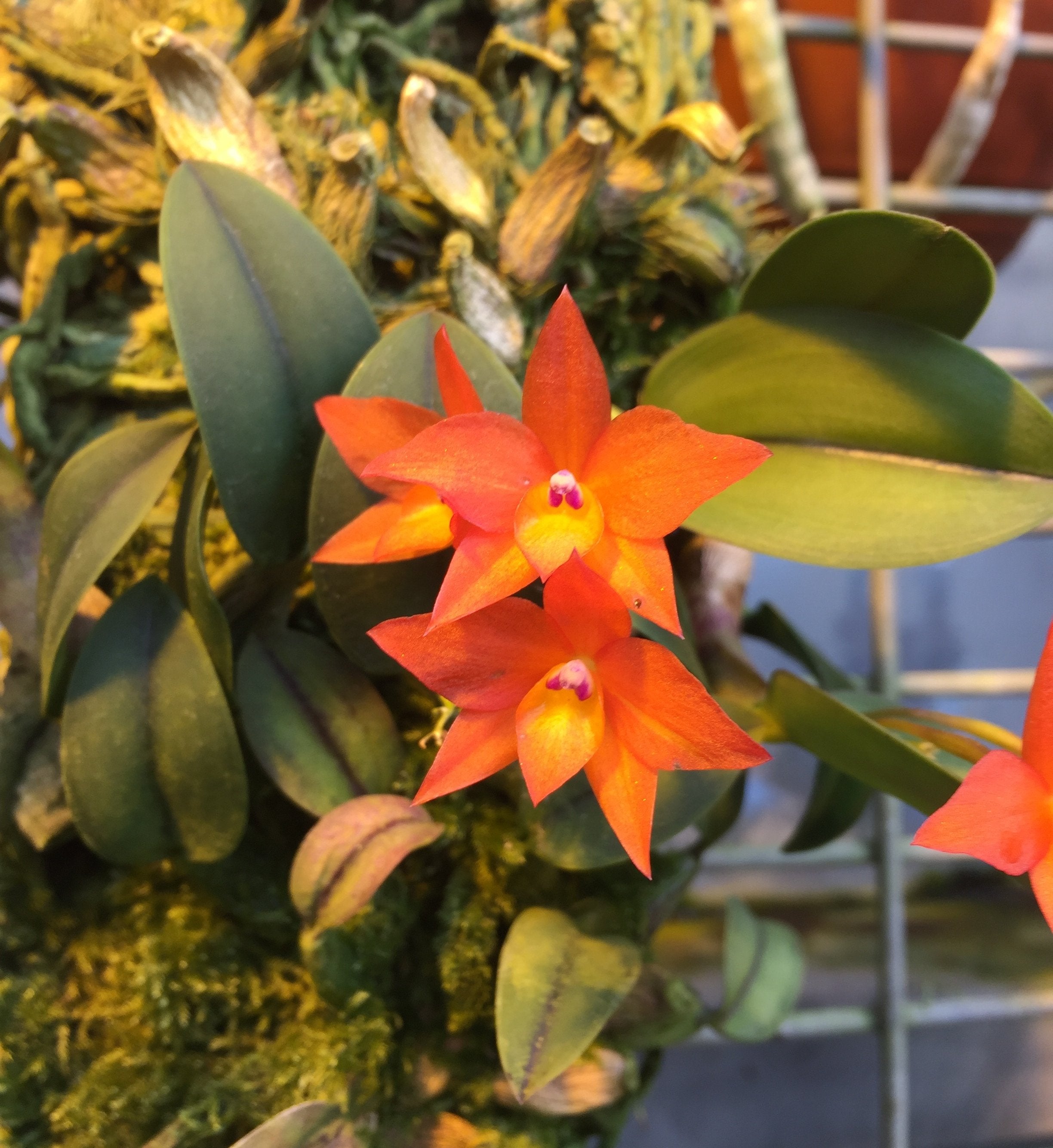
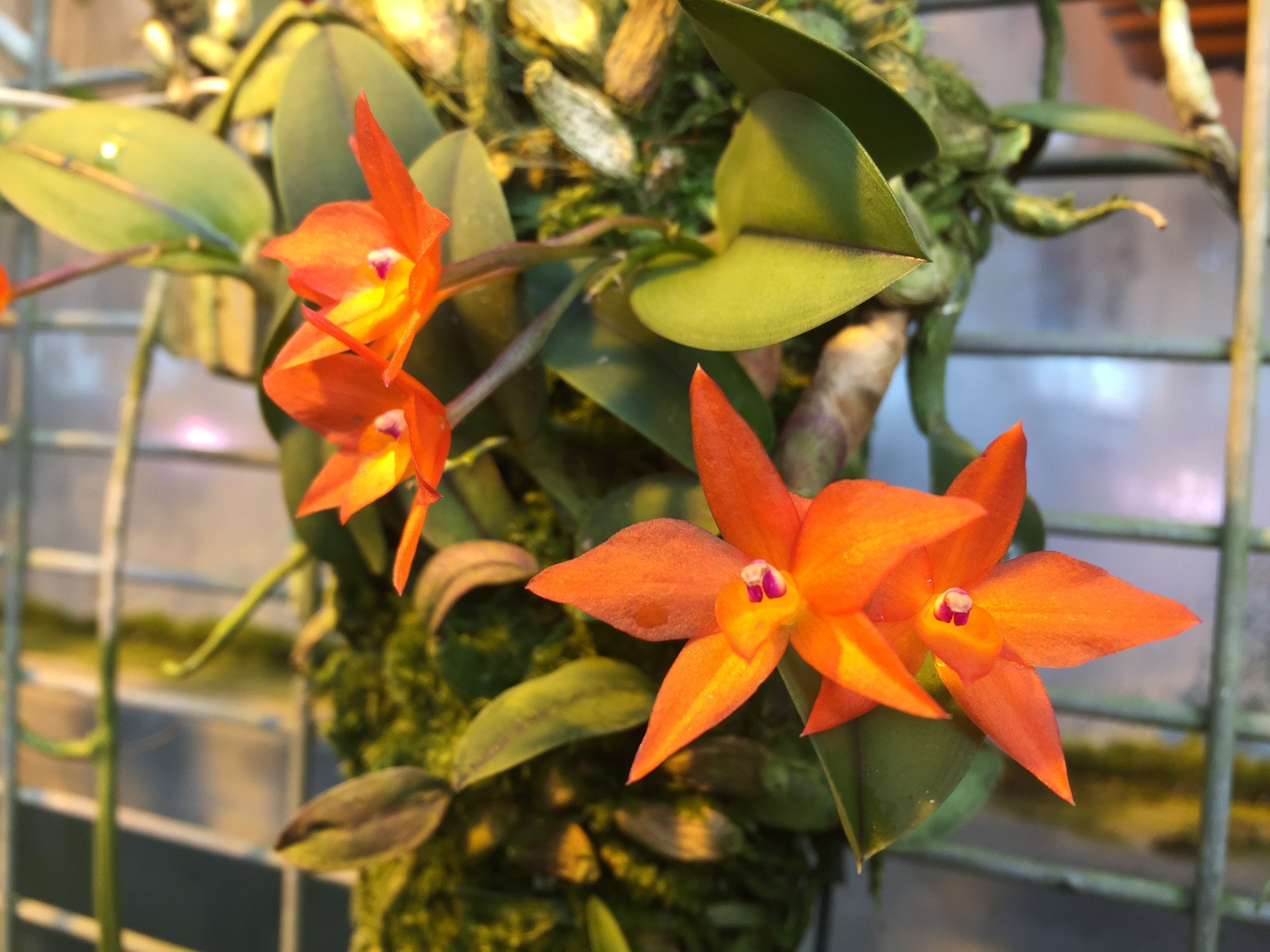
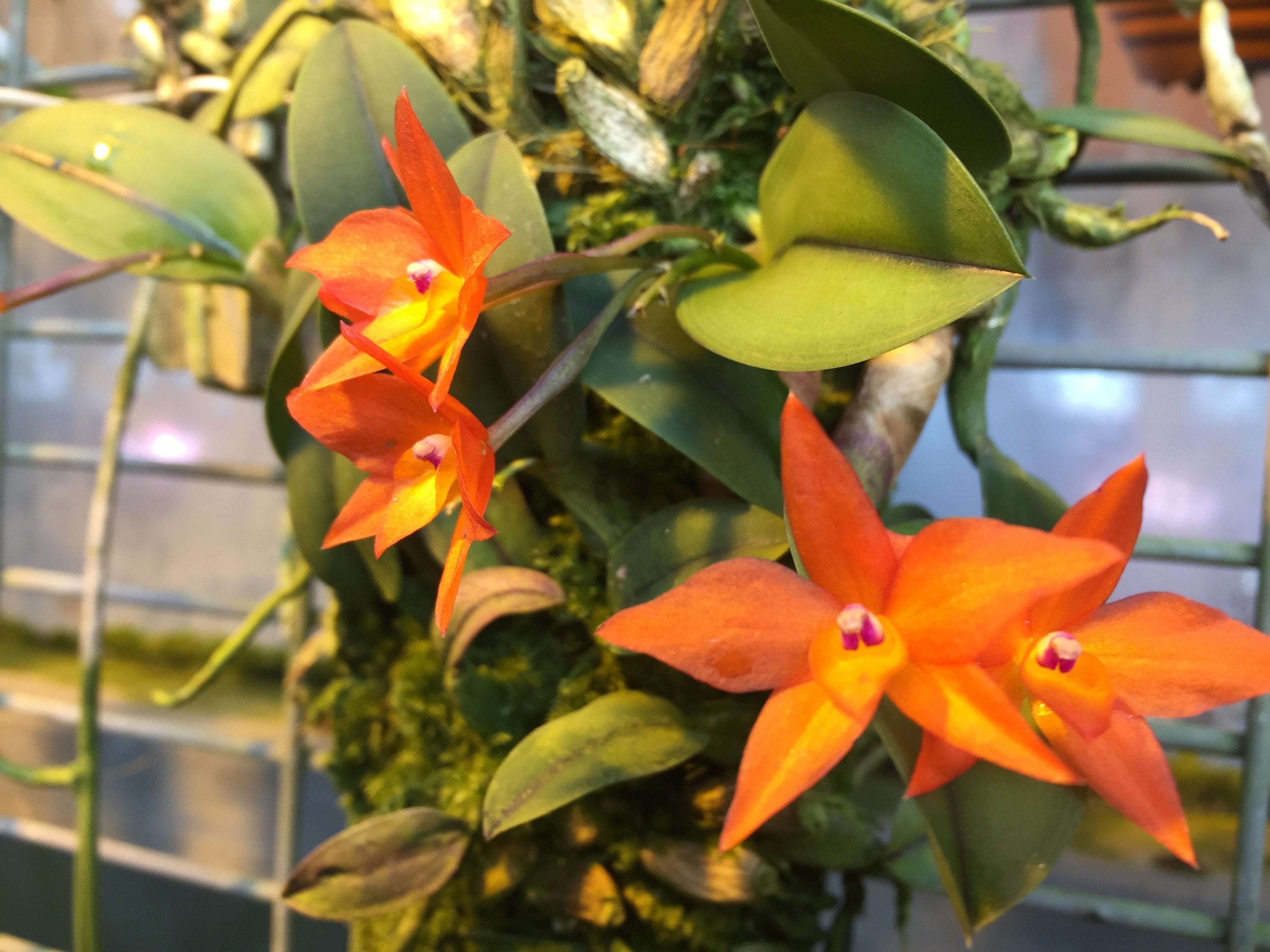
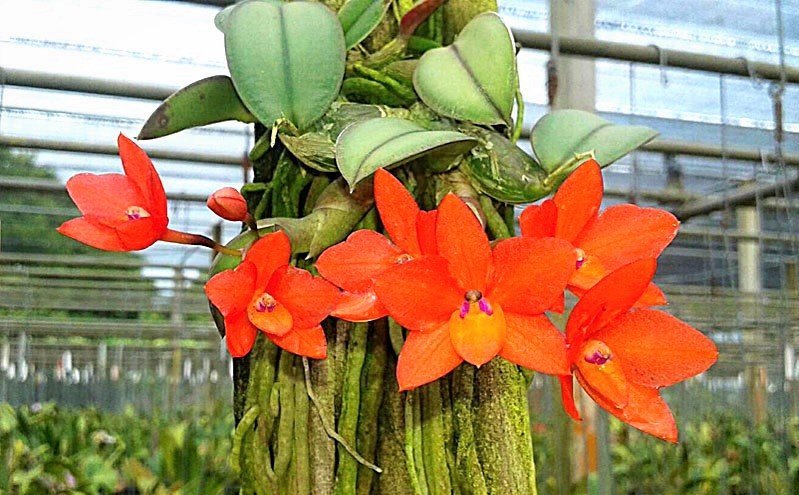
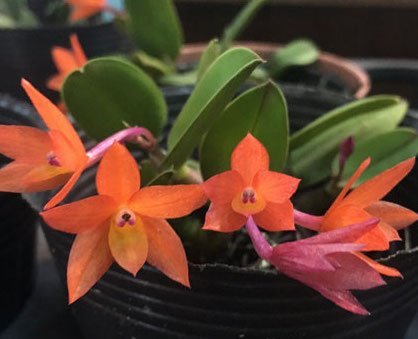
Sophronitis cernua is a true miniature orchid that proves a small plant can still make a big impression. Its compact growth consists of short pseudobulbs with sturdy, round leaves. Above them, clusters of bright orange-red to scarlet flowers appear. This creates a striking contrast—especially in older specimens—between the plant’s modest size and the abundance of color.
This species is particularly popular among collectors who have limited space but are looking for a botanical orchid with character. Furthermore, the plant can be mounted on a cork board or other piece of wood, making it ideal as a hanging miniature orchid.
Name and Taxonomy
Although this orchid is still almost always referred to as Sophronitis cernua in collections and in the trade, the modern accepted botanical name is Cattleya cernua. The species, along with the other former Sophronitis species, was reclassified into the genus Cattleya.
Since the old name is still very recognizable among orchid enthusiasts, we use the name Sophronitis cernua for this product. This ensures the plant remains easy to find for collectors specifically searching for Sophronitis.
The species name *cernua* loosely translates to “nodding” or “bent forward.” This refers to the short inflorescence and the way the flowers are positioned above the compact plant.
Origin
Cattleya cernua occurs naturally in various parts of Brazil and extends toward Paraguay and northeastern Argentina. The species grows both epiphytically on trees and small branches and lithophytically on rocky surfaces.
Unlike several former Sophronitis species that grow in cooler climates, S. cernua also occurs in relatively warm, low-lying areas. There, the plants often grow in light, open areas, where high humidity, morning dew, and local moss cover prevent the small roots from drying out for extended periods. At the same time, sun, wind, and the open growing environment ensure that excess water can drain away quickly.
In terms of care, this means the plant tolerates more light and heat than, for example, Sophronitis coccinea. However, the root zone should not remain bone-dry for days on end. The best results are therefore achieved with a combination of plenty of light, regular watering, sufficient humidity, and constant air circulation.
Characteristics
The plant produces small, somewhat flattened pseudobulbs that grow close to a creeping rhizome. Each pseudobulb typically bears a single thick, round to oval leaf. The individual growth shoots remain small, but as the plant matures, it can slowly spread across its substrate and form a dense carpet.
A short inflorescence bearing several flowers may emerge from a mature shoot. Depending on the individual plant and growing conditions, approximately three to seven flowers may form at a time. The flowers are typically about two to three centimeters in size and have a vibrant orange-red to scarlet color. Warmer yellow, orange, or deep red details are often visible at the center.
Although the individual flowers are smaller than those of many other Cattleya species, Sophronitis cernua more than makes up for this with the number of flowers. As a result, a well-developed plant can be almost completely covered in color during flowering.
Care
This miniature orchid requires a bright, warm to moderate location with relatively high humidity and plenty of air circulation. The balance around the roots is particularly important. The roots should be watered regularly but must not be trapped in a dense, oxygen-deprived growing medium.
Because the plant remains small and has a creeping growth habit, it also does not respond well to a pot that is too large. A compact and airy growing method better suits its natural growth.
Light
Provide Sophronitis cernua with plenty of bright, filtered light. This species can be kept at roughly the same light level as a Cattleya and, with gradual acclimatization, can even tolerate some direct morning or evening sun. Behind glass, however, intense midday sun in the spring and summer must be filtered to prevent sunburn and overheating.
A slightly reddish or purplish leaf color may develop in this species when the plant receives plenty of light. This is not necessarily a problem. If, on the other hand, the leaves turn dark green and flowering fails to occur, the plant is likely in a location that is too dark. Yellow-green, scorched, or bleached spots, on the other hand, indicate too much direct sunlight.
In a grow light setup, the plant can be placed relatively high and close to the light source, provided the leaves do not feel warm to the touch and there is sufficient air circulation.
Temperature
Sophronitis cernua thrives in warm to moderate temperatures. During the day, a temperature of about 20 to 28 °C is suitable, while the nighttime temperature should preferably be between 15 and 20 °C. A slight drop in temperature overnight supports steady growth and can promote flowering.
Short-term higher temperatures are generally tolerated when humidity and air circulation are sufficient. In particular, the combination of heat, stagnant air, and a plant that remains wet for an extended period should be avoided. Overwintering in cold and wet conditions also increases the risk of root and shoot rot.
Substrate and Cultivation Method
This species thrives particularly well on cork, fern root, hardwood, or another rough, durable substrate. Because the plant grows as a creeper, new shoots can then spread naturally across the material. A thin layer of sphagnum moss under the roots can help retain moisture slightly longer while the plant is establishing itself. However, do not use a thick, compacted layer in which the roots remain constantly wet.
If daily or very frequent watering isn’t practical, the plant can also be grown in a small, shallow pot or an open basket. In that case, use an airy mixture of fine to medium-sized orchid bark, possibly supplemented with a small amount of loose sphagnum moss, perlite, pumice, or fine charcoal. The mixture should retain some moisture but at the same time allow plenty of oxygen to reach the roots.
Never place the plant directly into a pot that is much too large. In such a pot, the center of the growing medium dries out too slowly, while the small root system cannot absorb the available moisture quickly enough. It is best to repot only when new root tips become visible, so that the plant can quickly establish itself in the new growing medium.
Humidity
A humidity level between approximately 60 and 80 percent is ideal. In very bright light or when growing on a mounted system, the humidity may be on the higher side. However, humid air must always be combined with gentle, continuous air circulation.
A small fan is therefore recommended in a plant or orchid cabinet. Do not let it blow directly and forcefully onto the plant; instead, ensure an even flow of air. This allows leaves and young shoots to dry more quickly after misting, while the roots benefit from the higher ambient humidity.
Watering
Water regularly and thoroughly during active growth. For a mounted plant, don’t just wet any moss present; also allow the roots and the entire growing medium to absorb water well. Then allow the surface to dry out slightly before watering again. However, do not let the plant stand dry for so long that the small pseudobulbs begin to wrinkle significantly.
A mounted plant may need watering daily or every other day during warm and sunny periods. In a pot, the frequency is lower because the substrate remains moist longer. Therefore, always check the actual condition of the root zone rather than watering according to a fixed schedule.
During cooler and darker winter periods, watering can be reduced slightly. However, this species does not have a strict, completely dry dormant period. As soon as new root tips or shoots become visible, watering can be increased again.
Preferably use rainwater, reverse-osmosis water, or other soft water. Water in the morning so that new growth and leaf axils can dry off before nightfall.
Fertilization
During active growth, a highly diluted orchid fertilizer can be applied once every one to two weeks. About a quarter of the normal recommended dosage is usually sufficient. Because the plant is small and has fine roots, a high salt concentration is more harmful than helpful.
Therefore, rinse the roots and the growing medium regularly with clean water. During the dark winter months, fertilization can be reduced, especially when the plant is producing very few new roots or shoots.
Flowering
Flowers emerge from newly matured shoots and, under European growing conditions, often appear in the fall or early winter. However, the exact flowering period can vary depending on temperature, light, and the timing of new growth.
A small or newly established plant sometimes needs to produce a few new shoots before it begins to bloom profusely. As the plant ages and grows wider, the number of flowering growth points blooming simultaneously also increases. As a result, the blooms become more impressive with each passing season.
Old pseudobulbs should not be removed as long as they are green and firm. They store water and nutrients and contribute to the vigor of future shoots. Moreover, a larger, intact cluster of plants produces the most abundant blooms.
Care Level
Sophronitis cernua has a moderate to slightly higher care level. The species is not exceptionally difficult, but it does require more attention than a standard Phalaenopsis. Especially for mounted plants, watering, humidity, and ventilation must be well balanced.
The plants offered are Adolescent and were recently imported, after which they were further acclimated at our facility. The presence of active root growth is an important positive sign. After receiving the plant, place it in a stable location and avoid moving or repotting it unnecessarily, so that the new roots can continue to develop.
Depending on the product variant selected, the plant may be delivered as Blooming or non-Blooming. For a non-Blooming specimen, it is important to allow for a further acclimatization and growth period before the first blooms appear under the new conditions.
Who is this plant suitable for?
This species is particularly well-suited for orchid enthusiasts and collectors seeking a compact botanical orchid with high floral value. It fits well in a collection of miniature Cattleya orchids, Brazilian species, or mounted orchids. Furthermore, it’s an interesting choice for anyone who appreciates the fiery red appearance of Sophronitis but cannot provide the distinctly cool conditions that some other species require.
For an absolute beginner, a mounted specimen may be less practical, as the roots will react quickly to a dry period that lasts too long. However, anyone with experience growing miniature orchids, who uses a well-ventilated plant or orchid cabinet, or is willing to check the watering schedule regularly, will find this species to be very rewarding.
Growing Experience Indoors, in a Greenhouse, or in an Orchidarium
Indoors, Sophronitis cernua prefers a bright east- or west-facing window, or a south-facing window with filtered light. A mounted plant requires relatively frequent watering in a typical living room. If that’s difficult, a small open pot or basket is more practical.
In a heated greenhouse, this species can be placed among warm- to moderate-growing Cattleya orchids. Ensure plenty of filtered light, sufficient spacing between plants, and good air circulation.
This miniature also looks excellent in a plant or orchid cabinet. Preferably place it higher up in the display, where there is more light and air movement. Although the species’ size makes it suitable for a terrarium-style display, it is less well-suited to a dark, enclosed terrarium where leaves and roots remain constantly wet. A light, ventilated orchid display case is therefore clearly more suitable.
Because the plant creeps along its substrate, it can also be used as a small hanging plant. As the colony grows, it forms a living carpet of pseudobulbs, leaves, and roots that remains attractive even outside the blooming period.
Extra care tip
Pay special attention to the tips of the new roots. Bright green or reddish root tips indicate that the plant is actively growing and that this is the best time to carefully increase watering and fertilization. It is also the safest time to repot the plant or attach it to a new piece of cork.
If the pseudobulbs start to wrinkle severely, the plant is not getting enough water or the roots are not functioning properly. In that case, first check the condition of the roots and the humidity before simply watering more often. Wrinkling can be caused by both drought and damaged roots that have been kept wet for too long.
Brief product description
Sophronitis cernua, now botanically recognized as Cattleya cernua, is a compact botanical miniature orchid native to South America. The plant forms small pseudobulbs with thick, round leaves and can produce abundant clusters of bright orange-red to scarlet flowers. An excellent choice for a well-lit plant or orchid cabinet, a warm greenhouse, a sunny windowsill, or a mounted display on cork.