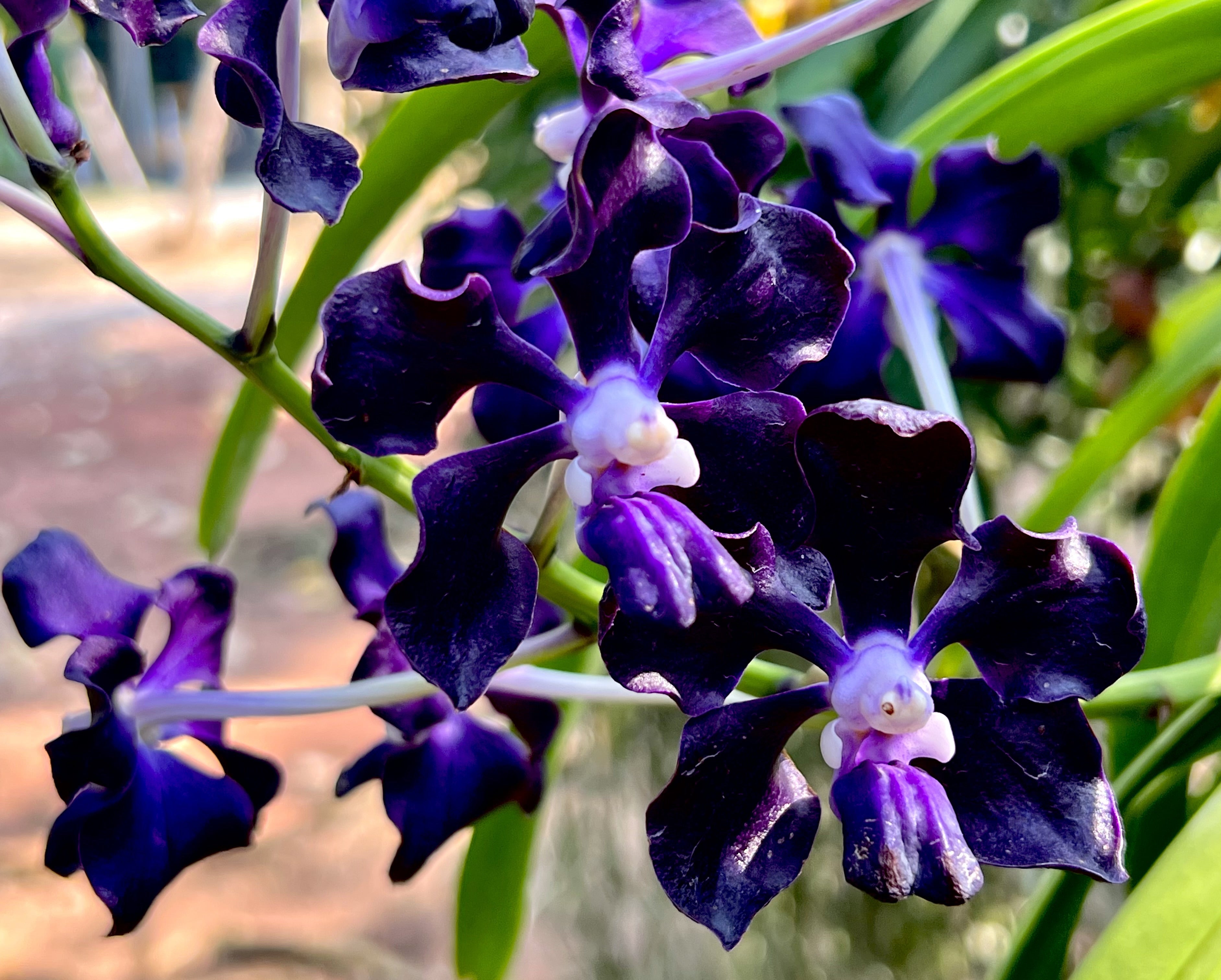
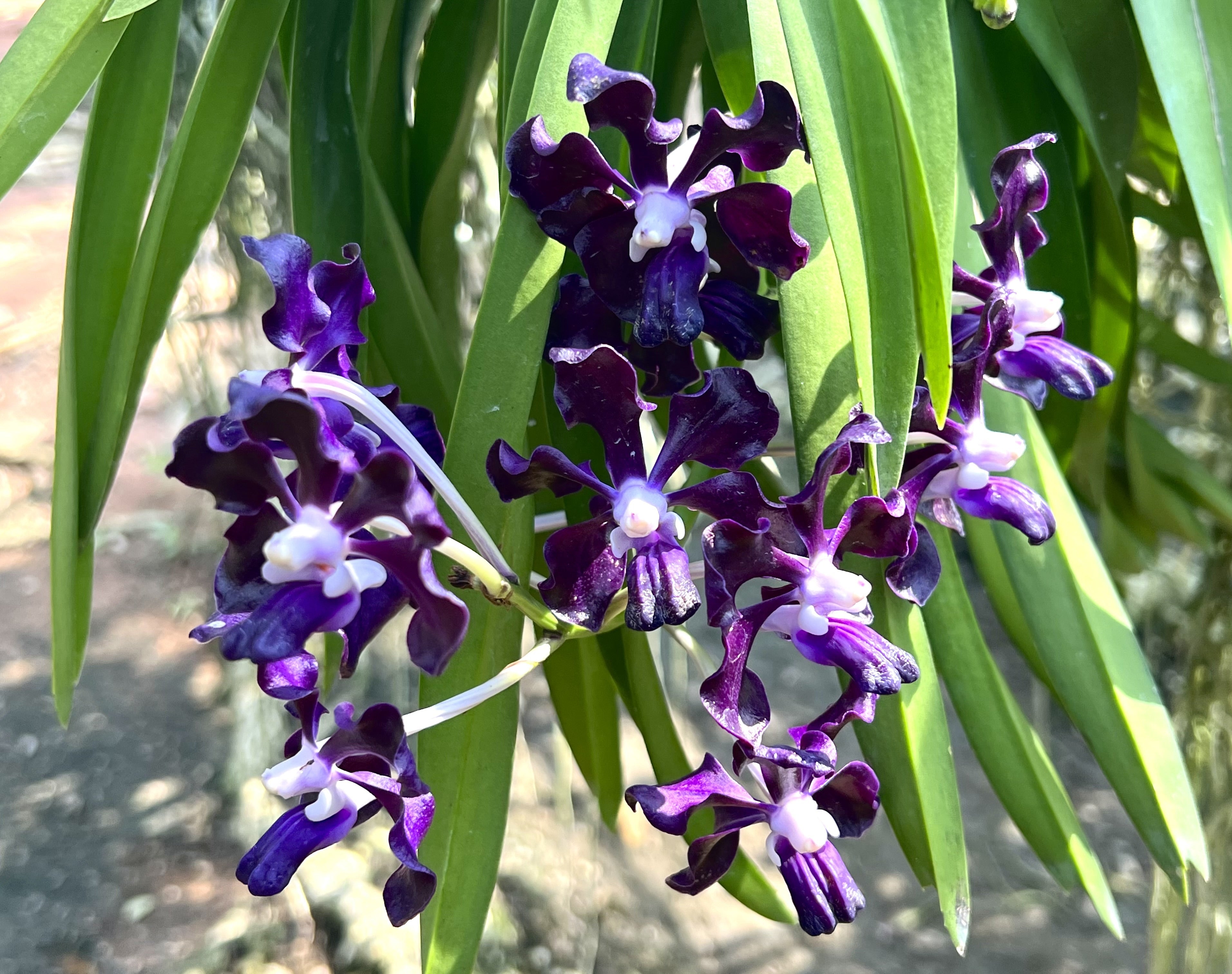
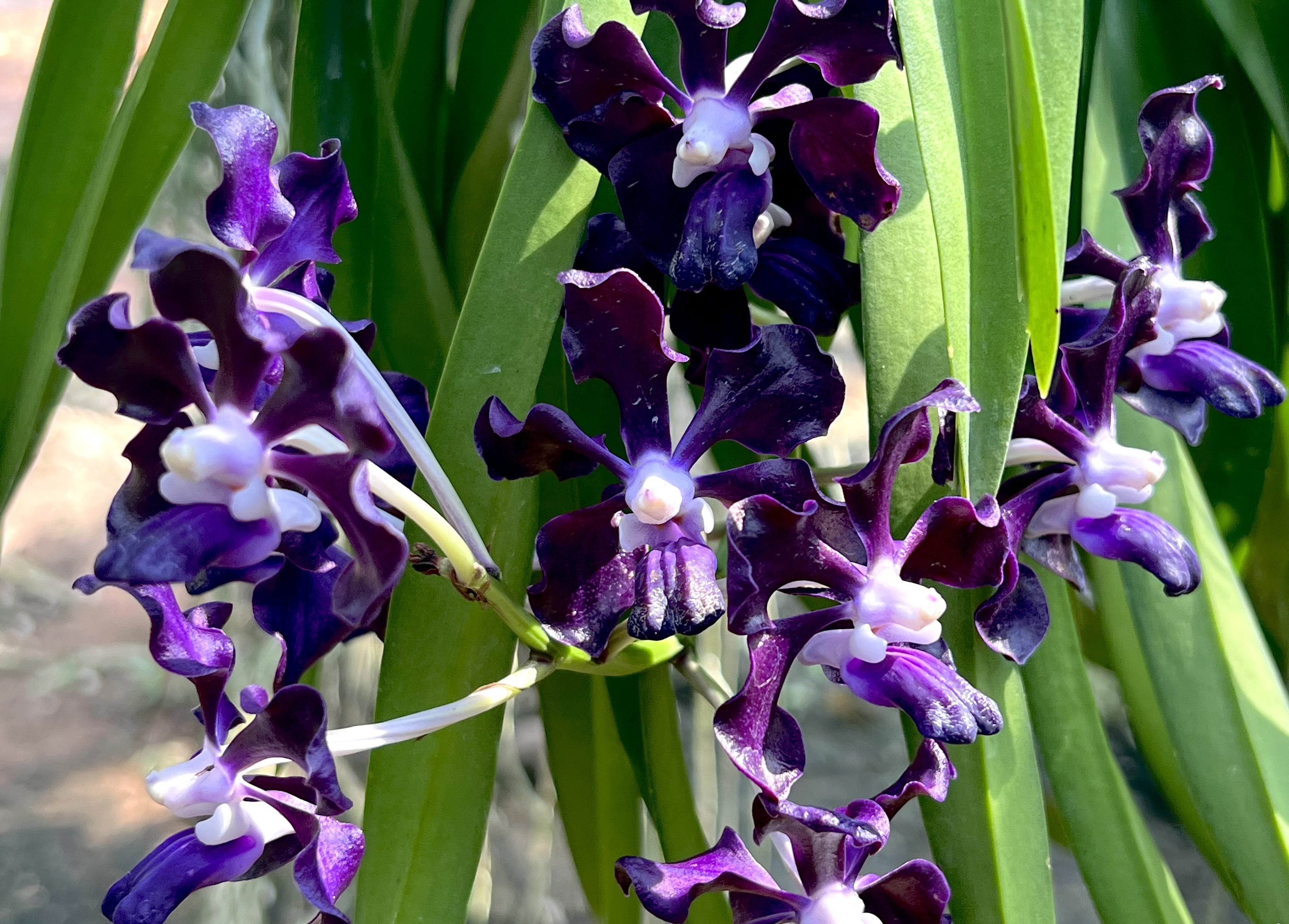
Vanda Jairak Black Knight is one of the most striking dark-flowered Vanda hybrids. The flowers are not literally black, but display an exceptionally deep violet to purplish-black hue that can appear almost black in softer light. In brighter light, the purple, blue, and sometimes wine-red undertones become more visible.
This modern hybrid is particularly interesting for collectors who appreciate not only a rare color but also character in the flower form. The slightly wavy, sometimes slightly curved-back flower parts give the flowers a more lively and botanical appearance than the very flat, round flowers of many commercial Vanda hybrids.
Origin
Vanda Jairak Black Knight is a horticultural hybrid registered in 2020, derived from Vanda × amoena and Vanda tessellata. Since Vanda × amoena itself consists of Vanda coerulea and Vanda tessellata, its genetic background is strongly dominated by Vanda tessellata.
This explains not only the distinctive flower shape but also the plant’s preference for warmth, plenty of light, well-aerated roots, and care that allows the plant to dry out quickly after each watering.
Characteristics
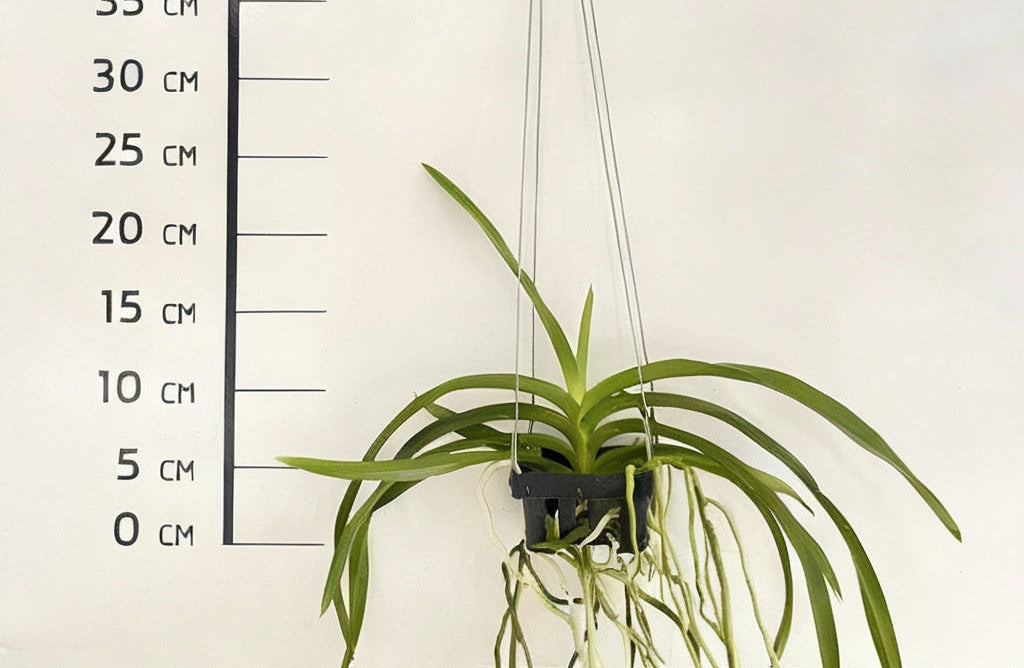
The plant grows monopodially from a single central stem and forms sturdy, strap-shaped leaves in two opposite rows. As the plant ages, it develops an extensive network of thick aerial roots.
The flower spikes emerge from the leaf axils and can bear several waxy flowers. The color varies—depending on light, temperature, and flowering stage—from dark violet to nearly purple-black. A lighter column and a purple-marked lip provide contrast at the heart of the flower.
The term “black orchid” should be understood here as a color description. True black pigment does not occur in Vanda. It is precisely the combination of very dark pigment and cool purple undertones that makes this hybrid so collectible.
Care
Vanda Jairak Black Knight requires the standard care of a warm-growing Vanda: plenty of light, warmth, regular watering, and, above all, plenty of air around the roots. The plant does not have a distinct dry dormant period, but it usually grows more slowly during the dark European winter.
Light
Place this Vanda in as much light as possible. A south-, southwest-, or west-facing window, a bright sunroom, or a warm greenhouse is most suitable. Gentle morning and evening sun is well tolerated once the plant has acclimated. Be sure to protect the leaves from sudden, scorching midday sun through the glass.
Insufficient light is one of the main reasons why a healthy Vanda fails to bloom again. Dark green leaves and sluggish root growth may indicate that the location is too dark. Always increase light intensity gradually to prevent leaf burn.
Temperature
During the day, a temperature of about 22 to 30 °C is ideal. At night, the temperature may cool down to about 16 to 20 °C. Due to the influence of Vanda coerulea, this hybrid can tolerate slightly cooler nighttime temperatures than Vanda varieties that grow exclusively in warm conditions, but prolonged temperatures below 15 °C are not recommended.
At temperatures above 30 °C, humidity, watering, ventilation, and light shading should all be increased.
Substrate and Cultivation Method
The best growing method is in an open Vanda basket or suspended with mostly free-air roots. In a drier living room, a very open mixture of coarse orchid bark, charcoal, or coarse inorganic material can help retain moisture slightly longer.
Never use compact potting soil, and do not pack the roots tightly in fine substrate. After watering, the roots must be able to aerate fully and dry out again fairly quickly. Repot a mature plant only when absolutely necessary; damage to the root system can slow growth and flowering for a long time.
Humidity
A relative humidity of about 60 to 80% is ideal, provided there is a constant air current. In a warm greenhouse, the humidity may be higher than indoors. High humidity without ventilation actually increases the risk of bacterial infection and rot between the leaves.
Therefore, do not allow water to stand for long periods in the leaf axils or the growing point, especially during cool evenings.
Watering
With this Vanda, pay special attention to the roots. Dry roots are silver-gray; when watered, healthy, active roots turn green. Thoroughly wet the entire root system and then let it dry out again.
A bare-root plant may need daily watering during warm, sunny periods. During cooler or darker periods, water less frequently. A plant in coarse bark also needs watering less often than a completely bare-root specimen.
Preferably use rainwater or other soft, lukewarm water. Avoid keeping the roots wet for long periods, and do not let the plant go into the night with water still in the growing medium.
Fertilization
During active growth, apply a low dose of orchid fertilizer regularly—for example, weekly at one-quarter to one-half strength. In low light and during slower winter growth, reduce the amount of fertilizer.
Rinse the roots and the growing medium thoroughly with clean water from time to time. This prevents the buildup of fertilizer salts, which can be recognized by brown root tips or a white coating on the roots and basket.
Flowering
With sufficient light, warmth, and active root growth, a mature Vanda can bloom more than once. The waxy flowers generally remain beautiful for several weeks. The final color appearance depends heavily on the lighting: in diffused light, the flowers appear almost black, while more direct light reveals their violet-purple hues.
The presence and intensity of a scent may vary by plant and by time of day. Scent should therefore be viewed as a possible additional characteristic rather than a guaranteed primary feature.
Care Level
Advanced.
This is not a difficult Vanda to care for when light, heat, and watering are properly balanced, but it is not suitable for a dark or moderately lit living room. In particular, its large root system and frequent watering needs require more attention than those of a Phalaenopsis.
After shipping or a change in location, the plant may temporarily devote more energy to root recovery. In that case, keep the conditions stable and do not repot immediately or trim healthy aerial roots.
Who is this plant suitable for?
Jairak Black Knight is suitable for the experienced orchid enthusiast who is specifically looking for a Vanda with very dark blooms and can provide the plant with an exceptionally bright, warm location. The hybrid is well-suited for a specialized greenhouse, conservatory, or a location near a large window with sufficient space for long aerial roots.
For collectors, the combination of the nearly black flower color, the strong Vanda tessellata influence, and the relatively recent registration is particularly interesting. With a specimen sold based on the current product photo, the actual flower color is already visible, so you don’t have to wait to see how dark the plant will ultimately bloom.
Growing experience indoors or in a greenhouse
This Vanda thrives best in a warm greenhouse, where it’s easier to combine ample light, higher humidity, and daily watering.
Indoors, the plant may be suitable for an experienced enthusiast with a very bright south- or west-facing window. In that case, be sure to water frequently, provide adequate ventilation, and account for the space a mature plant with long aerial roots will take up. This is definitely not an orchid for a dark room or a spot several meters away from a window.
Extra care tip
Never cut off healthy aerial roots just to make the plant fit more easily in a pot or glass vase. It is precisely the thick roots that store water and tell you when the plant needs watering again. Silver roots indicate a need for water; green roots mean the plant is still sufficiently moist.
Short product description
Vanda Jairak Black Knight is a rare modern Vanda hybrid with deep violet-purple flowers that appear almost black in diffused light. A spectacular collector’s plant for the experienced enthusiast, requiring a very bright, warm location and sufficient space for aerial roots.