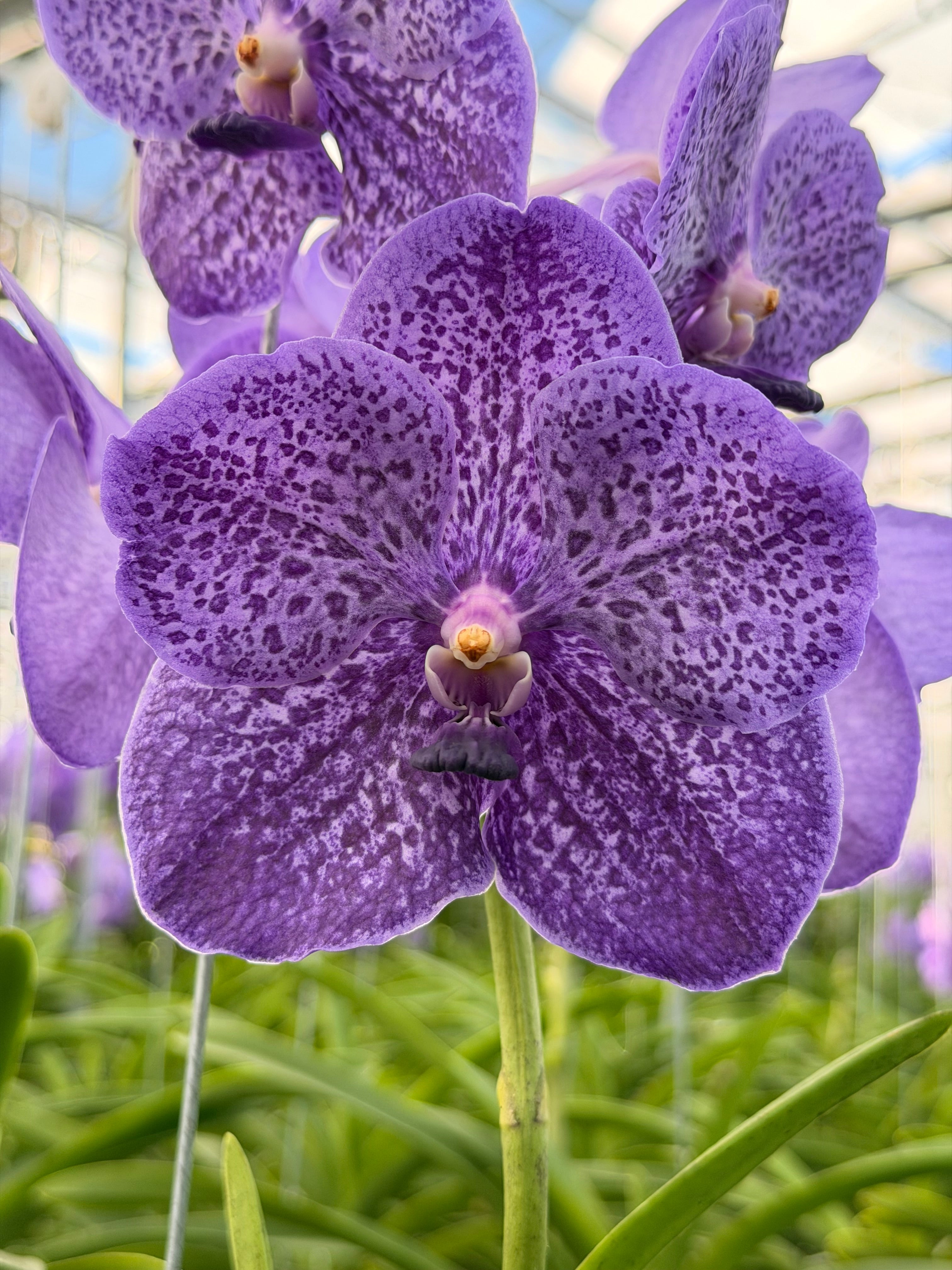
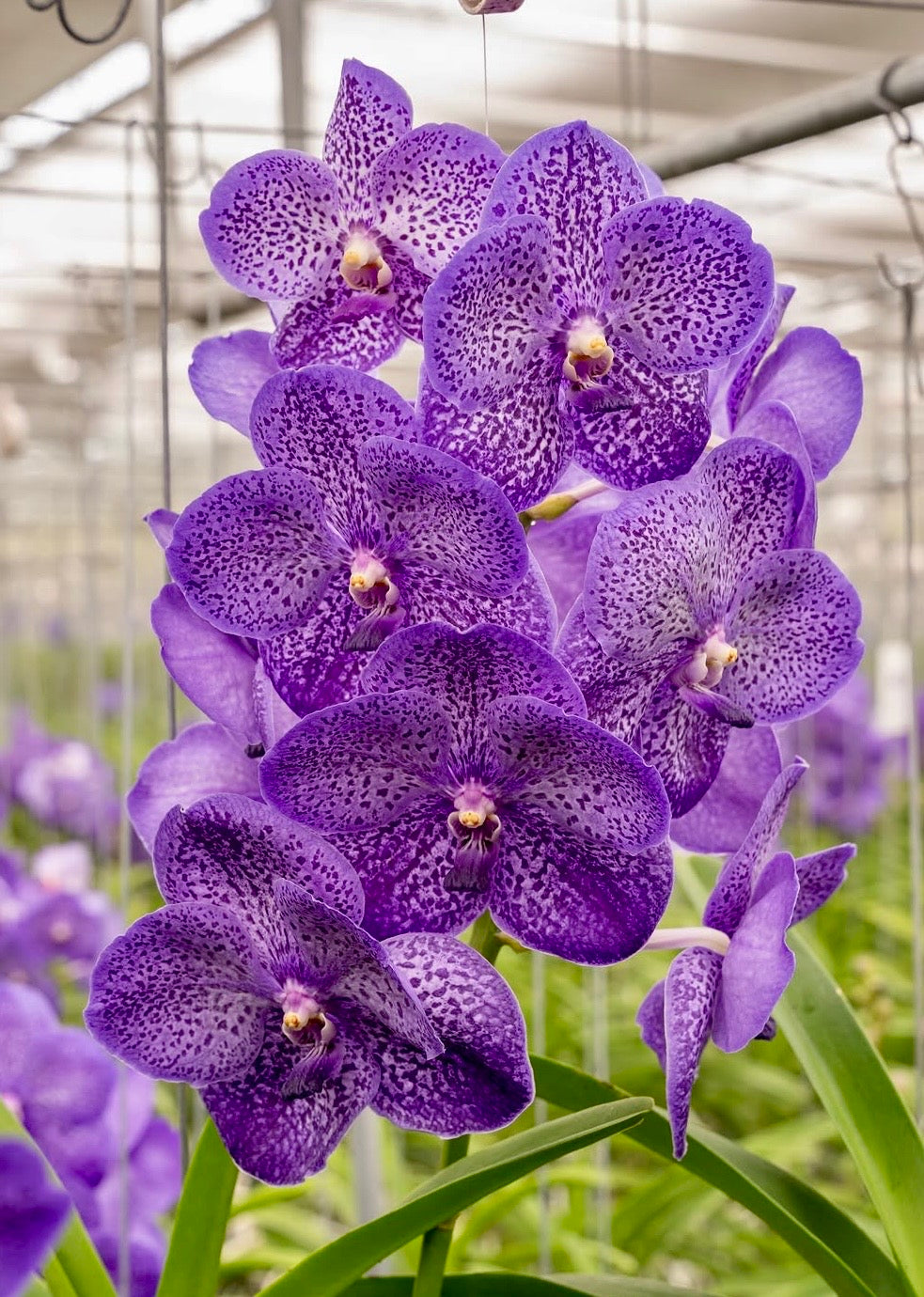
Vanda Sunanda® ‘Lavender Sprinkles’ is an exclusive hanging orchid with large, round flowers in soft shades of lavender and lilac. Over the light base color lies a delicate pattern of purple-violet dots, as if the flowers had been gently sprinkled with color. A dark purple lip forms the striking centerpiece and gives the flower extra depth.
With its broad, almost flat-opening flowers and long aerial roots, this Vanda has a distinctly tropical appearance. A mature plant can bear multiple flowers on a single sturdy stem, making it a true eye-catcher for a bright living room, sunroom, or heated greenhouse.
Name and Trade Name
This orchid is often marketed simply as Vanda Lavender Sprinkles. The full trade name is Vanda Sunanda® ‘Lavender Sprinkles’.
Sunanda® is a commercial Vanda line developed by the Dutch breeder and grower ANSU. ‘Lavender Sprinkles’ is the variety name, referring to the lavender-colored flowers with their characteristic dark purple speckles.
This is a cultivated Vanda hybrid and not the botanical species Vanda coerulea. The exact parent combination has not been publicly disclosed. Therefore, it is not appropriate to attribute a natural range or characteristics of any specific wild Vanda species to this plant.
Origin
Vanda Sunanda® ‘Lavender Sprinkles’ is the result of professional orchid breeding. The Sunanda® line is developed and propagated by ANSU, with a significant portion of the breeding and production taking place in Thailand.
The variety was developed for large, colorful flowers and good vase life. This makes it suitable as a decorative houseplant, but its tropical Vanda heritage is still evident in its care requirements. The plant requires plenty of light, warmth, air circulation around the roots, and a regular cycle of thorough watering followed by rapid drying.
Characteristics
This orchid grows monopodially. This means it grows upward continuously from a single central stem. The sturdy, elongated leaves are arranged in two opposite rows, forming a fan-shaped plant.
Sturdy flower stalks can emerge from the leaf axils. Each stalk bears several large flowers, which typically reach a width of about 8 to 10 centimeters. The flowers have broad, rounded petals and open almost flat, making the dotted pattern clearly visible.
The base color ranges from light lavender and silvery lilac to a slightly deeper violet. The flower is covered with a dense pattern of fine purple dots and short lines. These markings usually become more intense toward the center. The smaller lip is dark purple and forms a distinct contrast with the lighter parts of the flower.
The exact color intensity can vary by flower, plant, and lighting conditions. In bright daylight, the soft lavender tones stand out most, while the flowers may appear more purple in warmer or dimmer light.
At the base of the plant, an extensive network of thick aerial roots develops. These roots are not only intended for absorbing water and nutrients but also serve as the plant’s primary moisture reservoir. Vanda orchids do not produce pseudobulbs in which they can store large reserves.
Care
Despite its exclusive appearance, ‘Lavender Sprinkles’ is not exclusively suited for a specialized greenhouse. A bright living room can also work well, provided the plant is placed directly next to a very bright window and the aerial roots are watered regularly.
The most important factors to consider are light and water. A plant placed in a location that is too dark can produce healthy leaves and roots for years without blooming again. A Vanda kept with bare roots that receives too little water, on the other hand, will develop wrinkled leaves and dried-out root tips.
An open-cultivation method makes it easy to check the roots, but does require more attention than an orchid in a moisture-retaining pot.
Light
Provide this Vanda with as much bright light as possible. A spot directly in front of an east-, west-, or south-facing window is suitable. Morning and evening sun are generally well tolerated. Allow the plant to gradually acclimate to direct sunlight, and protect the leaves from scorching behind glass on very hot summer afternoons.
A bright room a few meters from the window is usually still too dark for a Vanda. If the plant cannot be placed close to a bright window, use a powerful grow light. Especially during the Dutch winter, supplemental lighting can make the difference between merely producing new foliage and the formation of a new flower spike.
Healthy leaves are generally medium green. Very dark green leaves often indicate insufficient light. Yellow-green leaves can be normal under strong lighting, but sudden pale, brown, or dry spots indicate sunburn.
Do not constantly move a plant with buds between different light conditions. An abrupt change in light, temperature, or humidity can cause buds to drop.
Temperature
‘Lavender Sprinkles’ grows best in warm to moderate conditions. During the day, temperatures of about 20 to 28 °C are suitable. On hot summer days, the temperature can rise higher, as long as the plant receives sufficient water, humidity, and ventilation.
At night, the temperature may drop to about 16 to 20 °C. A modest difference between day and night temperatures can aid in flower formation.
Protect the plant from prolonged exposure to temperatures below approximately 15 °C. The combination of cold and wet leaves or roots, in particular, can cause damage. Therefore, do not leave a Vanda near a window during a cold night, and preferably use lukewarm water when watering.
Cultivation Method
This Vanda is ideal for growing as a hanging plant. An open plastic or wooden basket provides the thick roots with plenty of oxygen and allows them to dry quickly after watering. The roots may grow freely outside the basket and do not need to be pushed back into the pot.
Do not cut off healthy aerial roots simply because they become long or unwieldy. The length of the root system is part of the plant’s natural growth pattern and plays an important role in moisture absorption.
In a dry living room, the plant can optionally be placed in a very open basket filled with coarse bark. Use only coarse, airy materials, and never allow the center of the root zone to remain wet for long periods. Fine potting soil or a compact mass of sphagnum moss is unsuitable.
A glass Vanda vase can also be used, but only if there is sufficient air circulation around the roots. When watering, temporarily fill the vase with water and then let it drain completely. Never allow the roots to stand permanently in a layer of water.
Repot or move the plant only when necessary. Vanda roots attach firmly to a basket and can easily break when loosened. The best time to repot is when several new, green root tips are visible.
Humidity and Ventilation
A humidity level of about 55 to 75 percent is ideal. At lower humidity levels, the plant can still grow well, but it will need to be watered more frequently.
Air circulation is just as important as humidity. Gentle ventilation helps the roots and leaf axils dry out after watering and reduces the risk of mold and bacterial problems.
Do not place the plant in a closed-off corner with stagnant, humid air for extended periods. Also, keep it out of the direct airflow from a heater or air conditioner, as the exposed roots can dry out very quickly there.
Watering
When watering, pay particular attention to the color of the roots. Dry Vanda roots are silver-gray. When they absorb enough water, they turn green. Thoroughly wet all living roots and then let them drain completely.
A bare-rooted plant can be misted or suspended with its roots in a container of lukewarm water for about ten to twenty minutes. Keep the leaves and crown above the water as much as possible. Allow the plant to drain thoroughly afterward before hanging it back up.
During warm, sunny summer days, a bare-rooted Vanda may need daily watering. During cooler periods, watering once every two or three days may be sufficient. A plant in coarse bark retains moisture longer and needs to be watered less often.
Use these frequencies only as a guideline. Always check the roots, temperature, amount of light, and how quickly the plant dries out. A fixed weekly watering schedule is usually unreliable for a hanging Vanda.
Water preferably in the morning. Remove any water that remains in the leaf axils or at the top of the plant, especially when the temperature drops at night. If possible, use soft rainwater, reverse-osmosis water, or other low-salt water.
Fertilization
During active root and leaf growth, apply diluted orchid fertilizer regularly. A quarter of the normal dose with about every other watering, or half a dose once every two weeks, is usually sufficient.
New bright green or purplish-green root tips indicate that the plant is actively growing and can utilize nutrients effectively. When growth slows during the dark winter months, the amount of fertilizer can also be reduced.
Rinse the roots regularly with clean water to remove accumulated fertilizer salts. White or hard deposits on the root surface, the basket, or the glass may indicate hard water or an excessively high fertilizer concentration.
Growth Habit and Dormancy
This Vanda does not have a distinct dry winter dormancy. With sufficient warmth and light, it can produce new leaves and roots year-round. After flowering, growth may temporarily slow down, but even then, the plant should not be kept dry for weeks on end.
As the Vanda ages, the central stem continues to grow upward, and more and more aerial roots develop along its lower section. Sometimes a mature plant produces a side shoot or keiki. It is best to leave this attached to the mother plant until it has developed its own well-established root system.
A plant with multiple growth points may eventually produce more abundant blooms. Therefore, do not remove a young side shoot solely to keep the plant compact.
Flowering
Flower stalks develop from the leaf axils of a mature plant. Under stable, well-lit conditions, ‘Lavender Sprinkles’ can bloom at various times of the year. A vigorous plant can have more than one flowering cycle per year, but this depends on light, temperature, root health, and how well it has adapted to its new location.
With proper care, the large flowers will remain beautiful for several weeks. Keep a flowering plant away from fruit, drafts, cold windows, and sudden temperature fluctuations. These conditions can shorten the flowers’ lifespan or cause buds to drop.
After flowering, do not cut the flower stem until it turns brown and dry. Use clean, sharp scissors for this. Unlike some Phalaenopsis hybrids, an old Vanda stem will generally not bloom again from the same stem; the next flower stem will emerge from a different leaf axil.
No reliable information is available regarding a strong cultivar-specific fragrance. This selection is therefore chosen primarily for its color, pattern, and flower size, not for a guaranteed fragrance.
Care Level
Vanda Sunanda® ‘Lavender Sprinkles’ has a moderate care requirement. The hybrid is vigorous, but requires significantly more light and a more active watering routine than a standard Phalaenopsis.
Especially when the plant is bare-rooted, the condition of the roots must be checked regularly. Those who wish to water on fixed days without checking the root color may have difficulty finding the right balance.
The plants offered are mature and therefore developed enough to bloom under suitable conditions. They have been imported and may initially use energy for recovery and the development of new roots after transport. Bright green root tips are a more important sign of recovery than the immediate appearance of a flower stalk.
After receiving the plant, place it in a warm, very bright, and stable location. Do not repot it immediately if the existing basket is still usable. Depending on the product variant selected, the plant may be delivered as Blooming or non-Blooming.
Who is this plant suitable for?
This Vanda is suitable for enthusiasts looking for a striking hanging orchid with large, softly colored flowers. The combination of lavender, violet, and the delicate speckled pattern makes it appealing to collectors of blue and purple orchids, without the flowers being artificially colored.
“Lavender Sprinkles” is also an attractive choice for anyone who already has experience with Phalaenopsis or Cattleya and wants to try their first Vanda. The visible aerial roots make it easy to monitor its water needs.
The plant is less suitable for a dark home, a small plant shelf, or someone who only wants to check on the plants once a week. Keep in mind not only the foliage but also the long, hanging roots. The required vertical space can be considerably larger than the basket in which the plant is delivered.
Experience growing indoors or in a greenhouse
Indoors, this Vanda looks best when placed directly in front of a large, bright window. A hanging hook near a window facing east, west, or south provides ample space for both the foliage and the roots. Be sure, however, that the plant can be easily removed or repositioned for watering.
A bright sunroom or heated greenhouse offers ideal conditions. There, the plant benefits from high light levels, warmth, humidity, and natural air circulation. During hot spells, it can be watered almost daily.
This Vanda can also be kept under grow lights, provided the lighting is powerful enough and sufficient distance is maintained to prevent leaf burn.
Due to its size, high light requirements, and long aerial roots, the plant is less suitable for a traditional closed terrarium. However, a spacious, tall, and well-ventilated orchid cabinet can work if the roots can dry out quickly enough.
Extra Care Tip
Use the roots as your primary indicator of when to water. Silver-gray, firm roots indicate it’s time to water again. Green roots still contain moisture and do not need to be watered immediately.
If the roots remain silver-gray after watering or turn brown and hollow, they are likely no longer active. In that case, check the new root tips on the stem. As long as fresh, firm growth appears there, the plant can recover.
Severely wrinkled leaves usually indicate a prolonged lack of moisture or a root system that cannot absorb enough water. Watering more frequently only helps if there are still healthy, functioning roots present.
Short product description
Vanda Sunanda® ‘Lavender Sprinkles’ is a mature hanging orchid with large lavender-colored flowers, a delicate pattern of purple-violet speckles, and a dark purple lip. The thick aerial roots prefer to grow freely in an open basket. A striking ANSU selection for a very bright living room, sunroom, or warm greenhouse.