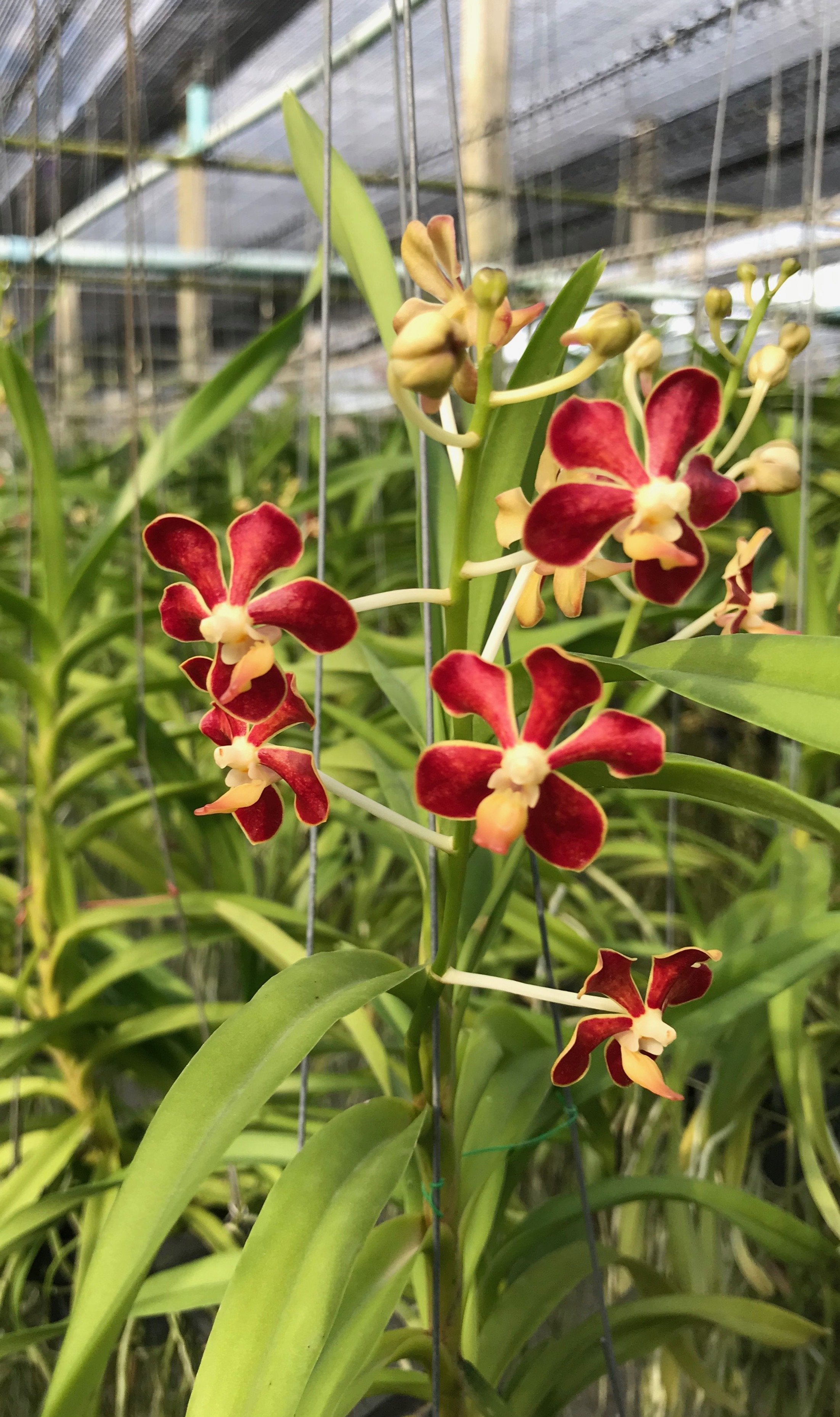
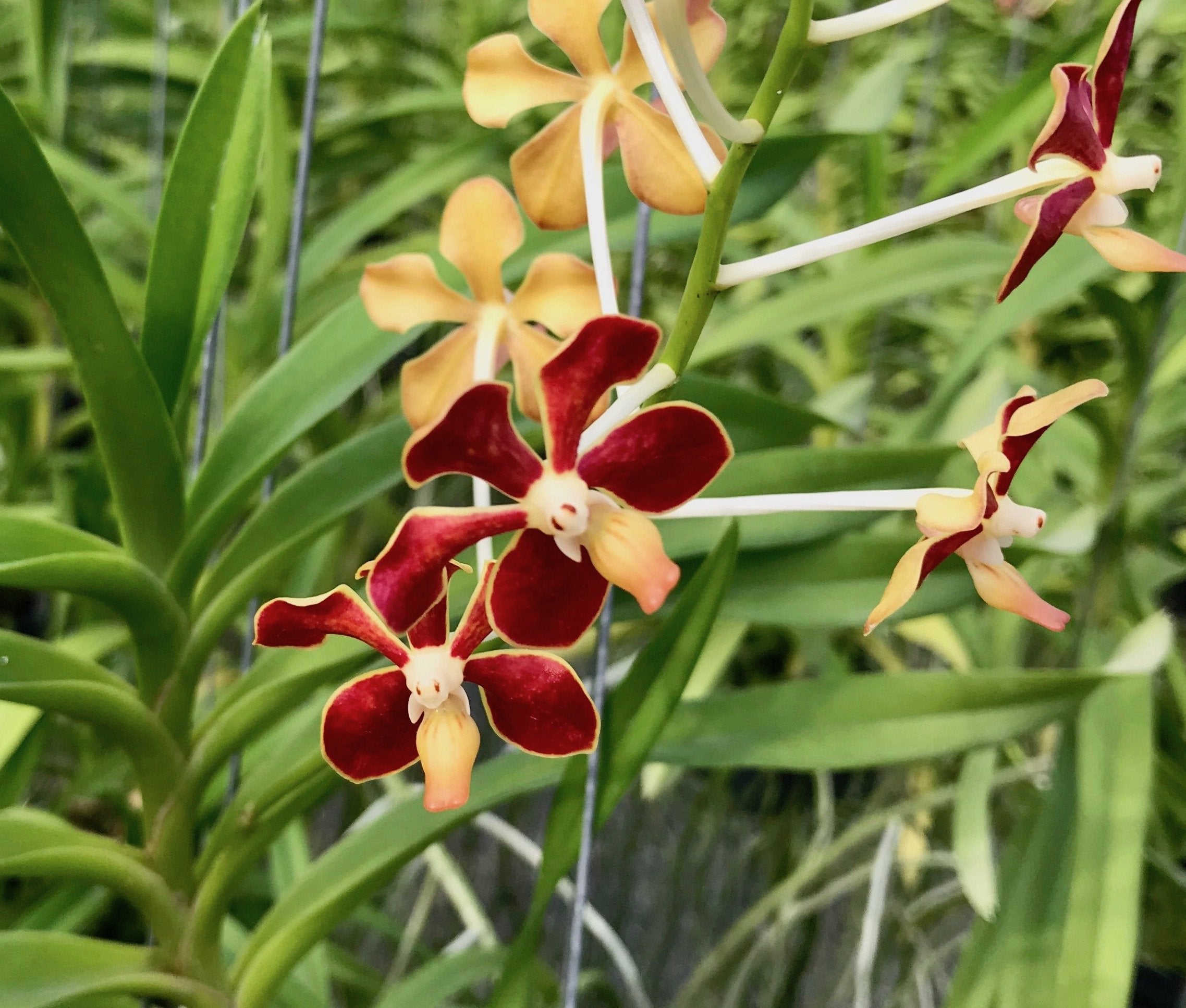
Vanda mariae is a rare botanical Vanda from the Philippines with a completely different appearance than the well-known large-flowered blue and purple hybrids. The flowers have a yellow base color, but are so heavily overlaid with reddish-brown to orange-red markings that they can appear warm copper-red from a distance. A fine, bright yellow border often remains visible along the edges.
This species is particularly interesting for collectors who appreciate natural Vanda forms, warm earth tones, and distinctly marked flowers. The sturdy, deeply folded leaves and climbing growth habit give the plant a distinctive botanical appearance even outside the flowering season.
Name and Taxonomy
Vanda mariae was not officially described until 2016 by the American Vanda specialist Martin Motes. The name is still botanically accepted.
Prior to the formal description, plants of this species were regularly offered as the Philippine form of Vanda limbata. That name turned out to be incorrect. The true Vanda limbata is native to Java and differs, among other things, in plant size, leaf structure, flower color, markings, and the structure of the lip.
Vanda mariae is generally smaller than Vanda limbata. The leaves are narrower, sturdier, and more deeply folded. The flowers of Vanda mariae have a yellow background with a striking reddish-brown pattern, while Vanda limbata usually blooms with a much more uniform and darker chestnut-brown color.
The species was named after Mary Motes, who dedicated many years to botanical and horticultural research on Vandas.
Origin
Vanda mariae is endemic to the Philippines. Kew places its natural range on Mindanao. However, the exact original collection site has not been fully documented. At the time of its scientific description, the exact location of the collected type specimen was unknown.
The species grows as an epiphyte on trees. The roots attach themselves to trunks and branches, where they are exposed to tropical rain showers, high humidity, and constant air movement. After a rain shower, the roots dry out relatively quickly due to their exposed position.
This background suggests a warm, humid, yet well-ventilated growing environment. The plant does not require a cool winter dormancy period and should not be allowed to remain dry for extended periods during active growth.
Characteristics
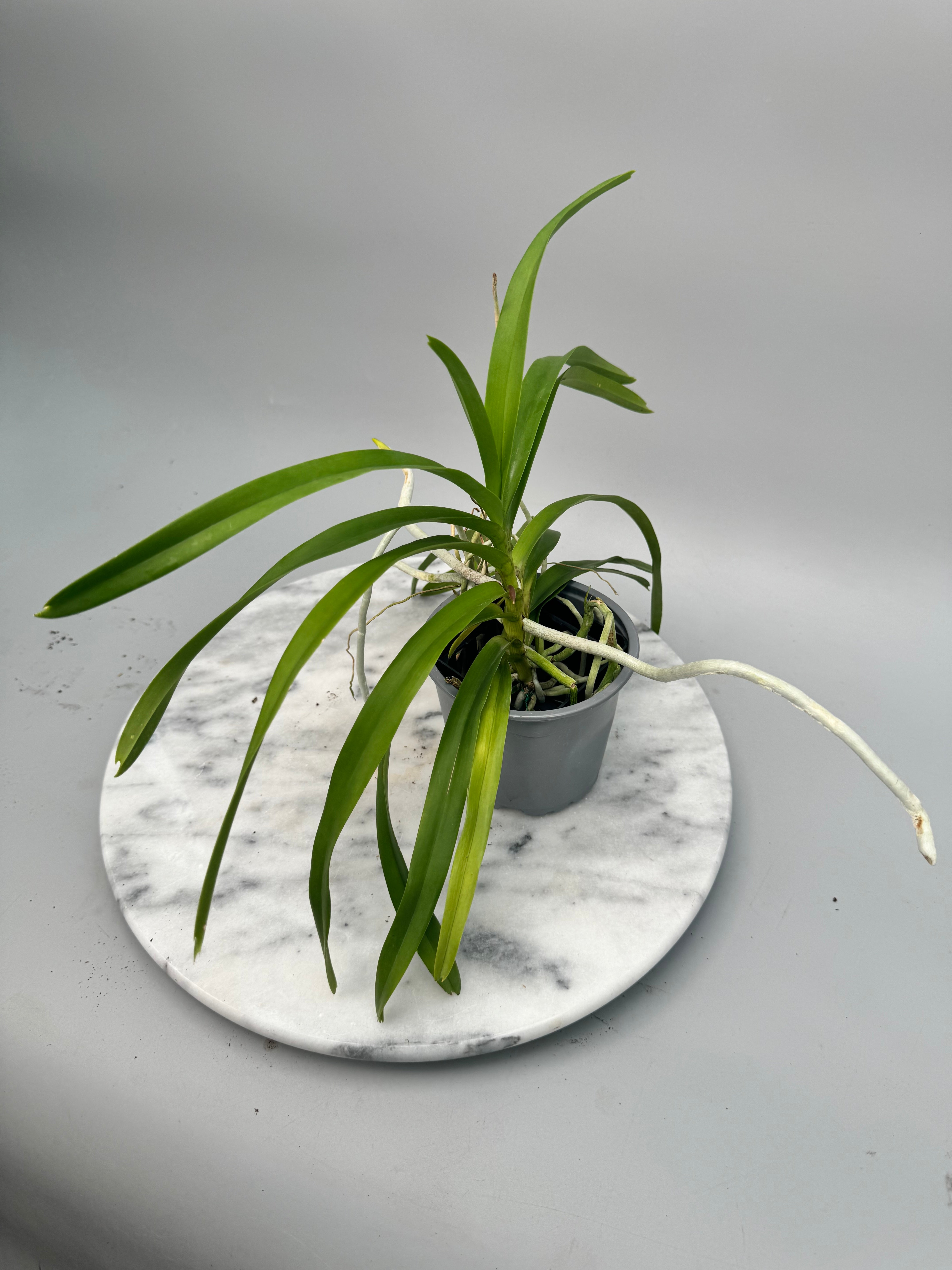
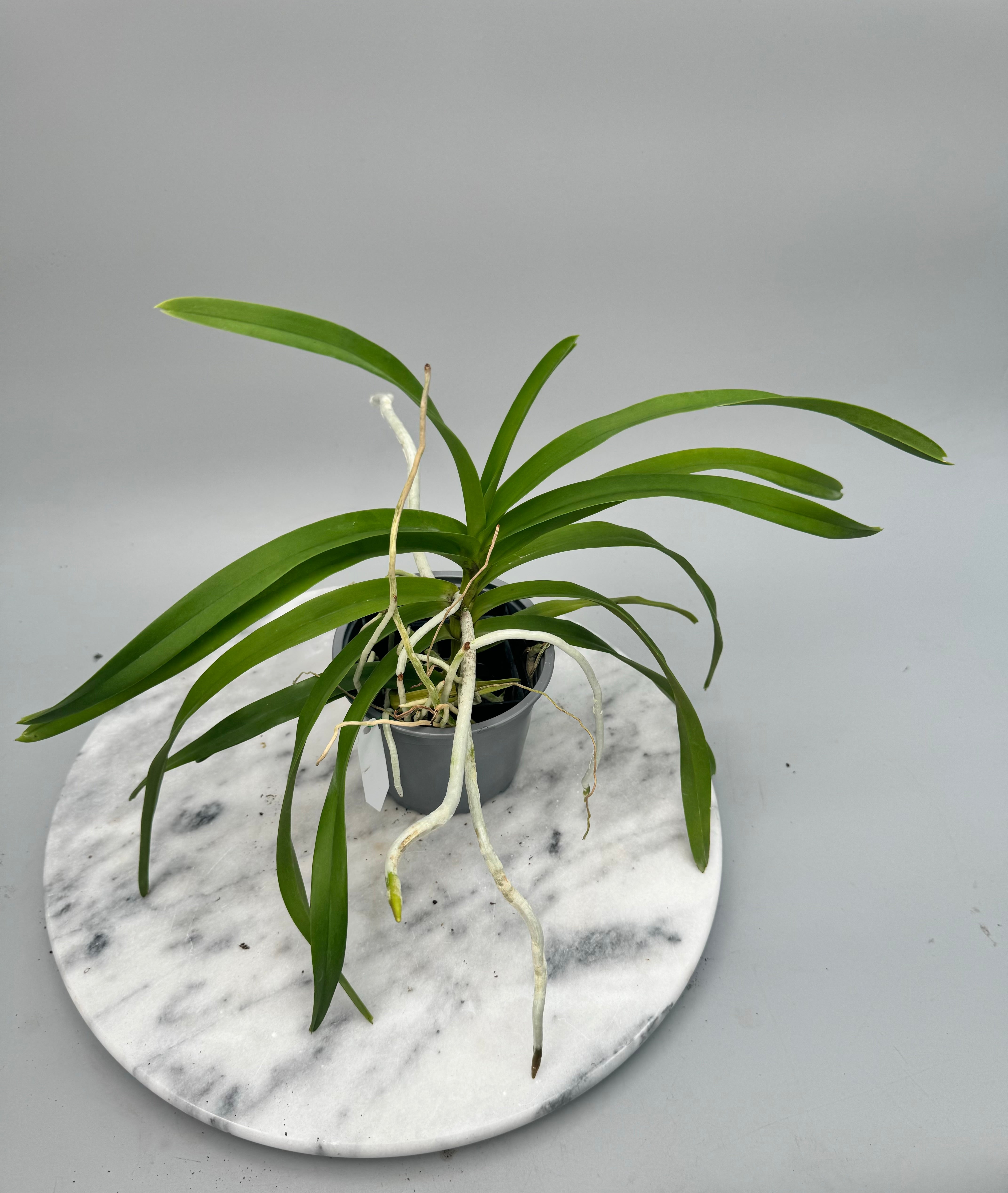
The plant grows monopodially and as a climber. New leaves continually emerge from a single central stem, while thick aerial roots develop along the older portion of the stem. No pseudobulbs are formed.
A mature plant typically reaches a height of about 30 to 45 centimeters or more. The width between the tips of the leaves can be around 35 to 40 centimeters. This makes Vanda mariae easier to manage than many large commercial Vanda hybrids, although the aerial roots do require extra vertical space.
The narrow leaves grow to about 20 centimeters long and are only a few centimeters wide. They are leathery, waxy, and strikingly deeply folded lengthwise. This sturdy leaf structure is a key distinguishing feature from the broader and flatter leaves of some related species.
The flower spike emerges from a leaf axil and grows to about 15 to 20 centimeters long. A mature plant can produce a loose cluster of approximately six to eleven flowers.
The flowers are about four to five centimeters wide. They are smaller than the flowers of a standard Vanda hybrid but have a more complex, distinct botanical pattern.
Flower Color
The base color of the flowers is light to golden yellow. An intense pattern of reddish-brown dots, squares, and interlocking lines covers the sepals and petals. In darker-colored specimens, this pattern covers nearly the entire surface of the flower.
A narrow, bright yellow line often remains visible along the outer edges. This clearly frames the individual parts of the flower and gives it a vibrant appearance despite the dark markings.
The lip is yellow and marked with red to orange-red. The column and center may also display lighter yellow accents.
There is natural variation within the species. Some plants bloom predominantly orange-red, while others display more brown-red, copper-colored, or dark chestnut-brown hues. The amount of yellow along the edges can also vary from plant to plant. The product photo is therefore a good indication of the type of flower, but not every plant will necessarily have the exact same color distribution.
Care
Vanda mariae requires warm temperatures, plenty of bright light, and an open root zone. The species grows well in a warm greenhouse or a ventilated orchid cabinet. It can also be kept indoors if a very bright spot is available and the aerial roots are watered regularly.
The main challenge is finding the right balance of moisture. During periods of active growth in warm weather, the roots should not be allowed to dry out for long periods, but they must be exposed to sufficient air after each watering. A root zone that is constantly wet and compacted can easily lead to root damage.
Light
Provide Vanda mariae with plenty of bright, filtered light. A spot directly by an east-, west-, or south-facing window is suitable. Gentle morning or evening sun is generally well tolerated. On hot summer days, protect the plant from sudden, intense midday sun coming through the window.
The leaves should be medium green to slightly yellow-green. Very dark green leaves and increasingly longer, limp new leaves usually indicate insufficient light. A plant that grows healthily for years but does not bloom is often kept in a spot that is too dark.
Allow a newly received plant to gradually acclimate to brighter light. A plant that has just arrived from shipping or a shaded greenhouse may get sunburned if placed directly in full sun.
This species grows well under plant grow lights. Ensure strong lighting and sufficient distance between the leaves and the light source to prevent the leaves from overheating.
Temperature
This Philippine species thrives in warm conditions. Daytime temperatures of approximately 22 to 30 °C are suitable. At night, the temperature may drop to about 18 to 22 °C.
Temporarily higher temperatures can be tolerated if humidity and air circulation are increased and the roots receive sufficient water. Prolonged heat combined with dry, stagnant air can lead to wrinkled leaves and dried-out root tips.
Protect the plant from temperatures below about 15 to 16 °C. A cold, wet root zone, in particular, can cause damage. Do not place it against cold window glass in winter, and always use lukewarm water when watering.
A slight drop in nighttime temperature is beneficial, but a pronounced cold dormant period is not necessary.
Cultivation Method and Growing Medium
Vanda mariae can be grown very well on wood, cork, or in an open hanging basket. A mounted growing method suits its climbing growth habit well and ensures plenty of oxygen around the roots.
The species can also be planted in a small mesh pot or open basket filled with coarse orchid bark, charcoal, or pieces of cork. Use only airy material that dries quickly after watering. Fine bark, potting soil, or a tightly packed layer of sphagnum retains moisture for too long.
In a drier living room, a small amount of loose sphagnum moss around a few roots can help retain moisture slightly longer. However, never cover the entire base of the stem with wet moss.
Allow long aerial roots to grow freely. Do not force them back into the pot, and do not trim healthy roots to make the plant more compact.
It is best to repot or mount the plant when fresh, active root tips are visible. Damaged Vanda roots recover slowly, whereas a plant with active root growth can establish itself more quickly in a new medium.
Humidity and Ventilation
A humidity level of about 60 to 80 percent is ideal. In a typical living room, the plant can grow at a slightly lower humidity, but a mounted specimen will need to be misted more frequently.
Good ventilation is essential. The leaves and roots must be able to dry after watering. High humidity without air movement increases the risk of black leaf spots, bacterial infections, and stem rot.
Do not hang the plant directly above a radiator, and avoid direct airflow from a fan or air conditioner. Gentle, continuous airflow works better than short periods of strong drafts.
Watering
During active growth, Vanda mariae can be watered generously. Thoroughly wet all the roots until they change color from silver-gray to green. Then let the plant drain completely.
A mounted or bare-rooted plant may need daily watering during hot summer days. In a humid greenhouse, the frequency can be lower. A plant in a basket with coarse bark retains moisture longer and therefore needs to be watered less often.
You can spray the roots or submerge them in a container of lukewarm water for ten to twenty minutes. Keep the center of the plant above the water and make sure no water remains in the leaf axils afterward.
Water again when the roots are mostly silver-gray once more. Allow them to dry out slightly in between waterings, but prevent them from remaining dry and deeply wrinkled for days on end.
In winter, watering can be reduced slightly as the plant grows more slowly due to less light. A complete dry dormancy period is not necessary. Water preferably in the morning so the plant can dry out before nightfall.
If possible, use soft rainwater or reverse-osmosis water. The active root tips of Vandas can be sensitive to hard water and salt buildup.
Fertilization
During active root and leaf growth, apply diluted orchid fertilizer regularly. A quarter of the normal dose once a week or every other watering is usually sufficient.
With a mounted plant, nutrients wash away quickly. Regular, light fertilization therefore works better than an occasional heavy dose.
Reduce the amount of fertilizer during the dark winter months when root growth slows down. Rinse the roots regularly with clean water to remove any residual fertilizer salts.
Fresh green, red, or purplish-green root tips indicate that the plant is actively growing and can utilize fertilizer.
Flowering
The natural flowering period usually occurs in late spring and summer. Under stable, warm conditions, an established plant may also produce a flower stalk at other times of the year.
The flower stalk grows from a leaf axil and bears a loose cluster of multiple flowers. With their warm reddish-brown, orange, and yellow hues, the flowers have an almost autumnal appearance, despite their tropical origin.
The flowers can remain beautiful for several weeks. A sudden drop in temperature, repositioning during bud development, or severe drying out can cause bud drop.
Growers describe Vanda mariae as a species that can bloom regularly once it is well-established. However, after import or a change in location, the plant may first need a full growing season to develop new roots.
Do not cut off a spent flower stalk until it turns yellow or brown. The next bloom will emerge from a different leaf axil.
Scent
In cultivation, the flowers are often described as fragrant. The scent is sometimes compared to honey and is generally most noticeable during warm, sunny times of the day.
The intensity of the scent can vary by plant, flowering stage, and environment. Because scent is not extensively documented in the original botanical description, a strong scent is not guaranteed in every specimen.
Therefore, choose this species primarily for its rarity, warm flower color, and distinctive markings. Any scent is an attractive bonus.
Growth Cycle
This species does not enter a deep winter dormancy. With sufficient warmth, light, and humidity, it can produce new leaves and roots for much of the year.
After flowering, growth may temporarily slow down. In that case, reduce fertilization and adjust watering to match the rate at which the roots dry out. However, do not let the plant remain completely dry for weeks on end.
Older plants may produce side shoots or keikis. It’s best to leave these attached to the mother plant until they have developed several roots of their own. A plant with multiple growth points may eventually develop a fuller form and produce multiple flower stalks.
Care Level
Vanda mariae has a moderate to high care level. The species is not extremely difficult to care for when heat, light, and humidity are available, but it requires more attention than a standard Phalaenopsis or a Vanda in a large glass vase.
A mounted plant, in particular, reacts quickly to a dry period that lasts too long. At the same time, the root base should not be kept constantly wet. The plant therefore requires observation rather than a fixed weekly watering schedule.
First, place a recently received or imported specimen in a stable, warm location. New, active root tips are the most important sign that the plant is adapting to its new environment. Do not change the growing conditions immediately while the roots are still dormant.
Depending on the available product variant, the plant may be delivered as Blooming or non-Blooming. A non-flowering mature plant may first develop new roots and leaves after being moved to a new environment before a flower stalk appears.
Who is this plant suitable for?
This species is suitable for collectors of botanical Vandas, Philippine orchids, and flowers with dark, natural color patterns. It particularly appeals to enthusiasts who value the subtle details and origin of a species more than the enormous flowers of a modern hybrid.
Due to its slightly more compact growth habit, Vanda mariae is more practical than some large-flowered Vandas. However, its aerial roots and climbing stem will still require sufficient vertical space over time.
The plant is well-suited for someone with a warm greenhouse, a bright conservatory, or a ventilated orchid cabinet. It can also thrive in a very bright living room, provided it can be watered regularly.
This species is less suitable for a dark location, a closed terrarium, or someone who only wants to water once a week. Due to its rarity and higher collector’s value, it is primarily intended for an enthusiast who is willing to actively monitor root growth.
Experience growing it indoors, in a greenhouse, or in an orchid cabinet
Indoors, Vanda mariae is best hung directly next to a bright east- or west-facing window, or a filtered south-facing window. Make sure the plant remains easily accessible for watering.
In a warm greenhouse, it can be placed high up among other botanical Vanda species. There, the plant benefits from plenty of light, high humidity, and free air circulation around the roots.
A tall, well-ventilated orchid cabinet may also be suitable. Keep a sufficient distance from the light source and ensure that water does not remain between the leaves for long periods after misting.
A traditional closed terrarium is less suitable. The plant will outgrow it and requires more air circulation and a faster wet-to-dry cycle around the roots.
Extra care tip
Don’t just look at the leaves; pay special attention to the root tips. If the tips are fresh green, reddish-green, or purplish-green, the plant is actively growing. This is the right time to provide water and diluted fertilizer more regularly.
If root growth stops after transport, keep the plant warm and in a stable environment. Do not try to force new growth by constantly keeping the growing medium wet. Stagnant roots actually need extra air.
Also watch for sudden loss of lower leaves. A single older leaf may die off naturally, but multiple leaves that quickly turn yellow or black are more likely to indicate cold, prolonged dehydration, damaged roots, or water pooled around the stem.
Short product description
Vanda mariae is a rare botanical Vanda from the Philippines with yellow-edged, copper-red to reddish-brown flowers and a distinct checkered pattern. The species is a climber, producing sturdy, folded leaves and developing long aerial roots. An excellent choice for a warm greenhouse, a very bright living room, or a well-ventilated orchid cabinet.